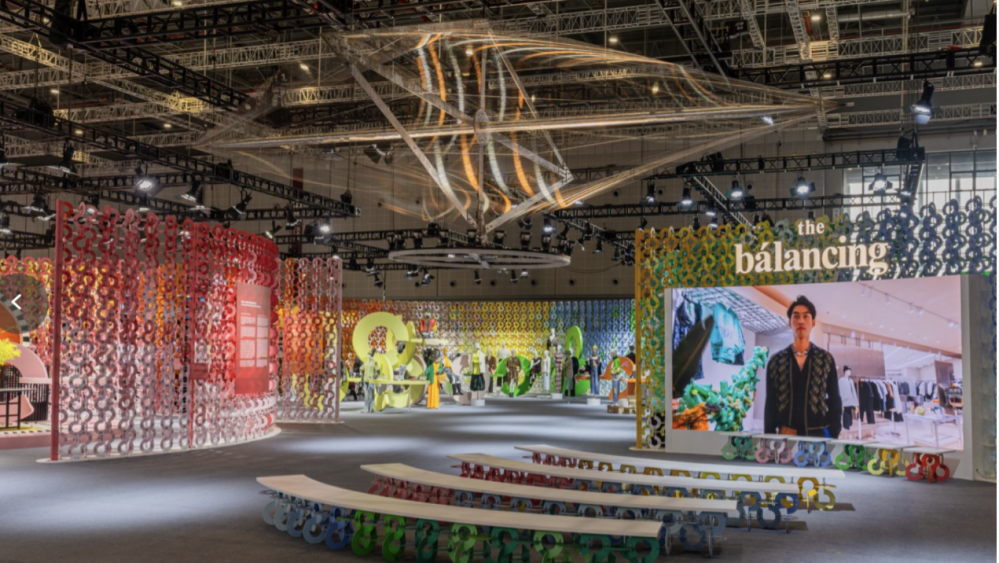
At the 7th China International Import Expo (CIIE), Bailian presented an artful blend of commerce and creativity with the theme “Folding Space — Unfolding the Infinite Potential of Art and Commerce.” Collaborating with over 70 brands from 17 countries, they unveiled an artistic exhibition featuring more than 600 distinctive items. This spatial art showcases the dynamic interplay between art and commerce while focusing on sustainable development for the future.
Related Articles
Bailian made a notable appearance at the 7th China International Import Expo, showcasing its “Folding Space” theme at the Bálancing booth. This theme represents the dynamic process of folding and unfolding, highlighting the fluidity and limitless potential of both art and commerce. By embracing a “commerce+” approach, Bailian is also building a sustainable, emotionally resonant and meaningful future through the convergence of art and commerce.
Folding Space: A Fresh Look at the Dynamic Interplay of Art and Commerce
At this year’s CIIE, Bailian and its fashion boutique, the Bálancing, have brought together global aesthetics by partnering with more than 70 brands from 17 countries. They showcased more than 600 unique exhibits in an area of over 1,000 square meters at the Bálancing Art Exhibition Booth.
With the themes “Home and Collection,” “Fashion and Art,” and “Scent and Ambiance” as the main focus, they connected a diverse range of brands and products spanning furniture, home goods, fashion apparel and fragrance home cleaning, opening a new chapter in storytelling.
The “Home and Collection” area mainly featuring home furniture brands, highlights the designs of Charles Rennie Mackintosh — a prominent figure of the Art Nouveau movement in the early 20th century — showcasing the designer’s extraordinary vision and the discerning tastes of the buyers, offering a sense of avant-garde creativity and inspiration.
In the “Fashion and Art” section, the focus is on apparel, footwear and accessories featuring over 40 brands from twelve countries, including China, the U.S., Italy, France and South Korea — showcasing approximately 300 exhibits.
The “Scent and Ambiance” section features an impressive collection of 32 brands from thirteen countries and regions, offering more than 300 fragrances and home care products. These international icons, each with its own unique olfactory signatures, invite consumers on a sensory journey that intertwines scent with emotion, creating an invisible dream.
Woven together by the threads of art, design and olfactory culture, the Bálancing connects brands and products across furniture, home decor, fashion, footwear, fragrance and wash care to tell the story of art merging with life, creating a harmonious union of utility and aesthetics.
Sustainability: New Links Under a Shared Global Language
A distinguished panel discussed “The Future Ecology of Sustainable Development in Art and Commerce.” The panel included Cao Hailun, general manager of Bailian Inc.; Ding Yi, a prominent contemporary abstract artist and curator; Tian Feiyu, director of UCCA and chief executive officer of UCCA Group; Che Fei, professor and dean of the School of Art and Design at the Beijing Institute of Fashion Technology; Yang Song, a contemporary artist and sculptor; and Liu Xueli, art director of UCCA Lab. They explored the vast potential of art and commerce in urban revitalization and the sustainable development of the social environment.
This year’s booth of Bailian features a modular design with reusable components to create a sustainable structure. After the event, all the folding pieces will be dismantled and repurposed within commercial spaces.
Artist Yang Song’s new creation, “Light Cone,” symbolizes the path of light as it travels along the timeline. It invites viewers into an art world that seems to stretch infinitely. The boundaries of art and exhibition space are expanding while the connection with commerce grows stronger. The possibilities for both art and commerce are limitless.
Looking ahead to the future of integrating art and commerce, Cao Hailun emphasized the importance of understanding art and culture. He explained that by doing so, “Bailian establishes a deeper resonance and cultural identity with consumers, creating a more enriching emotional shopping experience. Bailian will approach art with reverence in its business operations while evolving toward greater diversity and personalization. Additionally, curatorial models, the reinvention of urban cultural heritage and digitalization will become key focuses in the integration of art and commerce. These developments will provide consumers with shopping experiences that are richer in cultural content, more valuable in terms of identity recognition and more immersive.”
Revamping Scenarios: Discovering New Focuses for the Future of Retail
At the Global Fashion Summit: Shanghai Gala 2024, Johannes Neubacher, chief content officer at ChinamindNEXT and Zhang Shenyu, Chairman of Bailian Inc., engaged in a deep conversation on the theme of “Shaping Sustainable Retail.”

Urban renewal is a key issue in sustainable development. In discussing future planning, Zhang Shenyu mentioned that Bailian has been focused on the development of Shanghai as an international consumption hub and the revitalization of urban commercial spaces. They are actively involved in the rejuvenation and transformation of several buildings within the “River and Creek” regional framework, aiming to upgrade and innovate the city’s commercial ecosystem.
Furthermore, Bailian is expanding its reach. The latest urban and commercial district plans focus on Shanghai’s two major commercial hubs, Nanjing East Road and Huaihai Middle Road. One is designated as a “world-class business and commercial district,” while the other is designated as an “around-the-clock trendsetting street.”
In an exclusive interview with WWD China, Zhang Shenyu stated that cultural heritage buildings are tangible legacies and in preserving the life of historical structures, “we should embrace inheritance with innovation.”
From architectural conservation to content renewal, the approach should embody Shanghai’s spirit of openness and inclusivity. It should also reflect Yongan ‘s unique DNA as a century-old commercial icon. This positions Yongan as a conduit for dialogue between Eastern and Western aesthetics and ways of life.
Recently, Bailian partnered with WWD China to launch the “Heritage Next: The Beauty Reflected & Imagined” exhibition. This exhibition reimagines intangible cultural heritage through the lens of contemporary art, design and fashion. It also breathes new life into cultural traditions that embody the essence of human wisdom and civilization, showcasing them globally through this carefully curated experience.
In response to sustainability issues, Zhang Shenyu stated that Bailian has been exploring different ways to balance nature and commerce. Its fashion boutique, The Bálancing, has consecutively hosted several editions of the “Go Green” project.
Additionally, Bailian collaborates with ESG platforms to create a new public welfare ecosystem through different initiatives. Partnering with third-party platforms like Xiaohongshu (RED) and Alipay promotes the implementation of sustainable practices. These initiatives call on more consumers to adopt sustainable practices and support the development of a circular economy.
In the future, Bailian will uphold five major standards: the continuation of the department store legacy, the preservation of classic facade styles, micro-innovation within a defined scope and the integration of sustainable development concepts. It will continuously explore ways to extend the lifecycle of commercial buildings and promote the sustainable development of commercial spaces.
By integrating art into commercial spaces and everyday life, Bailian transforms commerce into not just a place for consumption but a fusion space for artistic expression and cultural exchange. In balancing artistic creativity with commercial practicality, Bailian draws artistic inspiration from different eras and presents new discoveries for a sustainable and beautiful life.