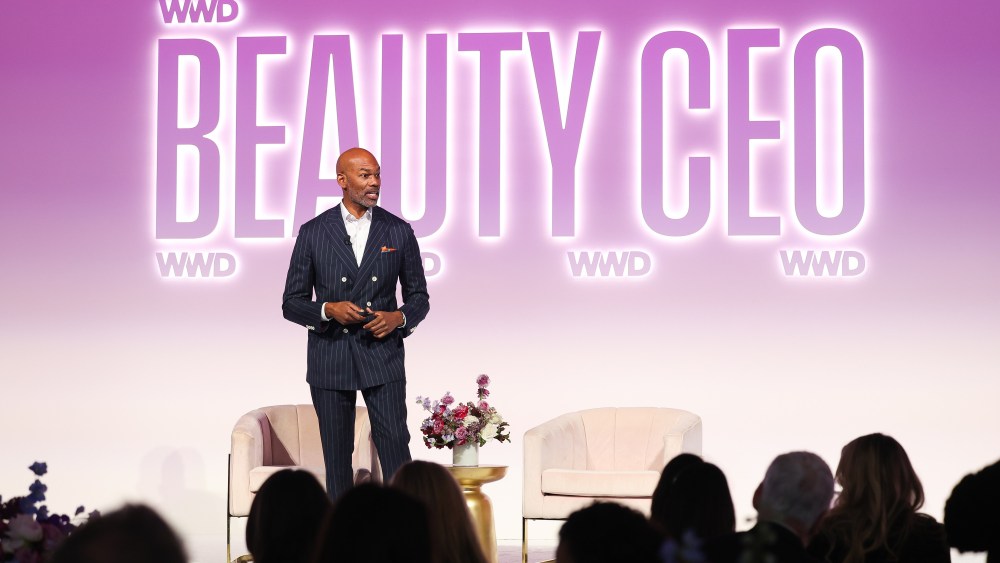
Dr. Julius Few has over 25 years of practicing as a surgeon, and has performed over 5,000 facelifts. But it’s not his medical prowess that defines his approach to beauty.
“My genesis began at IBM prior to finishing medical school,” Few said at the 2025 WWD Beauty CEO Summit. “Anyone who knows IBM understands that the concept of ‘think’ was all over the place. It’s this idea of using a systematic approach to overcome and simplify and deliver to the end user a solution-based process,” Few said.
Related Articles

That forward-thinking approach, Few said, was opposite to his medical training. “Medicine is the antithesis of it. It’s paternalistic, you’re taught in medical school you know more and better than anybody who you’re going to take care of. You tell them what they need to know, and ultimately, they’re supposed to do it.”
Marrying the two approaches, Few said, has become his superpower. “I realized that the definition of innovation is where art and science come together to become a reality.”
Long before aesthetic treatments hit the mainstream — and even further before it became popular to do injectables, laser and microneedling, for example, in a single appointment — Few was on the case.
“Ten years into my career, I wrote a book that was unconventional at the time on the idea of combining non-surgical modalities to get a surgical-like result. This involved threads, lasers, skin tightening and boosting technology, fat reduction technologies,” he said. “Nobody was in that space when we created this approach, and it became a gold standard in plastic surgery and cosmetic dermatology.”
It wasn’t long before Few parlayed both his listen-and-learn approach and his medical expertise into a product range. “The brand was rooted in the ethos of listening to my patient, and the idea that skin care doesn’t have to be nasty,” he said. “I was on Retin-A as a child, and I still had lumps and bumps from acne, and I had to hold my breath when I put it on my face.”
Among the problem areas he set out to solve were sun protection in a cosmetically elegant formulation, and one that was gentle enough for the sensitive undereye area. “We have not thought about skin care the same way we do with, say, gastrointestinal health — what you eat should be the same as what you put on your skin,” he said. Most recently, he’s seen seismic shifts in how GLP-1 has impacted skin health.
“Those patients’ skin was dull, dry, burned easily. The skin is different on the inside, it was unlike weight loss and it defied convention. So I set out to figure that out,” he said.
“We published a paper last week that was the first to draw a conclusion on how GLP-1s affect skin on a molecular level. This has defined what I believe to be a new emerging industry in terms of our patients.”
Ending his session with a call to action, Few said it’s time to raise the bar. “Clinical testing is one bar, but clinical testing that goes to peer-reviewed scientific journal publication is the top bar,” he said. “I’m proposing the new generation is about clinically based, medical journal-published material.”