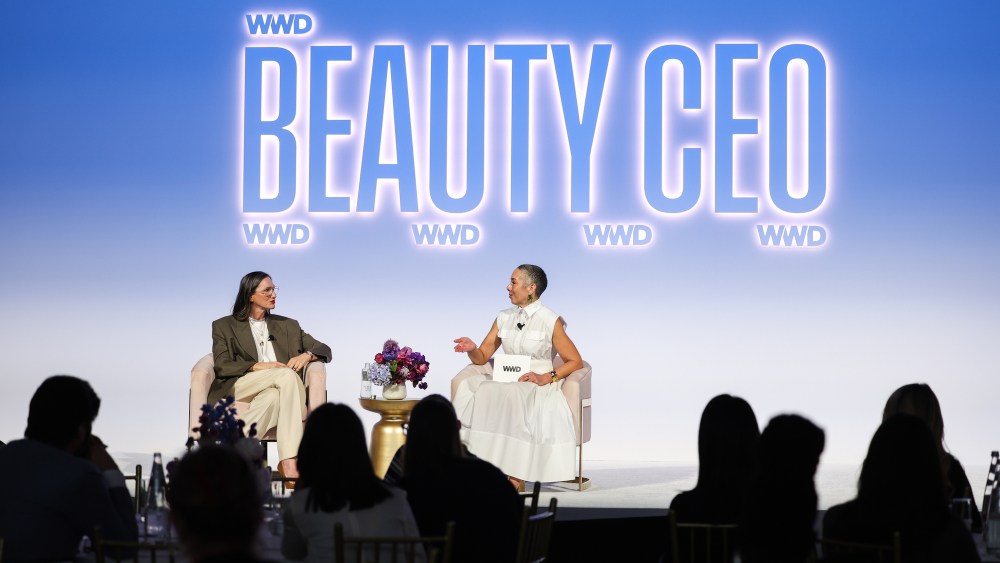
Jenna Lyons might pivot, but you won’t see her overcorrect.
The multihyphenate, who was named creative director of J.Crew in 2008 and president of the company two years later, has been up to much since her 2017 departure from the brand. To recap: she’s been a two-time reality TV star, most recently appearing as a cast member of “The Real Housewives of New York City”; cofounded a sustainable false eyelash brand, LoveSeen, in 2020, just ended a 10-year tenure on Shake Shack’s board, and is now creative executive director at FundamentalCo, a consulting agency launched by private equity giant Blackstone.
Related Articles

“I was at J.Crew for 27 years, and so I always knew what my life was going to look like — I knew what my week would look like, who my team was, when my vacations were, where my paycheck was coming from — what I wanted was to throw everything up against the wall,” said Lyons at the 2025 WWD Beauty CEO summit in conversation with Beauty Inc editor in chief Jenny B. Fine. “So I started doing a lot of different things.”
Though her gigs since have spun the gamut — even in her role at FundamentalCo, Lyons helps companies from Olaplex to Visa develop strategies and creative efforts — key throughlines have included unlocking success amid cultural and economic backdrops of uncertainty.
On Risk-taking
“What I learned during the disaster of 2008 was that there’s an instinct to kind of retract and stop doing everything,” said Lyons, who took the helm at J.Crew just as the financial crisis was happening. “While, of course, that’s important…what I realized in going through so many cycles like that is that what’s also important is what you do with what you have.
“How do you take bets? How do you actually step out and take risks? Because if you pull back too far and you get too scared, what happens is, when the world starts to come back — you’re just not prepared.”
Case in point: during the economic crash of 2008, J.Crew pulled back on real estate and slowed down on store openings. When the market recovered, “we just weren’t positioned to take some of those better deals — we’d sort of slowed our own process,” said Lyons, adding that when the next downturn came, “we said, ‘OK — what can we take advantage of in this moment? Are there great leases out there we can get? Or anything we can do in terms of buying SEO search terms?’
She applies the same ethos today in navigating mounting global tariffs and threats of a potential recession.
“Don’t overcorrect right now,” she said. “Be thoughtful, be strategic, but don’t give yourself whiplash. Any sort of tectonic shift like that should make you think about your core competency, what you do well, what you can do to stand out.”
It’s an ability that comes with refining one’s balance of gut instinct versus numbers in business.
Gut vs. Analytics
“They’re equally important. Analytics can create analysis paralysis; I grew up in a company where what was coming was more important than what had been; however, you can’t plan a business based just on your gut,” said Lyons, adding that one’s team is equally as important as those attributes.
“Don’t hire people who look like you or think like you or talk like you — my gut is one gut, but I need to have the gut of people around me who have different points of view,” she continued. “You will pick up on things if you’re quiet, but if you’re talking too much — you miss it.”
Another key pillar to success, Lyons said, is knowing — and always remaining grounded in — your “why.”
“A lot of people think a brand is a logo, but a brand is an ecosystem. It’s the essential idea that commands and focuses everything. If you have a strong brand and a strong idea, your team knows what you’re doing and where you’re going — in the absence of that, it’s easy to get lost.”
Part of the appeal for Lyons of joining FundamentalCo has been returning to that ecosystem and getting her hands wet at every level.
Doing the Work
“I’ve enjoyed getting to work with so many different types of companies, whether in beauty, finance, tech,” Lyons said. “I think I got to a point [at J.Crew] where every meeting I was having was an HR meeting — I wasn’t doing as much of the work, and I get to do the work now. I enjoy doing the work. Being able to have the privilege at my age and stage of career to learn things that are completely out of my scope and element has been incredible.”
In terms of the themes she’s drawn to today when it comes to beauty in particular, the category’s embrace of consumers, however they come — is top of the list.
“When I grew up, everyone looked the same — it was ‘Baywatch,’ and that was what I thought beauty was, because I lived in Southern California; it felt very one-note,” she said. “We still have a ways to go, but brands have woken up and started to connect to people and the ways that they actually want to look, and understanding that what works for one person might not work for another.”
While there’s similarly no one-size-fits-all formula to success, Lyons emphasized: “Make sure your core is infallible — that’s the most important thing. If you feel like you’re adding a lot, hold back on what is extraneous. It’s so easy to overcomplicate a company, but the fact of the matter is that the more distractions you have, the more distractions your team has, and the more distracted they’ll be.
“So take care of the things that really matter, take care of your team, be in constant communication, and maybe get off your computer and walk around.”