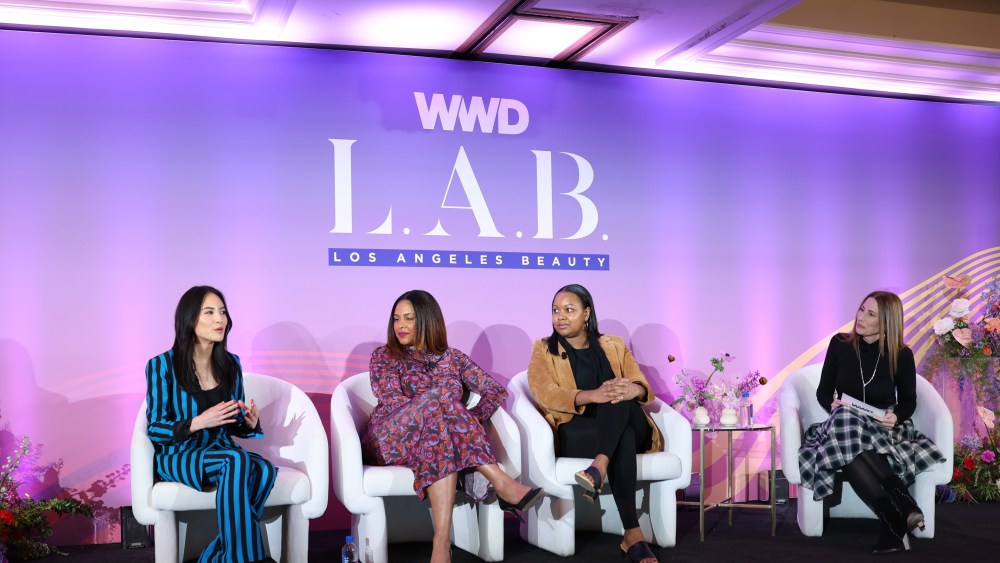
Indie brand founders are challenging the status quo.
“I use the tag line, ‘I like my products, how I like my people, nontoxic,’ which is a nod to surrounding yourself with talented conscious leaders and businesses,” said Dorian Morris, chief executive officer and founder of Undefined Beauty. “Because that’s where you can make a change.”
Joining Morris at WWD’s L.A.B. Forum in Los Angeles were Fiona Co Chan, CEO and founder of Youthforia, and Lesley Thornton, holistic aesthetician and founder of Klur. They sat down with Monica Arnaudo, chief merchandising officer of Ulta Beauty, who dug into how each founder is redefining the beauty industry.
Related Articles

“I’m not going to redefine beauty on my own,” Thornton said. “When I can inspire and educate my customer to feel confident, they’re going to define beauty on their terms. That’s not going to come from the brands, that’s going to come from the consumer.”
Morris brought up inclusivity and not just in terms of skin tone, but thinking more broadly. “It’s about economic inclusivity in terms of making sure that products are affordable because there’s a lot of people who want to do better for their skin, but they can’t afford it,” she said. “There’s also age inclusivity. There is this mindset around graceful aging and propelling and empowering people through that lens.”
While the positioning of each brand is different, similarities abound. Each has recently gone into retail. Youthforia is now in Ulta, Undefined Beauty is also at Ulta in addition to CVS and Target, among others, while Klur is at Credo. “Driving our business to Ulta means changing our organizational structure; it means leveraging a full omnichannel marketing strategy,” Co Chan said. “And for me, it means creating a lot of content specific to Ulta. We’re part of their Sparked program, which is for emerging brands and they’ve been great partners as we transition from a fully digital [direct-to-consumer] brand and going into full-on retail.”
To that end, Klur opted not to jump into all 200 Credo doors right away. “I’m trying to grow at the pace of my consumer,” Thornton said. “So if the customers are sending DMs or emails and I hear that we need a day cream, then you’ll get a day cream. Credo has allowed us to roll out in a way that the brand is recognizable. It’s getting the support that it needs. But also, because I’m so heavily influenced by my background as an aesthetician, I can physically get into the stores, I can fly around the country, meet the sales associate, shake hands, and do the education and events. I personally couldn’t do an Ulta right now. We’re not at that place. But essentially, the way that we’ve been able to succeed at Credo is because we picked a retailer that aligned with our values and already had our customer.”
“I’m self-funded,” Morris added. “I’m a team of one, so I don’t have any employees. And I haven’t spent any money on marketing. So all of my growth has been organic. I look at my retail partners as an extension of marketing support. This is actually my year of no. I’m being a little bit more strategic in terms of retail. I operate by closed mouths don’t get fed. I’m always going to ask the question and will press for better terms and better exposure,” she said. “We don’t have deep pockets like the L’Oréals of the world. And so we have to be very scrappy. It’s about retailers recognizing that we have strings that we are going to flex that are going to be a little bit different than the larger brands and giving us the runway and support to allow us to bring our brand to life.”
Meanwhile, all three companies have a very different approach to product development, but as indie brands, they each take a problem solution approach from both their communities and personal experience.
“For every product category that we’re going to enter, I think about whether or not we can introduce a new form factor,” Co Chan said. “We did that by creating a blush oil and made that color changing.” She also gave the example of Youthforia’s Daily Protective Primer, which was Co Chan’s answer to her sensitive skin. Her whole proposition is creating makeup you can sleep in, so she infused ingredients that stops the skin’s inflammatory response. “Nobody asked for this, but I needed it,” she added. “We see customers that use this product as a skin tint replacement. It has an ingredient that relieves redness and it’s really easy to use.”
Morris, on the other hand, created her number-one sku by accident. Her lab sent her the wrong formula, but she leaned into it and evolved it. “I’m so glad that I leaned into a mistake, which is now my hero product,” she said. “If it hadn’t been sent by mistake, my business would be in a very different place. And that was driven a lot by the amazing exposure and organic influencers in the sunscreen space. So there’s a little bit of listening to my consumer, but also leaning in when I think there could be a good whitespace opportunity.” Morris is also expanding categories. This summer, she’ll offer both scalp and hair care.
While Thornton no longer sees clients, she still uses her aesthetician prowess to inform new products. “If you’ve ever been to a spa, they’re going to give you a client form,” she said. “I still have all those client forms and I go through them and look at what it was that people needed. And you’d be really surprised to find out that what people needed 10 years ago, people still need today. It doesn’t necessarily change; formulas can just be more sophisticated. But the needs of the consumer, in particular, has not changed.”