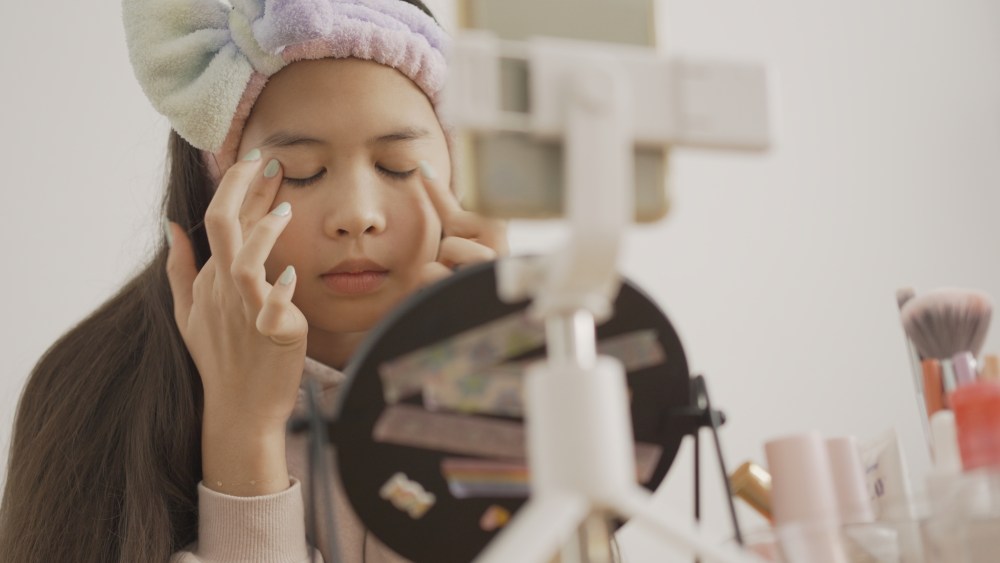
At what age is it appropriate for kids to start experimenting with beauty products?
Such was the question on the minds of many parents last year after the launch of Shay Mitchell’s latest business venture: Rini, a skin care and play brand for children ages 4 through 12.
Inspired by the parenting experiences of Mitchell, her cofounder Esther Song and her partner Matte Babel, Rini debuted with a collection of hydrogel face masks in November and immediately spawned widespread conversations online about the potential implications of exposing kids to beauty at a young age.
Related Articles

In a statement sent to WWD, Mitchell and Song explained their mission was not so much to introduce as to encourage exploration in toddlers and tweens who were already demonstrating an interest in the products their parents were putting on. “Proudly made in Korea, Rini embodies the philosophy of Korean beauty — gentle, science-driven and purposefully formulated — while removing the guesswork for parents,” they wrote. “Rini is committed to creating safe and age-appropriate products that inspire creativity and that Gen Alpha feels connected to.”
Gen Alpha‘s interest in beauty has grown in the past few years. “The annual skin care spend per teen is about 30 percent higher than it was five years ago, indicating that routines are forming earlier and becoming more durable,” said Jeff Lindquist, managing director and partner at Boston Consulting Group.
Last year, the total category spend outpaced the overall beauty market growth rate, up 23 percent year-over-year, compared with roughly 9 percent for the U.S. beauty market, Lindquist added.
The rise in curiosity and demand has been due, in large part, to the influence of young social media creators such as 16-year-old Salish Matter, who debuted her own skin care brand, Sincerely Yours, at Sephora U.S. in September, drawing more than 80,000 people to the American Dream Mall in New Jersey for the launch.
Gen Alpha brands “speak directly to the demographic (by) tapping creators who are peers rather than superiors to test and advertise the products,” said Alex Rawitz, director of research and insights at CreatorIQ. The strategy is working — the total earned media value for these brands reached $7.1 million in 2025, up 38 percent year-over-year, with 60 million impressions, per data from CreatorIQ.
“Social media and access to information are at the forefront of this generation,” said Mitchell and Song, adding that tweens are also “researching brands, reading reviews and using AI to analyze ingredients.”
Because of this, the category will continue to grow at a rapid clip in the year ahead, even in the presence of backlash, Lindquist predicted. “We do not see criticism reducing overall consumption. Instead, it is more likely to shift what Gen Alpha buys, favoring simpler routines, gentler formulations, clearer claims and products designed specifically for younger skin,” he said. “We expect the overall beauty market to grow around 5 to 7 percent in the next year, but Gen Alpha is likely to grow meaningfully faster than the market as a whole.”
That said, brands should be ready to navigate ongoing controversy. “Any brand operating at the intersection of youth, skin care and social media should expect healthy dialogue, and we welcome it,” said Julia Straus, cofounder and chief executive officer of Sincerely Yours. “Introducing young consumers to skin care should never be about accelerating beauty routines or aesthetics. At the end of the day, we’re building a brand that speaks with this generation, not at them.”