Yes To is on the fast track to growth.
When chief executive officer Ingrid Jackel was tapped to replace Joy Chen at the helm of the company in late 2015, she was tasked with energizing the mass naturals line through creative marketing and product development to bring it up to speed with the Millennial consumer. She was also charged with doubling the business from $50 million dollars to upward of $100 million. And with a slew of innovative lines and products rolling into stores this week of Jan. 30, industry sources are saying Jackel is already halfway there, projecting sales to grow 25 percent in 2017.
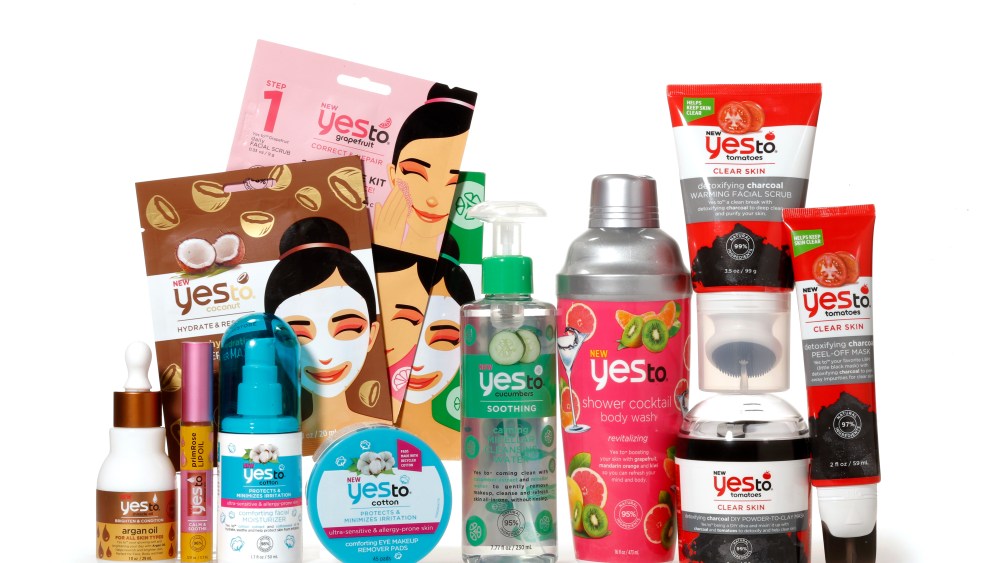
The first phase of Jackel’s game plan involved playing down the fruit and vegetable theme that Yes To is recognized for. Formerly known as Yes to Carrots, the skin, body and hair-care brand had once divided its products into segments by fruit- or vegetable-based benefit — the Yes to Tomatoes range tackled acne; Yes to Cucumbers for soothing irritated skin; Yes to Grapefruit for brightening, and Yes to Blueberries for antiaging. While those lines still exist, Jackel is branching out from weeding the garden for product ideas and has found other natural ingredient trends to develop lines with. In the second half of 2016, she introduced Yes to Coconuts, Yes to Charcoal and Yes to Miracle Oil, made with primrose and argan oils, and this year, she is unleashing Yes to Cotton for hypersensitive skin, formulated with cottonseed.
Related Articles

“We’re 95 percent natural — there are large amounts of natural ingredients and we don’t want to be restricted [to fruits and vegetables],” Jackel divulged to WWD, referring to non-food natural ingredients. “We’re not moving away from fruits and veggies — they are still very relevant. But as a natural brand, it would be irresponsible [to avoid other ingredients]. The strategy is broadening the scope of natural ingredients we have access to.”
Jackel is intent on marketing to a Millennial shopper who gets her skin-care information online, reads up on the benefits of natural products and is tapped into beauty trends via social media and influencers. “Consumers are very aware, more knowledgeable than any generation before,” Jackel said. “They research ingredients — you can’t lie to them. By the time they make a purchase, they’re very well-versed. And trends are going through continents and channels rapidly.”
To appeal to the social-media-savvy consumer, Jackel is unleashing product innovations that are both aligned with the brand’s natural proposition and attuned to the latest beauty trends. The first wave of launches for 2017, are rolling out now to Yes To’s 28,000 doors, including Target, Wal-Mart, Walgreens, CVS and Ulta. They include the Yes to Charcoal range, an offshoot of the antiacne Yes to Tomatoes line, based on what Jackel sees as the hottest skin-care trend right now. “Everyone wants to detox,” she proclaimed.
The detoxing charcoal line is where Jackel’s touch as a product developer shines through the most. It includes the Detoxifying Warming Facial Scrub, priced at $9.99, a tube of charcoal and tomato extract-infused scrub that warms upon contact with skin. The tube is topped off with a manual sonic cleansing brush. “She educates herself online, so she’s perfectly aware that there are warming scrubs out there,” said Jackel of her target customer. “She may not be able to afford it, but she’s seen that technology at Sephora under prestige brands.” Also in the new detox range is Detoxifying Charcoal Peel-Off Mask, which is priced at $15.99 and is topped off with comes with a built-in spatulalike applicator to assist in peeling off the mask. There is also the Detoxifying Charcoal DIY Power-to-Clay Mask, which is also priced at $15.99 and contains a bag of charcoal-based powder that is designed to be mixed with an item found at home, such as yogurt or honey, for a customizable experience. “Customization is huge — consumers are using products from their fridge to create their own skin care,” Jackel said. “It suits us well in the natural platform.”
Jackel also referenced “multi-masking” — using separate masks for different parts of the face or body to treat different areas at the same time. “Masking and patches is not just a fad,” said Jackel, who stressed multi-masking as a way for consumers to multitask. “We’ll see it further expanding and continuing into 2018.” To that end, Jackel has developed sheet masks for each Yes To range, from the Coconut Ultra Hydrating Mask to the Primrose Oil Mud Mask and the Two-Step Single Use Buh-Bye Blackheads Nose Kit, which includes a cotton-swab-soaked cleanser and pore strip. Masks retail from $2.99 to the basic sheet masks to $3.99 for the kits.
The upcoming Yes to Cotton line is formulated with cottonseed oil to soothe ultrasensitive, allergy-prone skin. It includes the Comforting Micellar Water, based on the French pharmacy cleansing and makeup removing staple that last year began catching on in the U.S. market.
Overall, Jackel is concerned with ensuring Yes To is a brand that is both “green and fun.” Last year, all marketing and social media got an overhaul with splashy new imagery and a redesigned web site. “[It needed to be] fun, bright, colorful and relevant at a higher emotional level,” Jackel said. To achieve that, the brand featured a slew of young-looking models, cheekily applying product and posing for selfie-style photos with overexposed lighting on brightly colored backgrounds, for the new campaign imagery. “Everybody’s embracing how fun it can be to apply a product and not think about perfection,” Jackel said.
Where Yes To heads from here remains an open question. Industry sources have suggested the brand could be the next Burt’s Bees, and it’s also an intriguing catch for large strategic buyers that are light on natural goods. Regardless, where Yes To ends up may not be any clearer in 2017.
Scott Potter, managing partner of San Francisco Equity Partners, the investment firm that has infused Yes To with capital since 2008, emphasized his firm is thinking longer term. “The brand has created a lot value from when we got involved. It is more than seven times its size, but the next phase of growth…is going to be a multiyear exercise,” Potter said.
“Clearly, we think this brand will be a very nice addition to someone’s portfolio in the future,” he added, though he noted Yes To could eventually become acquisitive itself and scoop up emerging natural brands. “We also think we have the standing with very large retailers that the brand could play a role in helping bring some smaller innovative brands to the market and be an aggregator itself.”