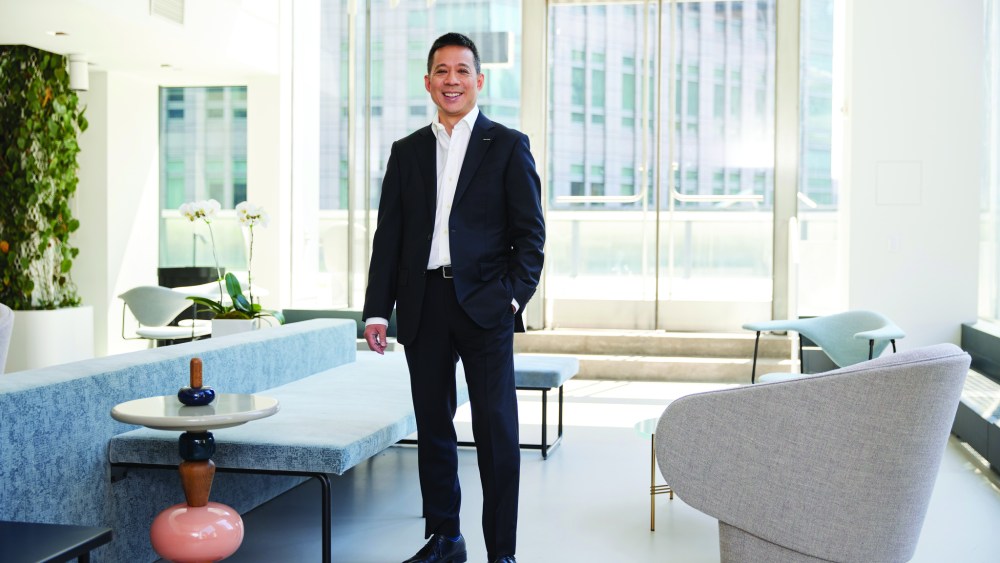
As chief executive officer of Shiseido Americas and global M&A leader for Shiseido, Ron Gee occupies a large office suite with all of the modern conveniences a leader could want. Yet his favorite place in the company’s Midtown Manhattan offices is the communal coffee bar, where Gee loves nothing more than a casual chat with whoever happens to be around. That camaraderie is typical of Gee, a sports fanatic who has thrived on interacting with his teammates — be they business or personal — since his days as a high school lacrosse player. What is less typical, though, is his route to the C-suite. A chemical engineer by training who started his career at Kraft Foods, Gee pivoted to finance, adding an MBA to his skillset, before moving to beauty. Here, the self-professed extrovert has thrived, latching on to the emotional aspects of beauty necessary to create consumer connections, while leveraging his knowledge of finance and operations. Today, he oversees Shiseido’s operations in North and South America, and is also the global lead for the entire group’s acquisition activity.
Related Articles
You have extensive beauty experience — at Coty, L’Oréal and Shiseido — but beauty wasn’t your original ambition. How did you get here?
I lucked out that my first job was at a food company, because it taught me I was into consumer products. I’m a chemical engineer and started off in manufacturing, but the idea that I can do something that impacts consumers directly made me fall in love with the the consumer packaged goods industry. I was at Kraft for over 10 years when I decided to move to the next challenge. I felt beauty was a whole other level of consumer engagement — there’s an emotional piece to it and also a piece that built businesses from scratch because it’s so entrepreneurial.
How has your degree in chemical engineering helped shape your career?
Manufacturing is instrumental in the consumer sector and my background allows me to understand how the end-to-end chain really works — the development side, the procurement side, production and service. I start with a different level of understanding. The fact that I’ve lived and worked on a production floor is immeasurable and really beneficial in terms of getting a different perspective when you talk to retailers and marketers and all of the different teams.
Are you ever tempted to jump in and lend a hand when you’re in the lab?
I’ll say, “That’s a centrifugal pump,” and someone will say, “How do you know that?!” I’ll say, “It looks familiar!”
You have an MBA as well as a master’s in chemical engineering. What was the catalyst for getting the second degree?
When I was at Kraft, I worked on this really cool global project focused on long-term vision, investments in technology and the future of manufacturing. I learned that in order to understand and make decisions about what to invest in, you have to understand the language of finance. I was being exposed to how finance helps you make the right business decisions, and thought if I understand that better, I can contribute more to the corporation and value add to myself between engineering and finance.
I made my desires known to my mentor at Kraft, and was so fortunate that my mentor had a connection with a regional chief financial officer at the company. Within three months, I got moved to another function in finance and within six months I was starting my MBA.
You’ve gone from chemical engineering to finance to now overseeing the enterprise. What have you learned about effectively transitioning to the next level in your career?
A career track cannot be a straight line or linear. You have to be willing to take what you might perceive as a step back to take five steps forward. When I moved from engineering to finance, I took a demotion, because I looked at the long-term view. It wasn’t fair that I should be given the same level of responsibility in finance that I had with engineering, where I had five years of experience.
That willingness to recognize what you really know and don’t know, and put yourself back as a person who needs to learn more — is important.
What are the qualities that have enabled you to transition so successfully?
Someone once said I have an incredible ability to thrive in ambiguity. Some people shy away from that because they like structure. Some people need clear direction. Thriving in ambiguity is a mindset. You have to recognize you don’t know everything and maybe things aren’t clear because your supervisor and peer group are in ambiguity, too, so that forces you to ask questions. You can’t be shy, you have to feel comfortable asking and be willing to try new things and if you fail, not be fearful that you are going to get punished. You have to be humble enough to learn publicly. You have to be willing to do that to grow your career in an authentic way.

How has your leadership style evolved over the course of your career?
I’m Chinese by background — both of my parents are Chinese and immigrated to the U.S. I grew up with a lot of pressure — you study and you don’t rock the boat. I learned my own voice by the time I got to high school and that voice allowed me to create an agility I didn’t know I had until I was tested. We were almost the only Chinese family where I grew up, and because there was not a common identity with others, I had to find ways to connect and understand people. That has served me well in a professional sense.
I’m an extrovert. I like to engage and meet people. I like to travel and see new places. Seeing the world through people and understanding their experience through their eyes is interesting to me. Engaging people is an important thing and showing people you care is damn important. We probably don’t do enough of that. I can’t necessarily pay everyone a million dollars a day, but I can show them I care and that I listen, and for me, that’s natural. It’s how I grew up.
Your parents must be proud of all you’ve accomplished.
My dad passed away a few years ago at 97, but if you were to ask him, what do you think of Ron’s career, he’d say, “When is he getting his PhD in engineering!” My dad was not an executive — he worked and put four kids through college. I learned a lot about work ethic from him and there is a piece of him that always wished he could do something bigger and better. That is what he seeded in me. For me, the difference was, it’s not about working harder, it’s about how do you take that work and have greater impact.
What I’ve learned through all of my changes is how to connect with people. It’s like the sports analogy — you can be a great individual player, but if you can be that and make your teammates even better, that brings you to a whole different level. That ability to connect — whether it is with your colleagues, the people who work for you, your boss — is important. That’s the way of making sure your message isn’t just a top-down message that is sent and interpreted by others. Because you are engaging with people daily — going to the café and grabbing a coffee is an experience that has nothing to do with level or scheduled meeting time or meeting objective. I look at it as not part of my job but as part of who I am.
You became CEO of Shiseido Americas as we were coming out of COVID-19 with a bruised and battered workforce. How did you rally the troops?
When you get isolated you find the most unique ways to connect. Because of COVID[-19] and the difficult decisions we were making in terms of transformation and divestitures, it forced me to put the best connective and empathetic ability out so everyone understood what I was trying to achieve and could be part of it in a positive way.
I started with the leadership team, making sure that I was sharing the content and context of what I was thinking — not just the decisions, but the process I went through. That made everyone more attuned with what I was thinking about. Sometimes they gave me more insights, sometimes they challenged me, sometimes they just listened.
It was double-sided therapy — the organization needed it and I needed it. It was COVID[-19], we’re in a shutdown, I move from CFO to CEO and our business is almost at a standstill. What do I do? For me the best thing was to get us as close together as possible, yet we were isolated. It almost sharpened the senses, to prioritize communication to the utmost. When we came back to the workplace and started getting into the new normal, we were able to carry a lot of that over and we saw an exponential gain from that.
The power of community is a big theme for us and we continue to push that. It is about a true way of working. We do amazing things not only internally but externally — the beauty of helping others. I’m happy we can make this connection for our employees and evolve it and make it valuable for everyone.
Shiseido recently announced its strategy, Shift 2025 and Beyond, described as going on the offense not defense. What does that mean for the Americas? As you look at the business in the year ahead, where do you see the most opportunity?
The U.S. and North America is the largest prestige beauty market in the word. We offer the Shiseido Group geographic diversification. The region is critical for the group to grow. Going on offense means what is the investment needed to accelerate growth in the Americas for the group overall.
Since we are global brand holders, we are responsible for Nars, Drunk Elephant and Tory Burch globally. We have innovations in product and marketing and in ways of working process-wise that lead the group. I’m excited that the growth opportunities are huge for the group. What we have done over the last two-three years post some difficult decisions has been nothing short of extraordinary.
Drunk Elephant and Nars are leading the group in performance and innovating in ways that have been explosive in the marketplace. Next year is going to be another great year of innovation for both brands. Not only innovation in newness, but our core stock keeping units and franchises continue to resonate and grow well. What we know is that when we are fueling our brand equity and awareness, we get a benefit across all franchises. As we continue to innovate we will continue to grow. We’ve got an ambitious outlook for the Americas.
What about South and Central America? Brazil, Mexico, etc.?
There is no doubt they are important. Brazil is the fourth-largest beauty market, and while it’s primarily mass, some of our brands in prestige are in the top one or three. In Latin and Central America, there is a movement toward upscaling and prestige in many aspects. These markets are a smaller piece of the pie today. We believe they will grow dramatically and we will invest it in going forward. It’s a very dynamic market.
Shiseido CEO Masahiko Uotani has talked a lot about skin health and is making a deeper push into wellness in Asia. How do you see that translating here?
It’s an important part of our future. The U.S. market is one of the top two considerations of how we think about wellness. Asia is the other one. It is quite different in the U.S., but dynamic. Ideas like sleep and food and food-ceuticals come into play. For Shiseido, we’re looking at what is the science between these elements of wellness and their impact on skin health and skin beauty. We are working heavily to understand that connection. We’re going to invest and learn. The market is evolving quickly — it is being disrupted in so many different ways. This is not going evolve in the traditional way, where we see a key retailer set up a wellness corner, for example, like taking the supplements corner of Target and plopping it in our channel and thinking it’s going to be successful. It’s how the evolution of beauty connects to wellness that is important.
What is the key opportunity for Shiseido when it comes to wellness in this market? Retailers say it is still a tough sell. What’s going to change minds?
There has to be real science that connects benefits beyond what supplements do. We have to bring that effect to some of the things we’re trying to solve for. We all know sleep has an impact on the health of your skin and overall health — how do we measure and understand that in a meaningful way so that we can build services and products that support that. That will be a pathway to market creation for Shiseido and the entire industry. There will be disruptors coming from other directions, not necessarily beauty. That’s why this is such a tremendous opportunity.
You were a key part of the team that did the Drunk Elephant deal and you’re also Shiseido’s global M&A leader. What have you learned about a successful integration as you ponder future acquisitions?
A successful integration means not everything is going to go smoothly. With founders and change, you’re always going to be asked as an acquirer — why are you making a change? That’s a litmus test. You have to articulate why that change is valuable, why it’s going to lead to value creation downstream. You have to go through challenges, and sometimes they aren’t pretty, to understand what makes sense, what you’re capable of delivering in a certain amount of time, etc. There is not one right answer when it comes to acquisitions — you’re not going to be able to integrate the same way every time.
You have to be agile as a leader and as a strategic, be willing to do that. If you have a playbook, a standard way to look at the businesses, you end up starting to make things look similar at a certain point.
As you look to the year ahead, what kinds of acquisitions are most interesting to Shiseido?
We’re going to be aggressively selective. We’re not a shop that does acquisitions for the sake of acquisitions. We’re very careful about our portfolio and how it fits into our overall strategic framework. I’m proud of what we’ve built over the years — our ability to connect with deal flow, to meet with founders, learning what innovative leaders are doing in our space and as things evolve, making sure there is a connection and reacting in a positive way.
Uotani-san has emphasized that skin health will be the guiding directive of the company going forward. Do you see a role for the fragrance brands in the portfolio?
We have beautiful fragrance brands — they are strong and profitable. For me, they do have a place. When I think about holistic wellness, fragrance has a place in that environment. We talk about the emotional benefits fragrance brings to self care, so I certainly believe fragrance has a place in our portfolio.
You’re such an upbeat guy. What makes you crazy?
If there is a lack of transparency, it drives me nuts. We live in an environment where transparency is one of our core values. Sometimes the lack of transparency is more about being fearful to share bad news. Is this the wrong time, am I going to get in trouble? We need to share bad news, because we need to fix things and improve upon things. Nothing is perfect. We know that. That’s why we need to build a community that is completely transparent and address challenges and issues we have.
How do you like your team to deliver bad news?
I like to hear bad news factually straight up. And fast.
What do you do outside of the office that is your passion?
I love sports — playing, watching, even collecting sports memorabilia. My favorite teams are the New York Yankees the Giants, the Knicks and the Islanders. Everyone asks me why not the Rangers but I grew up on Long Island!
I’m super competitive. I played racquetball as a kid at the competitive level and lacrosse. I love the ability to compete.
What’s your assessment of the competitive landscape in beauty?
Everyone is fighting for breakthrough innovation. Everyone is recognizing that is really important and hard and everyone is trying to figure out how to do things faster. It tests everyone. This is why our categories are resilient in difficult macroeconomic times. We are all pushing each other to be more innovative, to better connect with consumers, to deliver breakthrough science. At the end of the day, we all win because the market grows.