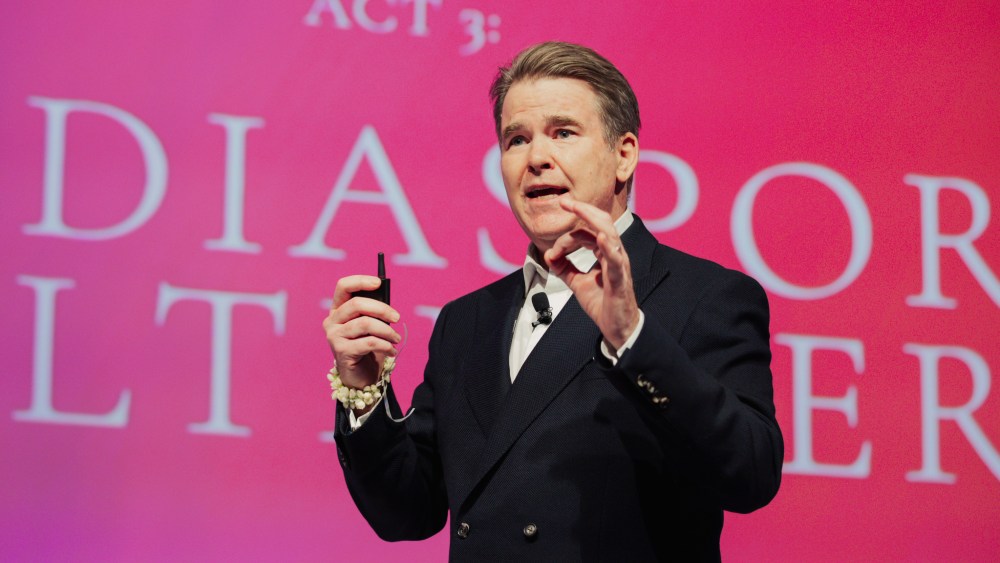
Paul Austin was well into his career as a senior fragrance executive when he realized he wanted something different.
“I was getting burnt out by the industry; I wanted to look for something else and be inspired again,” said Austin at the 2025 WWD Beauty Inc Catalysts conference.
He ended up embarking on a research sabbatical in southern India, during which he encountered a familiar aroma — jasmine sambac, commonly used as a fragrance note by brands all over the globe — in a new way.
Related Articles

“Walking to class, I would see these elegant southern Indian ladies with [jasmine sambac] flowers in their hair. It suddenly dawned on me that I had gone all around the world to take a break from the fragrance world, only to be at its absolute epicenter,” said Austin.
His time in India ignited a fresh spark for the fragrance veteran, in part driven by his increased awareness of the market’s fragrance paradox, as he describes it.
“The paradox is that India is alive with scent…and with such a sensory culture, surely it must be a superpower in fragrance,” said Austin, adding that India comprises nearly 20 percent of the world’s population; 900 million of whom are below the age of 35.
Yet, “India is less than 3 percent of the global fragrance market,” he said. “But that’s changing, and it’s changing quickly.”
Indeed, India’s fragrance market is growing more than 15 percent each year, with recent technological and retail advancements bolstering the category. Online and digital retailers like Nykaa, Tata CLiQ and Tira are boosting beauty discovery in the region, with Nykaa even hosting a three-day beauty festival in November in Delhi, similar to Sephora’s Sephoria beauty festival.
Just as significant, quick commerce — or Q-commerce, a way of online shopping that allows products to be delivered in major cities in as little as eight minutes — has seen a rapid rise in India. Blinkit, Zepto and Swiggy are among the key players fueling Q-commerce.
“It’s changing the game — for Gen Z, which wants instant gratification, fragrance and beauty go from being something much more considered to much more instant,” Austin said.
For those turning their attention to India, Austin said, localization is critical.
“India rewards brands and people that tune into the rituals it already has, rather than brands which try to impose what it doesn’t have already,” he said. Brands like Jo Malone, which recently launched a Diwali collection with Indian fashion designer Arpita Mehta, for instance, are exemplifying this practice.
Cartier and Harrods both recently hosted galas for Diwali, and Galeries Lafayette has opened a store in Mumbai, with plans for another in Delhi, as luxury — which is facing challenges globally — booms in India.
Homegrown Indian brands are worth watching, too, said Austin, who cocreated luxury fragrance brand LilaNur Parfums with Anita Lal. “People fell in love with it, because they could sense something universal in that story,” said Austin, pointing also to Bombay Perfumery and Forest Essentials as India-based brands to have on the radar.
“But don’t just think of India as the place of the 1.4 billion — there is also the multiplier effect: the Indian diaspora,” he said. “They represent the most affluent group of people in the U.S., and they’re hungry for beauty, they’re hungry for fragrance and they’re hungry to see themselves in this story.”