“Stress care belongs in every hood.”
That’s the mantra driving Devin McGhee Kirkland’s adaptogenic body care brand, Deon Libra, which launched in 2022 and aims to address chronic stress in Black and brown communities.
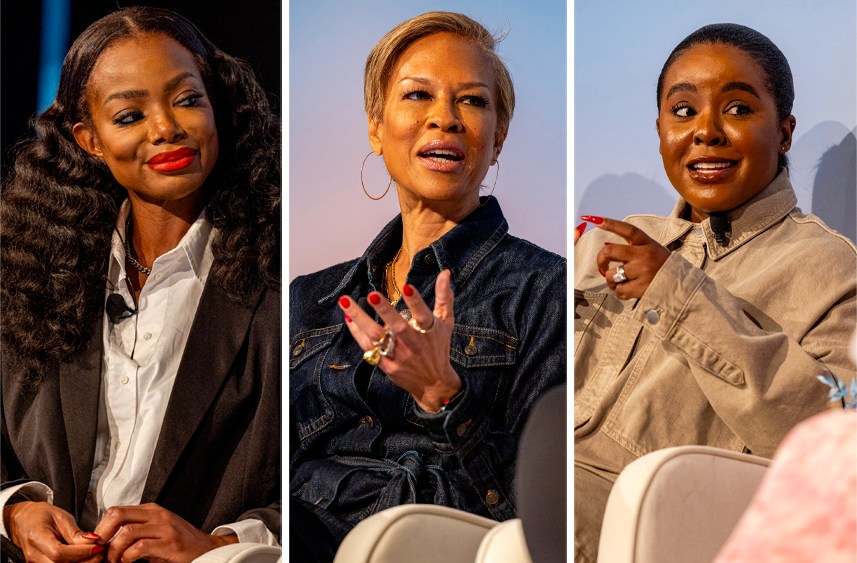
Much has been said about creating a more inclusive wellness industry, but for Black founders like McGhee Kirkland, Brown Girl Jane’s Tai Beauchamp and Movita Organics’ Tonya Lewis Lee, who took the stage with WWD executive editor Tara Donaldson to share their respective brand journeys, it’s clear there is much work to be done.
Related Articles

“When you think about Black and brown communities, we tend to index higher in terms of real issues of wellness, health and illness,” said Lewis Lee, who has introduced six skin, hair and prenatal vitamins since launching Movita in 2015. “I think the industry kind of looked at that and said, ‘Oh, well, they’re not “well,” so they’re not going to subscribe to these things.’ But when you get down to real wellness, there is such an opportunity that is lacking.”
In order for corporations to adequately cater to Black and brown consumers, they first must understand their histories, said Beauchamp.
“When you take the cultural perspective of what wellness looks like for Black and brown people, and take into consideration the historical experiences that go into that — wellness is not just about movement for us, it’s about healing the trauma that might be there, and how do we touch that — how do we create emotional wellness as well as physical wellness,” said Beauchamp, whose fragrances offer mood-boosting benefits.
For McGhee Kirkland, creating adaptogenic products that would resonate with her target demographic meant fine-tuning details that often go overlooked — from the taste of her anxiety-relieving supplements, to giving her products approachable names — Unbothered Elixir, Big Up Body Glaze, and so on — to the Megan Thee Stallion-inspired double entendres splashed across the brand’s packaging.
“Our [powder] has a chocolate base because we noticed that every adaptogen we were tasting in the market tasted like dirt,” said McGhee Kirkland, who cofounded the brand with her wife, Brit McGhee Kirkland. “Specifically speaking to Black people, a lot of us have a hard time doing healthy things when they don’t taste good, and so we wanted to get over that hurdle from the start.”
For McGhee Kirkland, whose father passed away from a stress-related heart attack, the goal is to deconstruct the idea of wellness as a luxury within the Black community, emphasizing it instead as a necessity.
“Even as a Harvard-educated businessman, as a father, as a former athlete, [my father] still did not have the wellness tools and resources, or even just the language to say ‘something is wrong,'” she said. “The more research we did on stress and how it affects Black bodies, the more I realized — why isn’t wellness marketed toward us more?”
While Black founders are at the forefront of change, meaningful allyship from predominantly white organizations and investors is paramount to maximizing impact.
“As Black and brown people, we support one another and that is important — the external allyship is what is really going to have the measurable impact that we desire to have,” Beauchamp said.
This support comes in many forms, among them resolving the lack of medical research and clinical trials focusing on darker skin tones.
“It can’t be on [founders] to do the clinical research,” said McGhee Kirkland. “It costs millions and millions of dollars to do it, so why is it us, as brands, leading the charge in the medical field in doing these studies? We’re asking them to do the work just as much as we’re doing the work.”
Internal representation is crucial, too.
“Hire Black and brown people. If you’re trying to market your products to people of color, you need people of color in your offices — you can’t figure it out on your own,” said Lewis Lee, whose vitamins are suitable for all women, but “if you go on our website as a Black and brown woman, you know that we’re talking to you directly.”
“Those cultural nuances are so important,” said Beauchamp, adding that in today’s creator-driven content ecosystem, brands should routinely be consulting with Black and brown creators to make sure their messaging — and intent — are up to par.
“Having our voices not only at the table, but actually directing how these conversations are had — it changes the game,” she said.
Companies and individuals should also seek to elevate founders of color who are driving change their way. “Is the question really, what do [companies] need to do to be more inclusive, or do they just support the brands who are doing the work?,” said McGhee Kirkland. “A lot of the time when people try to dive into diversity and inclusion, it becomes performative, so for me in this space, that allyship has been so important.”
The hair care space, Lewis Lee said, is an area in which Black founders have been able to meaningfully make their mark thanks to that balance of allyship and a purposeful brand ethos. Wellness, she believes, is next up.
“There is a hunger, there is a market, and there are definitely dollars out there for this — we’re all seeing that in our businesses, and it’s only going to grow from here,” she said.