
Updated 4:29 p.m. ET Sept. 18
PARIS — Swiss watch exports cooled significantly in August, but how much is the industry bracing for the autumn?
Shipments of wristwatches fell 16.4 percent in August, reaching 1.57 billion Swiss francs or $1.98 billion, and more than 13 percent in units in the month, according to figures published Thursday by the Federation of the Swiss Watch Industry.
On the one hand, a rush to ship to the U.S. in anticipation of the Aug. 7 application of the 39 percent tariff rate decided by U.S. President Donald Trump did not materialize, after upticks in April and July. Exports to the country slumped nearly 24 percent to 245.1 million Swiss francs.
Related Articles
On the other, all other territories in the top six, which account for around half of the global market for Swiss watches, saw double-digit declines.
You May Also Like
Most affected was China, which fell 35.6 percent to 115.3 million Swiss francs.
Across Europe, exports in the month dropped. Germany shank by nearly 25 percent, falling well short of the 100-million Swiss francs bar it had reached last year, while France saw a 9.7 percent decrease to 73.7 million Swiss francs. But Italy recorded a 3.1 percent rise to 72.6 million Swiss francs.
The Middle East showed a mixed picture with the United Arab Emirates shinking 8.7 percent while Saudi Arabia leaped more than 48 percent, albeit on a more modest base.
Describing the performance of the American market as a “normalization” after the rush to beat tariffs earlier in the year, RBC analyst Nikolaos Lafioniatis said that “interestingly, [rest of the world] Swiss watch exports declined materially in August, which may be a function of lower product flows at the expense of front-loaded U.S. inventory build, which we have also heard from recent Asia watch retailer channel checks.”
He also noted “ongoing demand weakness in Asia-Pacific, and tepid demand trends in Europe” from the bank’s observations.
Two-year gains were eroded by midsingle- to high-double-digit factors and August’s figures also showed that three-year gains were dented.
Save for the U.K. and Hong Kong, respectively flat and up 2 percent, the U.S., Japan and China’s exports fell under 2022’s figures for the same period.
No materials category was spared, with the industry body highlighting “very negative results, both in volume and value.”
Likewise, all price segments, with watches priced more than 3,000 Swiss francs — considered a key category habitually driving growth — and entry-price models less than 200 Swiss francs most affected.
Despite the dreary backdrop painted by August’s export figures, Swiss watchmakers and the industry at large had their game face on in early September. That was nowhere more visible than at the sixth edition of Geneva Watch Days, which ran from Sept. 4 to 7 and saw 66 brands showing their latest offerings to 17,000 visitors.
Initiated in 2020 by a cadre of 19 brands including Bulgari, Breitling, Girard-Perregaux, H. Moser & Cie. and Ulysse Nardin, the rendezvous has now emerged as a major touchpoint on the watchmaking calendar.
At the opening conference, Breitling chief executive officer Georges Kern expressed confidence for a resolution “in the next weeks and months” of the tariffs situation and said he “cannot imagine Switzerland running around with 39 percent tariffs, so let’s stay positive and have a plan B.”
It’s a sentiment that echoed across the industry. Swatch even released out a tongue-in-cheek “What If…Tariffs?” watch with the 3 and 9 markers swapped on the dial. It described the piece, available only in Switzerland, as “hopefully just a limited edition,” which will cease to be available once levies change.
For those in the industry not taking such a maverick stance, there were cautious mentions of price increases as well as margin cuts that would be split between brands, retailers and distributors should negotiations fail to result in lower rates.
“Tariffs are something that we always try to manage in a way that it doesn’t penalize the appetite of the final client for purchasing a beautiful watch,” Jean-Christophe Babin, who is CEO of Bulgari and the LVMH Watch division, told WWD in an interview.
“We don’t want to create huge discrepancies either, because discrepancies are always negative, because they create a gray market, they move people from domestic to travel retail, which is a more volatile environment,” he continued. “It’s in the interest of no one to punish American clients because tariffs are [high].”
But coming across louder was the trifecta of resilience coupled with agility and creative nous.
“When there is a challenge, it’s not just one but two or three opportunities that arise,” Benoît de Clerck, CEO of Zenith, told WWD. “Today [tariffs] are a challenge, we will find a solution, we know it’s not yet final, there are still discussions and things will happen. We will react in a timely manner and in the appropriate way.”
For the 160-year-old brand in LVMH Moët Hennessy Louis Vuitton’s watchmaking stable, the focus was being highly agile and “producing what we can put on people’s wrists, not just produce to put on shelves,” the executive said.
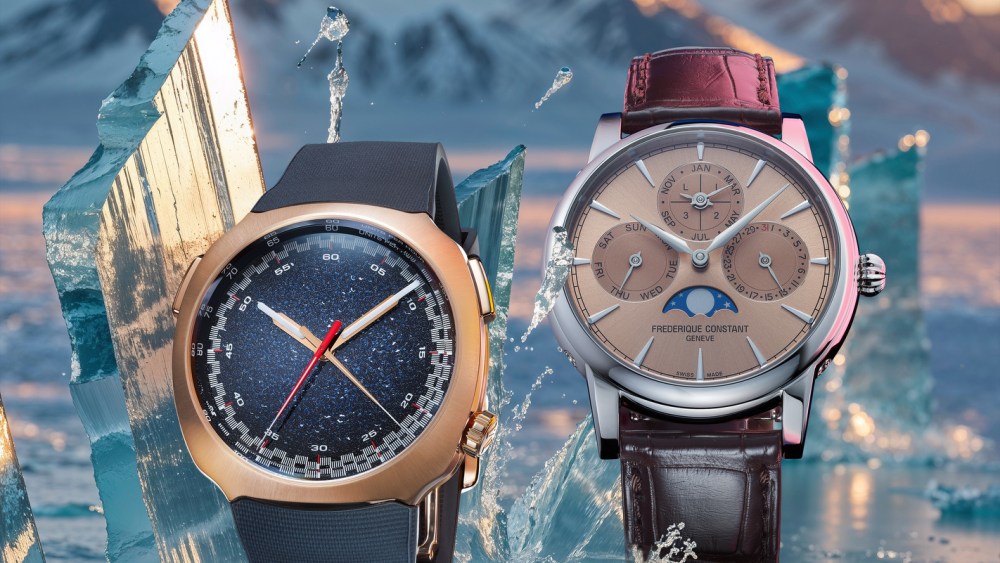
With around 150 novelties showcased in an exhibition open to the public at the Rotonde du Mont-Blanc on the shore of Lake Geneva, brands from Tag Heuer, Frédérique Constant and Ferdinand to clockmaker L’Épée and customization specialists such as Artisans de Genève had come prepared.
Across the city, momentum was also building with brands not formally taking part in the Geneva Watch Days such as Piaget or Hublot hosting intimate gatherings or Roger Dubuis unveiling a new Salon retail concept with its Place du Molard boutique.
Another idea that loomed large from the four-day showcase was that collectors and by extension consumers, were willing to face a premium when they preceived high added value, be it know-how, craftsmanship or innovation.
“Today calls for dream-worthy products,” said Manuel Emch, CEO of Louis Erard. The brand, which produces a maximum of 4,000 pieces a year, does 50 percent of its sales online with the U.S. accounting for a third of those sales.
Case to his point, the release of the Louis Érard Gravée Main, which features more than 50 hours of hand-engraving, priced at 5,450 Swiss francs.
With tariffs and state taxes added at checkout bringing its price up in the $10,000 ballpark, Emch assumed it wouldn’t sell but “proportionally more” were acquired by U.S.-based consumers, he said.
That said, he noted that the volumes of brands like his didn’t add up to the units lost overall in the Swiss watch industry.
Babin separately noted that 35 percent of the winners of the annual Grand Prix de l’Horlogerie de Genève, or GPHG, were Geneva Watch Day participants, but that these brands accounted for “less than 10 percent of the industry’s turnover.”