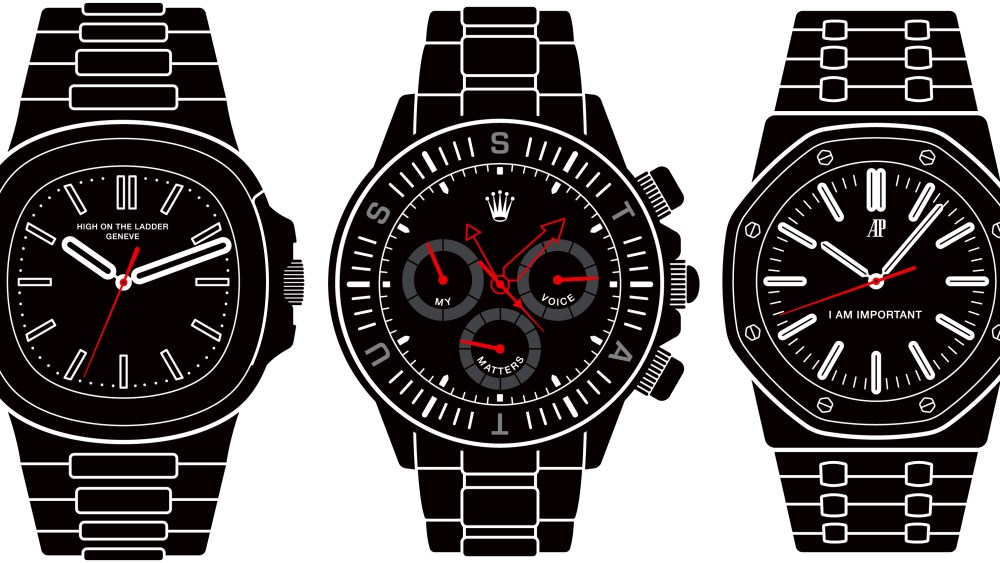
A Swatch Chrono is waterproof, tells you what time it is and has some buttons to control a stopwatch — which you will seldom use. My Rolex Daytona does the exact same things. While it doesn’t do them any better than the Swatch, it costs 200 times more. Why would I buy a Daytona then? A Nautilus? A Royal Oak?
Humans like to think of themselves as the most rational of beings. I think that’s an illusion, and my taste in watches proves it.
When we make a purchase, we know it’s not only about the price and the product. We’re aware that there’s usually something else at play. A sort of invisible force, shaping our decisions. What that force is, exactly, has always been a topic of speculation. Some call it business and commerce’s twilight zone. Until recently, even the finest in marketing in the fashion and luxury industry didn’t understand it very well, let alone measure it with precision.
Related Articles
Thanks to neuroscience, things are changing fast. Our understanding of how purchase decisions are formed in the brain has evolved enough to put our finger on that something else. For the first time, scientists are able to determine the role and the importance of that invisible force. And it’s already altering the way luxury brands interact with their customers.
You May Also Like
We are truly Homo Economicus. Our brain always and automatically favors minimal pain against maximal gain. Simply put: In every decisions we make, we seek the biggest bang for our buck. If that is true, why are some of us happy to splash 30,000 euros on a Rolex that does the same as a 150 euro Swatch?
To understand this, it helps to think of purchase decisions as exchanges of money against the fulfillment of tangible and intangible needs. When I buy a bottle of Evian, I exchange my money against the fulfillment of my need to hydrate, which is a tangible goal. I also pay to fulfill my intangible need to feel youthful and vital. When I purchase an SUV, I exchange my money to fulfill my mobility need — tangible. I also pay to fulfill my goal to be more assertive amid the intimidating traffic out there — intangible.

Scientists have recently made intriguing discoveries about these intangible needs. First of all, they most often operate on a subconscious level. Meaning you and I are not fully, consciously, aware of how these hidden drivers shape our purchase decisions. Hence the term “implicit motivation.” A second discovery is that the immaterial component generally weighs more on a purchase decision than the material side of things.
The third discovery is quite a funny one. It turns out our conscious brain doesn’t like the fact that it’s only playing a minor role. To cope with the situation, the conscious brain constantly invents — or, to use the cool scientific term, confabulates — narratives that create the illusion that conscious thinking is in control, while in reality it isn’t.
These three discoveries add up to a fascinating truth: Our purchase decisions are mainly controlled by intangible needs that act under the threshold of conscious thinking, and to cope with being excluded from the party, the conscious brain makes up stories about the whole process.
This is why it is so difficult to understand the why behind our own decisions, including our purchase decisions. Ask men why they purchase luxury watches. First, they’ll talk about all the functions theirs has. When pressed, they might admit it has something to do with prestige and social status, an attempt to make it understood that they have made it in life. But that’s where the answers stop. These answers, much like any answer in similar interviews, are a mix between the confabulation and our incomplete and imprecise grasp of the “why.” Our introspective limits keep us from understanding what truly goes on in our subconscious brain.
But if we’re aware that interviews, surveys and questionnaires are bound to fail, then how can we shed light on this twilight zone? Enter “Project Implicit.” This collaboration between the universities of Harvard, Washington and Virginia has resulted in a research method that directly taps into the subconscious brain, making it possible to measure and map the hidden component. Just imagine the magnitude of this bit of science: it’s making that invisible force in our brain visible.
This method is a game changer. Every professional in fashion, cosmetics, and luxury knows that — above all — their business is about fulfilling clients’ intangible needs. Prestige, status and sexuality all play a big role. But these are very broad concepts, they can mean so many things. Compared to the ultra-detailed understanding of the tangible aspects of these businesses, the classic understanding of the intangibles was shockingly blunt.
I say was because, at last, implicit research is starting to fill in the blanks. Today we are able to measure that men purchase Daytonas, Speedmasters and Royal Oaks because they fulfill their need to signal status to other men, the need to make their voice matter, and — finally — the need to be important. Basically, they’re saying, “Look at my watch, I’m high on the social ladder, therefore I am important, therefore my words count.” The deep inner urge to fulfill this trio of needs is what implicitly motivates men to pay 200 times more for a Rolex than for a Swatch. Isn’t that amazing?
I have to admit, as a modest collector of luxury timepieces, this has changed the way I look a the Nautilus on my wrist. And it certainly is changing the way luxury watch brands interact with their customers.
Olivier Tjon is cofounder of Beyond Reason, a neuromarketing consultancy that specializes in the immaterial component of purchase decisions.