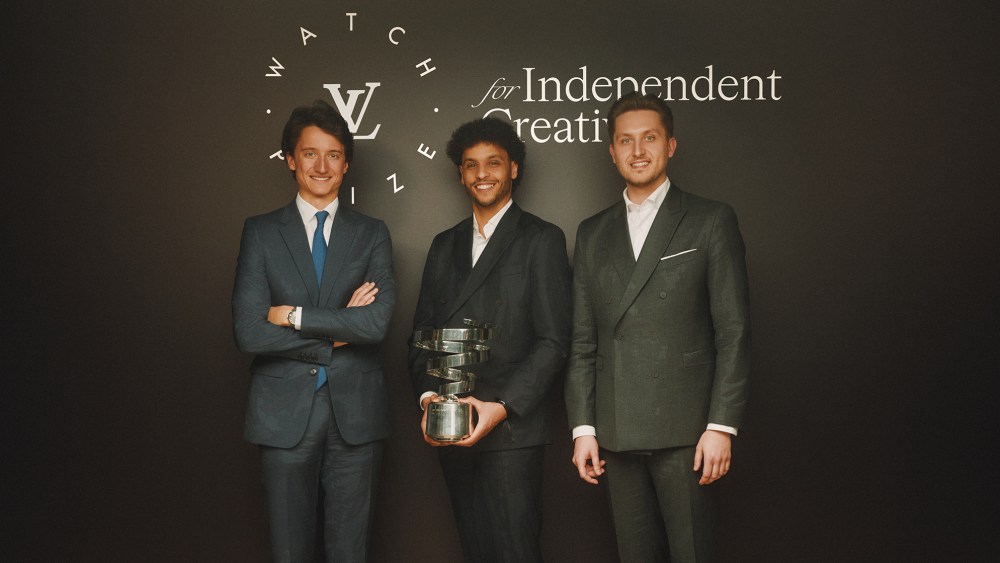
PARIS — Fledgling watch brand Hazemann & Monnin won the second edition of the Louis Vuitton Watch Prize for Independent Creatives, confirming Alexandre Hazemann and Victor Monnin as rising industry talents just two years after founding their workshop.
The French duo were chosen among five finalists at a prize ceremony held at the Fondation Louis Vuitton on Tuesday evening in front of an audience of industry experts and collectors, capping a monthslong search that saw more than 1,000 applications whittled down to 20 semifinalists.
Related Articles
The award comes with a grant of 150,000 euros plus a one-year personalized mentorship with the teams at Louis Vuitton and La Fabrique du Temps Louis Vuitton, the high-end watchmaking workshop headed by Michel Navas and Enrico Barbasini.
You May Also Like
Raúl Pagès, the Swiss independent watchmaker who won the first edition of the prize in 2024, handed Hazemann and Monnin the silver spiral-shaped trophy. The four other finalists were Fam Al Hut from China; Lederer from Switzerland; Daizoh Makihara Watchcraft Japan, and Quiet Club, also from Japan.
Speaking on stage, Jean Arnault, Louis Vuitton’s watch director and the force behind the prize, said it aims to shed light on lesser-known watchmakers and buffer them against variations in market demand.
“The idea behind this initiative was to say, Louis Vuitton will allow for sustaining the level of excitement around independent watchmaking by championing it,” he said. “Most of the time, you never even see these pieces.”
Hazemann & Monnin’s winning design, the School Watch, was the culmination of their studies at the Edgar Faure high school in Morteau, one of France’s leading watchmaking schools. It features a movement with an instantaneous jumping hour and a passing chime, and comes in a limited edition of 20, consisting of two interpretations.
Hazemann’s version, with blue accents, won the F.P.Journe Young Talent Competition in 2023, while the Louis Vuitton prize jury distinguished Monnin’s interpretation, which features natural stone dials made of malachite and opal. Their next creation will feature both their names on the dial.
Speaking after the ceremony, Monnin said the positive reception for their debut project would help them grow their workshop in Saint-Aubin-Sauges in Switzerland, which currently employs 10 people.
“We did not really expect this. The School Watch was originally created for an assignment, but it became something much more personal. We poured all of our emotions into it and today, I think those emotions have shown through,” he said.
While Hazemann specializes in engineering, complex calculations and the technical construction of the watch, Monnin focuses on project management, overall organization and the aesthetic direction. The duo said they were taking a considered approach to growth.
“We will gradually introduce more models but we believe in taking our time. The watches will be ready when they’re ready,” Hazemann said.

“We’re focused on quality over quantity,” Monnin chimed in, noting that the brand tries to produce as much as possible in-house. “If, year after year, we can increase production by 10 percent to 15 percent, that would already make us very happy. There are practical limits, too, as our workshop is still quite small. We’ll see in time how we evolve.”
Arnault said it’s becoming increasingly difficult for big brands to recruit young watchmakers.
“When it comes to the traditional path of joining an established house and spending 20 or 25 years mastering the craft before reaching a certain level of complication, it’s becoming harder to find talent in Switzerland, at least — perhaps less so globally,” he said.
“What we’re seeing instead is a new generation, like these two, who are much more inclined to start their own ventures, because the world has changed,” he added.
Monnin is a fourth-generation watchmaker, while Hazemann was guided by the need to express his creativity. “At a certain point, you become an entrepreneur because it’s the only way to follow your dreams,” he said.
Arnault was pleased to see strong international participation in the prize.
“It’s really only Louis Vuitton that can push an agenda like this on a global scale,” he said. “I also think interest in watchmaking has become much more international in recent years. We saw it even among collectors — the coronavirus pandemic played a role in educating them, and a lot more people became interested in independent watchmaking.
“That’s why we’re now seeing more and more watchmakers emerging outside Switzerland. The Japanese have been very strong for centuries, of course — but elsewhere, not so much until recently. Now we’re seeing American, Chinese, Russian, even Australian watchmakers applying for the prize,” Arnault added.
“When you see these timepieces in person and hear their makers explain them, you realize they’re capable of technical feats that many even in Switzerland could not achieve,” he said.