
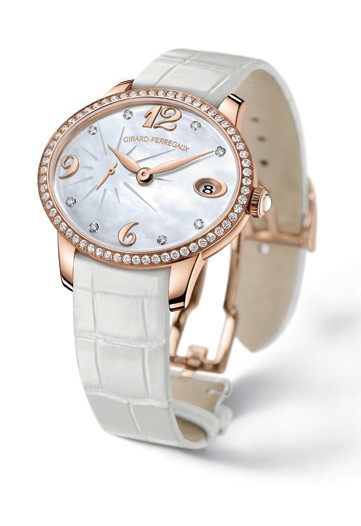
LA CHAUX-DE-FONDS, Switzerland — Girard-Perregaux marks its 220th anniversary this year with a series of exhibitions around the world, from New York to Shanghai, as it plans the reopening of its museum here in 2012, following the theft three years ago of several historical watches, their recovery and restoration.
The new Girard-Perregaux 1966 Tourbillon with Gold Bridge will also mark the anniversary and hark back to the brand’s pivotal invention, the Tourbillon.
Swiss haute horlogerie firm Sowind Group, which owns the Girard-Perregaux and JeanRichard brands, is entering a new phase of its history following the death of chairman and owner Luigi Macaluso in October. It’s now led by his sons Massimo and Stefano Macaluso, chief executive officer and president, respectively, of Sowind SA, and his widow, Monica Mailander Macaluso, chairman of Sowind Holding. The company’s priorities are technological innovation and the expansion of its retail and wholesale distribution while maintaining an exclusive positioning. Massimo and Stefano Macaluso joined the company more than a decade ago and were influenced by their father, an entrepreneur, art collector and a former race car driver with a passion for luxury watchmaking, who rekindled the Girard-Perregaux and JeanRichard brands.
Related Articles
You May Also Like
In 2008, French luxury giant PPR took a 23 percent stake in Sowind, which moved PPR into the world of haute horlogerie and allowed the two companies to combine knowledge base, research and development, distribution and sourcing.
“This agreement stems from the magic feeling between [PPR chairman and ceo] François-Henri Pinault and my father, and it is one that offers further potential for growth,” said Massimo Macaluso in an interview at the Girard-Perregaux headquarters in this town near Neuchâtel, in a Swiss valley about three miles across the border from France.
Although Girard-Perregaux shows at the Salon International de la Haute Horlogerie in Geneva and not at the Baselworld watch and jewelry fair, Sowind manufactures movements for several brands in the industry that are present in Basel, from Bulgari and Hermès to Boucheron and Harry Winston. Sowind stands out in the industry as a family-owned firm, with a technological platform, in-house production and upscale, historic brands. JeanRichard dates back to the 17th century, and founder Daniel JeanRichard is credited with inventing several machines and tools necessary to the craft of making watches. Ninety percent of Swiss watchmaking originates in this area, which spans from Geneva to Biel/Bienne.
“This is a tough region, with very long winters, and we had to find a way to pass them,” grinned Macaluso, sitting in one of the antique rooms devoted to the craft and positioned so that workers would face the sun all day long.
Sowind also counts collaborations with fashion brands Bottega Veneta and Ermenegildo Zegna. To celebrate its 100th anniversary, Zegna last year partnered with the company for a limited edition watch.
“They retailed at 23,000 euros [or $30,360 at average exchange] and we sold them all,” said Macaluso.
That led to the signing of a long-term partnership between the two companies for a collection of signature watches to be sold in Zegna stores only and to bow in mid-2011. Last year, Sowind produced a unisex watch for Bottega Veneta in titanium, which also sold out, and is “negotiating” a second timepiece, said Macaluso. The executive said Sowind’s “flexible structure, know-how and desire to try different things” are instrumental in the different paths it takes.
“Its quality and its limit at the same time is that Sowind is based here — it’s difficult being global from here, but with fashion, there is a global approach to marketing. It’s more sophisticated than with watches only,” said Macaluso, who is also on the management committee of Gucci. “We learn, and it’s always more than a business experience for us. ‘Just in time’ does not exist in watchmaking. There may be particular industrial difficulties working with fashion designers, so it’s a two-way learning curve.”
As fashion companies are increasingly interested in the production of their own watches, Macaluso is considering setting up a fashion department.
The connection with PPR is an additional tie with fashion “and a necessary one,” he said. On the heels of the announcement in March of the $6 billion-plus deal between LVMH Moët Hennessy Louis Vuitton and Bulgari, Macaluso said, “Conglomerations between brands allow for synergies in distribution, a must if you want to progress, expand your horizons in Asia, the U.S. or South America.”
The executive said each time a new mall opens, “if you are small, it’s difficult to negotiate and find the right space in the mall and this can limit your growth.” How the partnership with PPR will evolve depends on Pinault, he added.
“Watches are a personal passion for his own pleasure,” said Macaluso. “If there were the will to increase the investment in Sowind, we would be interested. We have an excellent relationship with Pinault and it’s not only a professional one.”
High on the agenda now is to get “closer to the markets,” following the industry’s crisis in 2008, and the rising “hysterical” demand from China, greater than that in the pre-2008 period.
“Watches are one of the first accessories for Chinese, before cars even,” he said. “It’s a necessary status symbol in an area where the brand remains important.”
Girard-Perregaux has been present in China for the past eight years, and there are 18 points of sale that carry the brand, and six boutiques, including Hong Kong and Macau.
“Chinese like classic, round, reassuring watches, not complicated, and easy to read, in pink gold, with light dials and diamonds” he said.
Given that it’s difficult to have good margins in China because of import taxes, Sowind counts on Chinese tourists and entrepreneurs who travel. The American market has also picked up, with 140 percent growth in 2010 compared to the previous year, and gains registered especially in the West. The first U.S. Girard-Perregaux boutique opened on New York’s Madison Avenue last year. South America “is booming,” noted Macaluso. Europe remains flat and “still very difficult,” while Russia is “picking up vigor. In any case, we’ve never seen such a moment of evolution and change of markets, and it’s exciting.”
Despite the economic crisis, Sowind “continued to invest in technology, reaping the rewards of a saner distribution,” noted Macaluso, who conceded stocks were “a big problem,” as many stores went bankrupt during the crisis and “big groups forced big purchases.”
There are 10 Girard-Perregaux boutiques in the world, including franchisees, and Macaluso said more are in the works.
There also are around 500 multibrand stores that carry Girard-Perregaux worldwide, and 200 for JeanRichard. Sowind produces 20,000 Girard-Perregaux watches a year, employing 300 people.
Since 1791, Girard-Perregaux has registered more than 80 patents. Constant Girard-Perregaux, who had taken over the company Jean-François Bautte founded in Geneva in 1791, was the architect of the Tourbillon movement, with the arrow-shaped gold bridges, and the pioneer of the wristwatch concept. In the Sixties, the company launched the first high-frequency movements (36,000 vibrations per hour). The brand’s luxury watches boast complications such as minute repeaters, perpetual calendars, moon phases and split-second chronographs. Almost all the movements and parts are made and decorated by hand.
“We are an independent historical brand, with an in-house industrial technology, the right product at the right moment and the market is going in our direction,” added Macaluso.