Friday’s high jewelry runway spectacular at the Musée des Arts Décoratifs during Paris Fashion Week will be the culmination of a big year for Messika, which is marking its 20th anniversary.
Earlier this year it was inducted into the French luxury goods association Comité Colbert. Over the summer, the brand created jewelry for members of the K-pop group Seventeen to mark their latest album and 10-year milestone.
A 1,500-square-foot flagship on New York’s Madison Avenue opened in September, while Messika also rolled out a theft protection solution backed by the French fintech start-up Grace. Before the year’s end it will also launch a new fine jewelry collection.
Related Articles
It’s hard to imagine that in 2005 Messika was a jewelry upstart aiming to democratize diamonds and breaking jewelry out of the safe.
You May Also Like
“There were only four people around the table,” said Valérie Messika, founder and artistic director of the brand, of the early days.
With her during an interview were chief executive officer Jean-Baptiste Sassine, who is also her husband; her cousin Didier Cherqui, the director of creation, and Aurélie Darmon, who serves as chief marketing officer.

Today, headcount tops 500 globally, there are 550 points of sale and 100 boutiques in 85 countries, including India and Uzbekistan. Messika has 21 collections, including its bestselling Move design.
While the executives do not share sales figures for the privately owned company, industry sources say revenue is more than 300 million euros.
Messika puts the brand’s success down to its diamond expertise. Her father is respected diamond dealer André Messika.
That’s why her latest high jewelry collection, “Terres d’Instinct” (or “Lands of Instinct” in English), was conceived as an ode to Africa, home to “the most beautiful diamonds of the world,” and inspired by a trip to Namibia, she said.
To further highlight the brand’s ties to Africa, Messika called on the London-based Ethiopian designer Feben Solomon and Vicnate, the six-year old label of Nigerian designer Victor Anate.
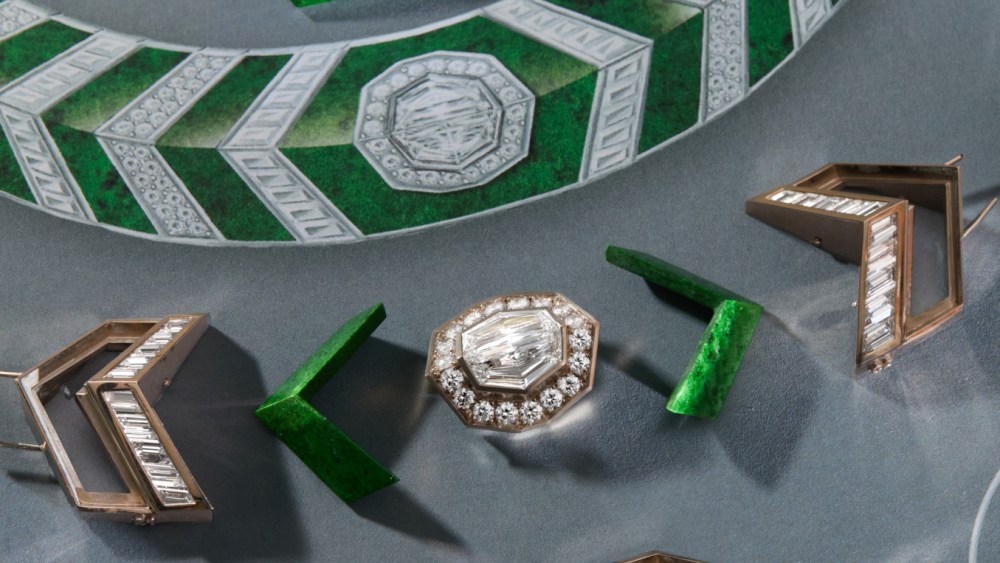
While diamonds account for the lion’s share of the Terres d’Instinct collection, Messika has also used colored stones for the first time.
There are 24 carats of green tsavorites scattered around a 3.12-carat emerald-cut diamond on the yellow gold Terra torque necklace, while the Astra collar evokes night skies with blue sapphires interspersed with diamonds. Spessartite garnets and pink sapphire versions of the drop-shaped Hypnotic line are also on display.
The So Move Rainbow set, unveiled at the Madison Avenue store, will be on the runway on Friday. It features a striking necklace set in a rainbow of 189 sapphires that total more than 35 carats and thousands of diamonds.
High jewelry has grown strongly, and accounts for 15 percent of revenue, up from 5 to 6 percent four years ago, said Sassine.
Another prominent factor in Messika’s growth was a shift in jewelry consumption.
“Today, it feels obvious to say that jewelry is something you can buy for yourself, a way to assert your personality rather than a sign of commitment for a couple,” said Valérie Messika. “We had the right positioning at the right time, with the right product and a new way of speaking about it.”
Past campaigns have featured Kendall Jenner, Kate Moss — who went on to design collections with the jeweler — Gigi Hadid and Natalia Vodianova. Its jewels have been spotted over the years on the likes of Beyoncé Knowles-Carter, Rihanna and Madonna.
The CEO said the company was growing in “90 percent of its markets,” anywhere from 5 to 30 percent. He named Taiwan, Thailand, Singapore and Indonesia among territories where Messika hasn’t yet landed.
“Those are markets to be built,” he continued. “And then there is the U.S., which is beginning to be sizable and must weigh even more in coming years.”
Currently around 15 percent of Messika’s business, the U.S. is fertile terrain that has seen a 30 percent spike this year. The average basket in the U.S. is $5,000 and five-figure sales are “not rare” on its e-commerce, the CEO added.
Sassine remains confident about the U.S., although the brand raised its prices by 7 percent in September due to the 15 percent tariffs that President Donald Trump slapped on European goods.
Sassine added that surging gold prices are a bigger — and global — issue for jewelers like Messika. The brand raised prices by 3 percent in February but the precious metal’s price has risen 25 percent since.
In that, he and Messika are taking the long view. “What’s most important is desirability, which is what makes sales go up or down,” he said. “We are lucky it keeps going up. Now when margins are [squeezed] the challenge is being able to shoulder this for as long as possible until things calm down.”