PARIS — Call them the ultimate status symbol.
A net worth in the 10-figures might set apart today’s wealthiest and most powerful, but for the 0.1 percent of centuries, their flex was measured in hundreds of carats, preferably inherited.
Take Napoleon Bonaparte.
When he wanted to cement his reign within the continuity of the country’s hereditary royal lines, the former Revolution-era general turned statesman commissioned a sword, set with the cushion-cut Regent diamond, a 140.64-carat stone that was part of France’s royal collection and is now on display at the Louvre. He subsequently wore it for his coronation as emperor of France.
Related Articles
It is among some 60 gem-filled objects on display at the Hôtel de la Marine in Paris focusing on the crowning glories of royal, artistocratic or fabuslously wealthy families around the world.
You May Also Like

“Dynastic Jewels,” which runs until April 6, brings together highlights from The Al Thani Collection, the Victoria and Albert Museum in London and a handful of public and private lenders, including jewelers Cartier, Chaumet, Mellerio and Van Cleef & Arpels.
Opening the exhibition are seven displays showcasing loose gems, including two stunning engraved Moghol emeralds, a set of 15 amethysts from the Ural Mountains that were once set on a crown for Bonaparte’s second wife Empress Marie-Louise and the pear-cut Star of Golconda, a 57.31-carat diamond named after the India fort at the center of famed diamond fields in Eastern India.
“Jewelry is an assertion of power, as a sign of prestige and as a reflection of passion,” said Amin Jaffer, director of The Al Thani Collection. “Since the beginning of time, the ownership of the rarest, most precious and, we can say, sometimes the most beautiful materials given by the Earth has been a mark of authority and a mark of power.”
Curated by Emma Edwards, project curator at the Victoria and Albert Museum, the show dives into the gems that were the trappings of European courts.
One gallery is devoted to a dozen tiaras from the 19th and 20th centuries, which highlight the contemporary influences of their times but also speak volumes about the gradual entwining of aristocratic lineages with wealth from industrial business successes.
In the next room, dynastic jewels from the courts of the U.K., France and Imperial Russia are explored.
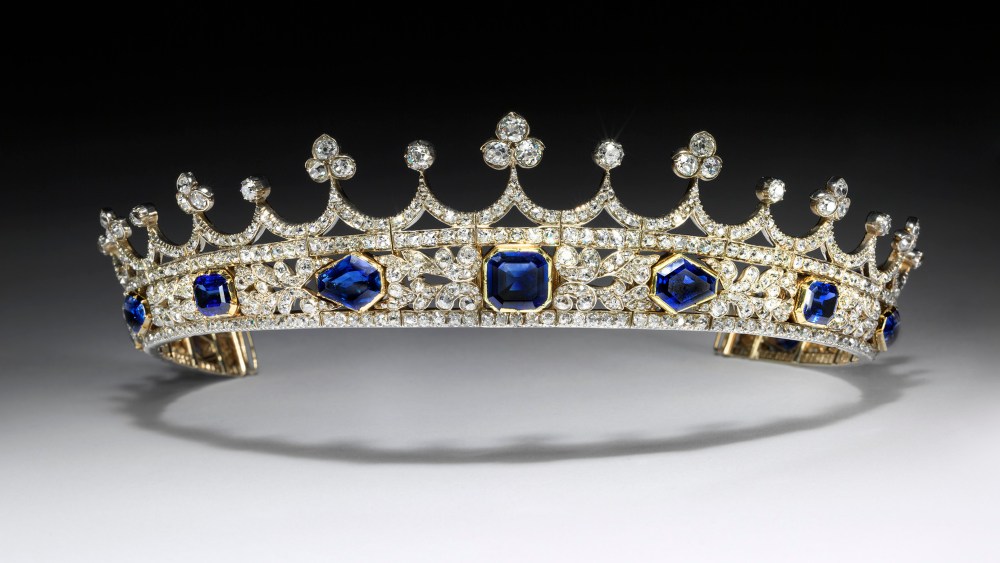
Standouts include the sapphire and diamond coronet and the emerald tiara of Queen Victoria, both designed by her much beloved husband Prince Albert; Napoléon’s sword, now set with other gems; brooches and ornaments meant to be sewn onto the clothes of Russia’s Catherine The Great, and jewels sent by Tsar Alexander I to Frances Vane, Marchioness of Londonderry, during a sentimental affair.
Then comes the final gallery chronicling the upheavals brought by the 20th century, which saw prominent industrialists and glamorous icons become a new aristocracy, while royal houses from around the world also became clients of European jewelers.
On display are the geometric shapes of a pair of bracelets once owned by American tobacco heiress Doris Duke; a Cartier necklace of rubies and diamonds set in platinum commissioned by Maharaja Digvijaysinhji of Nawanagar, and a replica of the crown of Empress Farah Pahlavi of Iran, a Van Cleef & Arpels creation from 1967.
Although originally meant to be displayed at the Hôtel de la Marine, three pieces are now missing following the Oct. 19 heist at the Louvre museum.
Empress Eugénie’s pearl and diamond diadem along with her bow-shaped diamond shoulder brooch, as well as a pair of diamond and pearl earrings that once belonged to Napoléon’s first wife Joséphine de Beauharnais are among nine jewels stolen during the break-in.
According to an Interpol notice, eight remain missing. Authorities put the value of the jewels at 88 million euros, noting the greater loss was to the country’s historical heritage.