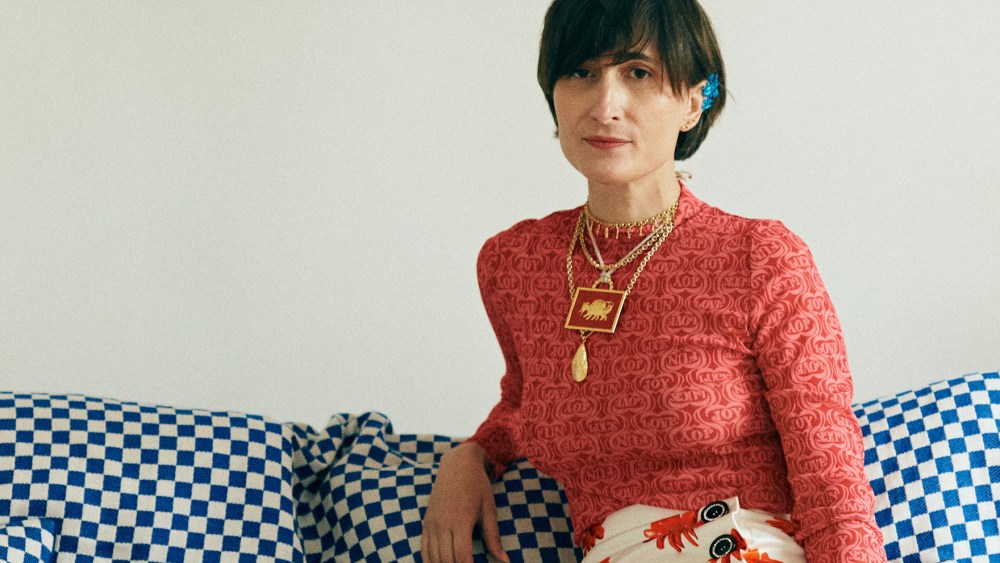
After 15 years in the jewelry field, Paris-based jewelry designer Fanny Boucher thought she was done with it.
In fact, if you’d asked her at the time, she’d have sworn her life would be reading The New Yorker and going to yoga whenever fancy struck her. “I was fed up with bridal [ranges] and gold was so expensive that you couldn’t do fun things,” she recalled.
But jewelry wasn’t done with the former literature and philosophy student who had spent a decade in India working as the ears and eyes of jewelry designers, spending five years as director of creation and stone expert for internet-first jewelry label Gemmyo.
Related Articles
“Most of all, I realized that jewelry is my medium. I tell stories through those materials when others write songs,” she explained, saying that she wanted to return to her roots in storytelling without falling into the trope of inventing a familial connection to jewelry-making.
You May Also Like
Hence the birth of Bangla Begum, Boucher’s “imaginary best friend,” an entirely fictional character whose jewelry box the French designer is creating. The moniker struck her as the right one as it nodded to her formative years in India — and it’s Anish Kapoor-approved, too.
“He probably doesn’t remember our encounter, but I felt I couldn’t change [the name] anymore after that,” she said with a laugh, recounting how she’d explained her new project to the artist when they were introduced by mutual friends.
Launched in 2019, the brand encapsulates Boucher’s “personality with all its weirdness, in jewelry form,” with an offering she described as “nerdy” and connected to the kind of tall tales she feels everyone can connect to.
Case in point: the recently launched “Falaika” earrings featuring a donkey and a conch, inspired by an island in the Persian Gulf renowned for its archeological treasures. They are described as “playful and delightfully weird…meant to shimmer on your ears — and in your mind.”
Costume jewelry that told stories beyond adornment — evocative of historical figures, jokes or memories, said Boucher — were a niche that felt unoccupied and ripe for development.

With precious metal prices climbed to stratospheric heights, Boucher felt a more affordable entry price point would bring a clearer market fit. Prices start under 100 euros for, say, gold-plated stainless-steel earrings finished with a pearl.
But Boucher didn’t plan on making up for accessible entry points through volume, or staying limited there. Prices go up into the four-figure range for a ring engraved with “sexual heraldic” symbols or a chunky pendant that can double as a vase.
And rather than a conventional creative cycle, Boucher decided that only one new design would launch at a time, and that all her pieces would be made in France. For the most part, items are produced to order.
For this year, she’s targeting 1 million euros in sales, a marker that will trigger a host of projects, including an internal production unit.
To that aim, Bangla Begum’s international expansion has always been an integral part and Boucher planned for it by making sure the brand’s Instagram account communicated in English from the get-go, something of a gamble for a French brand.
So was the name, according to Boucher. Initially “a little wobbly” about choosing project “Bangla Begum,” which means “Bengali lady,” lest it be seen as cultural appropriation, she ultimately decided it would be an opportunity to pay homage to a country that saw her grow into her own, personally and professionally.
Boucher’s jewelry story began when she ditched her philosophy studies to travel to India, where she subsequently served as the eyes for jewelry designers who were not based in the country but produced there, a great way to “exercise that muscle.” She followed a first attempt at an “old school” brand with seasonal collections and a wholesale model with gemology lessons. That led her to meet the other Gemmyo cofounders and returning to France for good.
“My brand reflects my life and my bizarre life story has India in it — for a sizable chunk of time. If anything, [Bangla Begum] is an homage to the place where everything started for me,” she said, adding that she hoped that those encountering the name would at least become aware of Indian and Bengali culture.
But she was also adamant that she would not tap into any other aesthetic than her own quirky universe.
Take the Boob ring, priced at 450 euros for the silver version. The tongue-in-cheek take on the signet ring ended up selling some 1,500 pieces. Boucher is planning on following it up with a butt-shaped one, modeled after the rear ends of antique statues, although its moniker is still up in the air.
And it’s starting to pay off. Although 50 percent of the brand’s sales are still done in France, the U.S. is rising fast, recently becoming the brand’s second largest market, taking 15 percent. It’s also where her first commission for a solid-gold version of the Boob ring came from. After that come the U.K. and Canada, which account for 9 and 7 percent, respectively.
Next would be the brand’s first physical store. Currently, the brand can be viewed by appointment at its Parisian showroom, but Boucher wants to use a retail space as an opportunity to further unfurl and build upon the Bangla Begum universe, in addition to having an additional source of sales.
Another major area of development for Boucher is production. Internalization is already underway, with two part-time craftspeople based in Paris, on an overall five-strong headcount. This wasn’t necessarily on the cards this soon after the launch but, according to Boucher, “good workshops get bought up by big groups, small ones are difficult to work with and are unwieldy for an independent label.”