
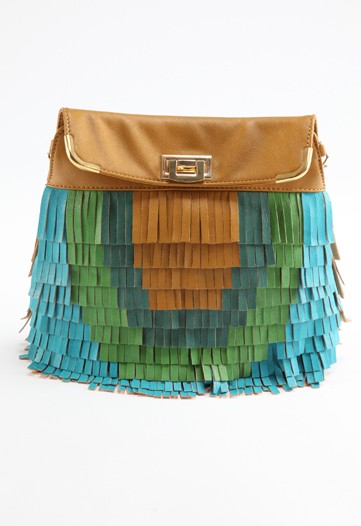
Better. Faster. Cheaper. that’s the mantra of some accessories vendors showing at this edition of WWDMAGIC.
Simply put, many accessories companies are striving to offer more for less to stay alive and potentially thrive amid this challenging economy. For example, Elizabeth Gillett, creative director for the line bearing her name, has amped up production of her scarves and wraps to provide more frequent smaller runs of trend-driven styles to provide newness and allow specialty stores to test drive products.
Meanwhile, Jeremy Bassan, designer of Buddha Bags, has added a logo key fob and id-credit card case to each of his handbags. “We’re trying to give our customers more for the same price,” he said.
Related Articles
And Rafia Cooper, designer of the Los angeles-based jewelry line Rafia, has decreased the amount of jewelry offered at the higher end of her price range and eliminated requirements for boutiques to place minimum orders, making up the difference in reorders.
You May Also Like
Interestingly, some of the changes have helped propel companies, even in this economy. Gillett said the economic downturn led her to rely more on her instincts, take risks and put her product out there in a new way. It’s a process that has reenergized the company.
“I take a more confident position,” said Gillett, who designs scarves that start at $20 wholesale and higher-end wraps wholesaling for $89 to $110. “It feels good to do that.”
Whereas in the past Gillett would wait for orders before producing, she now buys materials in bulk, follows her gut and makes merchandise, and hopes for orders. She may be inspired en route to work, make a sample that day and move forward quickly, updating her Web site weekly. The formula, so far, has worked with the line posting better-than-expected first-quarter numbers.
“Now i have to be more forecast-oriented,” she said. “It’s a little bit more of an aggressive position, but it’s invigorating for the company.”
Cooper, designer of Rafia, found that a less expensive component to her business — handmade initial charms, necklaces and bracelets — has helped to keep her line afloat. The personalized pieces that incorporate crystals, pearls and semiprecious stones start at $2 wholesale for a small initial charm. Bestsellers include a coin pearl bracelet featuring cultured pearls with gold dipped letters spelling out a name or other word on a velvet band.
At the same time, she has scaled back on her more elaborate, higher-priced items (her most expensive piece is $90 hoop earrings adorned with rubies, emerald and other stones) trying to keep most in the $20 to $45 wholesale range.
“If it’s under $100 retail, it sells,” Cooper said, adding that the line’s “Made in America” aspect has resonated with buyers, too.
Cooper also sees positive movement in the hair accessories category. In turn, Rafia is doing well with colorful hair clips with hand-dyed silk, mohair and crocheted elements wholesaling from $3.50 to $11 and headbands running $9 to $14.
“Hair accessories are becoming more and more popular,” she said, adding that she has noticed a recent uptick in business conducted at trade shows and on Main Street. “More people are shopping and I’m seeing more people at the malls.
“I’m starting to see more orders and more reorders,” Cooper said about a possible economic shift. “I think we’re going to climb out of it.”
Jeanne Kirkland, chief executive and designer for Urban Posh, an Austin, Tex.-based jewelry line, said she hopes that’s the case. The economy has forced her to lessen her profit on the front end. “I don’t put a full markup on product,” she said, noting that she is more concerned about the livelihood of her specialty store clients.
Fortunately, the strategy seems to be working. “I’m getting reorders every couple of weeks,” said Kirkland, who counts Neiman Marcus CUSP stores and Shebang in Chicago among her accounts.
At the same time, Big Buddha, a Santa Cruz, Calif.-based line of non-leather handbags, has found a silver lining within the challenging marketplace.
Bassan, the line’s designer, said he has picked up some new accounts, namely some stores that did not want to carry non-leather bags in past years. They are rethinking their position, he said. “It [the economy] has opened some doors for us.”