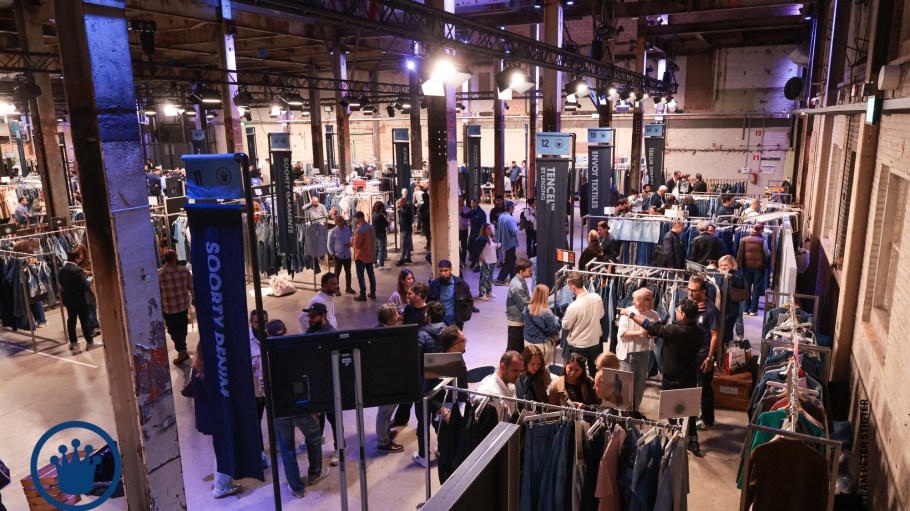
The denim supply chain officially kicked off the Spring/Summer 2027 season last week at Kingpins Amsterdam.
While a note of caution echoed throughout the industry, exhibitors rose to the moment—showcasing innovative solutions that drive sustainability and efficiency, inspiring collections that ignite creativity, and breakthrough ingredients that enhance fabric performance.
Here’s a look at some of the event’s highlights.
Related Stories
Sustainable & Efficient
Mills are rethinking traditional production methods, introducing innovative technologies and materials that reduce water use, minimize chemical waste, and enhance fabric performance.
Calik Denim presented its next step to conserve water. The Turkish mill introduced REVO-SU, a proprietary technology that uses zero water in both dyeing and finishing stages. It also generates no chemical waste during the dyeing process, achieving a 1,400,000 m³ water savings in this phase alone.
The mill also launched Re/Essence, a collection of comfort and rigid ecru and PFD fabrics. The collection combines cotton-linen blends, recycled cotton, Tencel and recycled alternatives for the comfort stretch options. The fabrics’ natural colors help visually tell its sustainable story.
AGI Denim expanded its color range for Chip-Off, a pre-treatment that builds up the surface area around yarns to achieve sharper contrasts between highs and lows in abrasion. The Pakistani mill also floated colorful yarns in wefts, used special spinning techniques to add softness to 14.5 oz. cotton fabrics and showed articles made with The Lycra Company’s Vintage FX, which provides comfort stretch with recovery.
AGI was one of four mills that helped developed fabrics with Lenzing’s Tencel HV100, a new variation of the branded lyocell that addresses some of the challenges of using in denim. Whereas standard Tencel fiber is cut one length, resulting in smooth and shiny fabrics, HV100 is made with various fiber lengths, giving final garments a more irregular and less shiny appearance akin to cotton.
Advance Denim in China, Textil Santanderina in Spain and Orta Anadolu in Turkey were the other mills that helped develop the HV100 fabrics. Since the initial tests earlier this year, Lenzing has expanded its outreach to a total of 17 mills.
Orta debuted a trio of innovations, including Atmos, a plant-based pigment coating that mimics photosynthesis when the fabric is in sunlight. The coating means the garment absorbs CO2 and harmful gasses and converts it into fresh air. The technology is in the early stages—Orta hasn’t tested the fabric yet in laundries but plans to explore the concept further.

The mill also bowed Cool Blue, a family of quick drying fabrics that releases moisture into the air, and a new black that protects the wearer from sunlight and UV rays.
Siddiqsons introduced Cryo Black, a sulfur dye that reduces water consumption by up to 60 percent and is dyed at room temperature. The fabric is compatible with advanced low-impact finishing methods such as ozone and laser, meaning brands can eliminate potassium permanganate from their recipes.
Advance Denim presented Acore, a fabric made with a new way of cotton spinning so it feels lighter and more hallow. A rep noted how the fabrics are a good alternative to Tencel blends, which can be too drapey. The mill also introduced Reflex, a fabric that maintains a rigid look and has just 3 percent growth. The key ingredient is a fiber with a unique filament structure that prevents it from shrinking in the wash.
Tejidos Royo kicked off the season with circularity and performance top of mind. The Spanish mill showed denim made with 100 percent post-industrial cotton waste from its production. Alejandro Ventura Pérez, the mill’s sales manager, said clients are responding positively to the fabric’s authentic look. Though other mills are focusing on regenerative agriculture and other types of natural fibers, he said Royo believes reusing waste is the future of sustainable denim.
The mill also introduced a new tear resistant denim that looks like standard denim.
On Trend
Attendees were buzzing about the opportunities digital printing brings to denim. Lower minimums, speed to market and waterless processes make it an attractive proposal to manufacturers trying to maintain their sustainable goals in an unpredictable market. However, it’s the technology’s ability to unlock creativity and present to customers something brand new to lure them back to stores that is really spiking excitement.
Stella Blu leaned into the intrigue by keeping their digitally printed garments and accessories shrouded in garment bags. A rep for the Prosperity Textiles division said it is the only denim mill with NTX’s CoolTrans Technology, a waterless textile coloration system that can color almost any textile material without heat and up to a 90 percent reduction in water usage. Panels of jeans are printed on both sides and then cut by laser for sewing. Brands can get as creative with it as they want with prints, spanning trompe l’oeil designs to basic blue jeans. Stella Blu is in the process of creating a LCA for the printed fabrics.
Startup Lab Denim showcased its technology to digitally dye denim. The firm’s post-weave colorization system preserves the authentic look, feel, and durability of conventional denim while drastically reducing environmental impact.
Copen United showed a new range of digital print options for pocketing, waistband and linings. Isko Luxury by PG also showed digitally printed flocked fabrics.
Attendees described ArtMill’s digitally printed denim offering as “runway ready.” The design studio emphasized how brands can adapt the technology to fit their price points. For example, big box stores can print poplin on one side, while more premium brands can opt for two-sided prints on 10-11oz. denim to offer a more authentic denim look.
Several mills cited trend forecasts for inspiring their striped collections. Calik’s Worktive collection showed several options with various stripe widths and colorways. Selen Baltaci, Calik’s marketing manager, said stripes are expected to attract attention for the next couple of seasons. AGI Denim showed striped weaves, including a standout black denim with coffee-colored pinstripes. The mill also had a double loom denim, with one side indigo and the other side striped for unique turn-ups. Tat Fung presented seersucker and striped jacquard.
Herringbone constructions are also prominent for S/S ’27, seen in collections by Artistic Milliners and Cone Denim. ArtMill offered herringbone canvas. Similarly, mills see a shift toward fabrics with vertical slubs. AGI Denim said “more expressive” vertical lines are on the upswing. Isko revisited Y2K with Neo Vintage, a fabric range with exaggerated vertical slubs and old-school G-Star Raw character.
Jacquards are continuing to have impact. Twin Dragon said textures and prints were a crowd favorite during the show. Textile designer and jacquard expert Kelly Konings presented “Weave! Crafting the Future of Digital Weaving,” a gallery of jacquard textiles and garments made with local and natural materials such as indigo cotton, seaweed yarns and Gotland wool.
Meanwhile, the latest collection of Isko Luxury by PG fabrics were more subdued compared to previous seasons but no less complex and creative. The six-part capsule spans military-inspired herringbones, various ecru weaves and fabrics made with silk, wool, linen and hemp. Effects like flocking also make an appearance, this time on the inside of garments for softness.
Colors Captivate
Mills are anticipating color to drive trends in S/S ’27.
Isko’s showed Dirty Whites, a line of ecru fabrics that bleach, overdyed and tea-stained to create a “historical look.” Some also have a dry hand, lending itself well to heritage and workwear designs. The mill also showed a range of sun-bleached hues achieved through overdyeing.
Tat Fung’s Planet Indigo collection featured fabrics dyed with natural indigo and persimmon, which the mill sources locally from Chinese farmlands. The mill also showed three vibrant spring colors for yarn dyed denim.
Green has been a trending color for several seasons. Orta is meeting the market’s demand for green with a new forest green shade that is neither too military nor too bright. Bi colors, like green on top of purple, are also new for the season. Blue-blacks and brown-blacks add subtle variations to basic black denim, especially when the fabrics are washed down.
As tinted denim becomes more mainstream, mills are developing ways to make the process more efficient. Arvind presented Eroded, a collection that mimics the effects of overdyeing. The Indian mill achieves the effect through dual dyeing. Meanwhile, AGI Denim and Maritaş introduced fabrics with built-in tints. Rather than overdying black or indigo jeans, these developments automatically revealed tinted colors in the wash.
Arvind showed more vivid colors in Rolling in the Deep, a fabric line of yarn dyed denim.
Comfort Charts
Softness continued to be a strong selling point.
One of Cone Denim’s most popular fabrics was a gauzy double weave. In general, Pierette Scavuzzo, Cone Denim design director, said attendees were interested in airy, big twill denim—or the “denim version of summer non-denim.” Drapey 100 percent Tencel fabrics that pick-up color nicely and authentic-looking fabrics that can flex with looser silhouettes were also in demand.
Cone also approached comfort through performance fibers. The mill used Coolmax and Lycra Adaptiv technology to deliver unrestrictive stretch and heat regulation to both men’s and women’s garments.
Artistic Milliners’ Lounge Edit offers soft and drapey options—some made with Eastman’s Naia, which adds thermal regulation, moisture control and quick dry properties without adding bulk.
Beyond denim, ArtMill is seeing interest in 9 oz. Bedford corduroy.
Other mills are delivering comfort through lightweight, breathable fabrics made with linen.
Linen is proving to be an important ingredient for Maritaş. The Turkish mill showed a series of linen-blended fabrics ranging with 10 to 70 percent linen content.
Advance Denim showed a line of denim made with up to 20 percent linen. The fabrics have broad appeal, though most denim brands are limited the fiber for capsule collections rather than core products.
Linen and linen-like fabrics are appealing to ArtMill’s broad cross-section of clients. To give big box retailers a price-friendly option, the firm presented 100 percent cotton fabrics that mimic linen’s slub pattern. A canvas with linen is also available.
Orta showed black and indigo linen, and options with Tencel and stretch for extra comfort. Sebla Onder, Orta’s marketing and sustainability manager, noted how linen is casting a shadow over hemp, which began seeing momentum about was five or six years ago. However, she added that both use no harmful chemicals or water in the fiber processing, making them attractive alternatives to customers.
Problem-Solving Solutions
Tonello repositioned two of its dye processes as solutions for brands and retailers seeking ways to refresh unsold stock—an issue that Alberto Lucchin, Tonello’s marketing and sustainability manager, said is looming over global denim markets, especially as upcoming EU regulations will prevent companies from disposing goods. Currently, he said most brands rely on laser and ozone to update goods.
With Wake, Tonello’s patented system for natural dyeing, the Italian firm showed a capsule of garments overdyed with seven types of commercially viable natural dyestuff. The technology adds opportunities for brands to tell a sustainable color story and to use locally sourced dye materials.
Tonello used DyeMate—a system that allows garment dyeing with indigo, sulfur and VAT dyes in a single, low-temperature process—to show how the effect alters the appearance of raw denim. The process enriches fabrics with deep hues, transforming indigo garments with dark tones.
Denim Deal, a global initiative targeting one billion pairs of jeans made with at least 20 percent post-consumer recycled cotton by 2030, showed proof-of-concept collections from its hubs in India and the EMEA. Denim Deal contributor Nicolas Prophte said the collections are a blueprint for how the industry can make circularity visible and wearable.
Using fabrics from Sharabati and Kipas, the EMEA collection features 19 garments produced by Ereks and finished with removeable buttons from Dorlet. Additionally, the garments have digital product passports (DDPs) powered by PDNA’s platform. Similarly, the collection from Denim Deal’s India Hub—led by Enviu and GATS—integrates DDPs and Product Environmental Footprints powered by Green Story. The collection features fabrics from Raymond UCO.
Denim Meets AI
Soorty partnered with design consultant Miles Johnson to launch “Heroes of the Past and Future,” a collection of workwear garments inspired by fishers, loggers, miners and cowboys. The collection included reproductions of uniforms worn by each profession and Johnson’s modernized interpretations, enhanced with waterproofing, durability and thermal regulation. An AI element brought the collection to life. Soorty converted the archival photographs that inspired the collection into an album of moving images.
Sake III, an ongoing project that brings an artistic lens to denim finishing, has received an AI-powered upgrade. For this latest edition, artists Sadia Rafique and Matt Duckett transformed Cone Denim’s fabrics into their canvas, using Tonello’s laser technology as their brush. The result: more than 100 unique works of art. One standout piece—a horse—featured an embedded QR code that, when scanned, brought the image to life as a dynamic animation on the viewer’s screen.
Software company Material Exchange shared the next phase of its digital sourcing platform, Frank. With AI, users can use conversational language in the search function and ask broad and super specific questions. Additionally, with AI, Frank can tell the user if a fabric aligns with their EGS goals, suggest alternatives from their network of suppliers and run LCAs on materials. Once prompted, Frank will serve as a liaison between the brand and supplier.
Show Initiatives
“Female authorship” was the focus of “Roots: Women Weave the Future,” a capsule collection by House of Denim’s incubator program and US Denim Mills. Eva Immerzeel and Nikki Kolk—two 20-year-old talents from the incubator program—worked side by side with Maryam Amin, US Denim Mills’ creative head R&D, in Amsterdam to create the collection.
“Collaborating directly with the women at House of Denim felt seamless—we spoke the same design language. Roots gave me the chance to see how our skills and perspectives complement each other, and how denim can connect us and unfold creativity in meaningful ways,” Amin said.
The collection utilized four US Denim Mills’ fabrics made with regenerative cotton, Tencel, linen and hemp as well as selvedge dyed with natural indigo. Fabrics were dyed with the mill’s Eco Zero dying process, a rope-dyeing process that cuts water usage by up to 93 percent, electricity consumption by up to 72 percent, greenhouse gas emissions by 82 percent, and chemical use by 24 percent compared to traditional methods.
Vicunha presented “Ancestral Future,” a collection of garments and accessories designed by Latin American designers. At a time when consumers are seeking authenticity, diversity and new narratives, Vicunha said Latin America stands out as a hub of creativity, color and expression. The collection balanced Latin American heritage and artisanal techniques with the mill’s forward-thinking fabrics.
“Fashion is transformation,” said German Alejandro Silva, Vicunha executive commercial and marketing director. “For Vicunha, denim must drive change in a continuous, plural, and sustainable way. More than just fabrics, we create connections that unite identity, responsibility, and innovation—always seeking to combine the best of the past with new solutions that guide us toward the future.”
Finishing technology company Jeanologia played a large role in the show’s “Made in in España” initiative. The dedicated space showcased the strength and creativity of the Spanish textile industry, featuring suppliers Tejidos Royo, Textil Santanderina, Pinter, Recover and Tintes Egara.
Along with showing Reiconics, the 2023 garment collection of made with Recover’s recycled cotton, Jeanologia presented “Mediterranean Soul,” an homage to the eco system that surrounds the firm’s HQ in Valencia. Through photo-real prints of landscapes, text about the environment and nature-inspired abstract designs on a variety of fabrics, the company showcased the breadth of results a brand can achieve with a single design. Other garments featured modernized pleated details and prints plucked from traditional Spanish costumes.
Ignasi Gil-Vernet, the R&D mechanical manager for Pinter Group, said the spotlight on Spain was an opportunity to connect with the “fashion side” of the industry.
The Barcelona-based company, which produces attachments for spinning mills to create stretch and super-stretch fabrics, typically works directly with mills and factories. However, he noted that engaging in direct conversations with designers provides valuable insight into whether the company’s technological developments align with market needs—such as innovative solutions that enable greater use of recycled content in fabrics.