As Pride Month comes to an end, the age-old question, “Which brands were genuinely supportive of the community, and which were simply capitalizing on it” has resurfaced.
For years, major brands and retailers across the globe—including Target, North Face, Calvin Klein, Converse and Nike, to name a few—have released campaigns and special collections to align with Pride Month to show their support. However, some efforts have fallen flat and been branded as “rainbow washing,” a phrase often used when a company uses rainbow imagery or symbols to appear supportive of the LGBTQIA+ community but doesn’t take any real action to help the community.
Related Stories
By creating capitalistic campaigns with no genuine intent, brands may end up causing more harm to both the community and their own reputation, Meg Ten Eyck, founder of EveryQueer, explained. “Many brands view the LGBTQIA+ community as a lucrative market segment, eager to capitalize on our spending power through targeted campaigns and rainbow-themed merchandise rather than recognizing that we are a marginalized community,” Ten Eyck said. “While visibility is important, superficial gestures can trivialize the ongoing struggles for equality and acceptance faced by the community.”
One retailer that has been painted in a bad light for rolling back Pride campaigns and rainbow-washing is Target. In 2024, the boycotted retailer announced it would only sell Pride-themed apparel for adults and home goods “in select stores, based on historical sales performance.” This was a drastic reversal for the chain, which had typically sold these items in many of its U.S. stores for the past decade.
Adding fuel to the fire, some designers involved in Target’s Pride collection claimed they were not paid for their work or designs. Target did not respond to SJ Denim’s request for comment about these allegations.
“First of all, f*ck Target, Target is on some anti-LGBTQIA+ crap,” art director and illustrator Shanée Benjamin said in a now-deleted Instagram video, about her experiences working on Target’s 2024 Pride campaign.
This controversy follows Target’s 2023 Pride rollout, where the retailer pulled Pride merchandise from some stores after the company and its employees became the target of a “volatile” anti-LGBTQIA+ campaign, which included threats against store workers.
The retail giant also faced backlash this year after announcing the end of certain diversity initiatives, citing the need to “stay in step with the evolving external landscape,” while still claiming its commitment to “inclusion” and “belonging,” according to an internal memo shared by chief community impact and equity officer Kiera Fernandez.
“The main risk of limiting support to Pride Month is fostering a perception of opportunism rather than advocacy,” Keith Fraley, assistant professor of fashion business management at FIT, told SJ Denim. “This can lead to consumer backlash and long-term reputational damage, especially if a brand’s internal policies or external partnerships contradict their Pride messaging.”
Inclusivity across the board
In some cases, it does seem that many brands are “damned if they do, damned if they don’t” when it comes to Pride Month, so how can brands authentically navigate this space without coming off as performative or insincere?
According to Rob Smith, founder and CEO of The Phluid Project—a gender-free brand that specializes in selling clothing, accessories and beauty for the LGBTQIA+ community—it’s all about creating functional clothing that aren’t a want, but a need for the community. For example, The Phluid Project partnered with Spencer’s in 2023 for its first retail partnership focused directly on sexual wellness, with the goal of creating products that help consumers “do what feels good regardless of gender, experience or ability.”
The collaboration featured 12 products, including a compression binder which is used particularly by transgender men and non-binary people. By using a binder, wearers can flatten their chest—creating a more masculine appearance by compressing breast tissue—which helps alleviate gender dysphoria and make them feel more comfortable in their bodies.
“Our mission statement is to challenge boundaries with humanity,” Smith said. “For me, it’s all about going into spaces like Spencer’s and being disruptive in a good way. We never want to take away from the girl who wants to be girly or the boy who wants to wear a dry-fit polo shirt. We’re just trying to create space in the middle where everyone can feel comfortable shopping.”
Brooklyn-based designer Lucas Stowe echoed Smith’s sentiment, adding that true authenticity in business comes from being inclusive in every aspect.
“It’s really tough, because for a giant corporation like Target, they’re going to lose millions of dollars if [a campaign] doesn’t go well. So yeah, you can work with these companies, but you have to understand their goal is to generate profit…that’s always the bottom line,” Stowe said. “I think a good example of that is when I was really pushing for extended sizing [at my day job, Steve Madden]. That conversation led to a broader one about inclusivity in general. They were like, ‘Oh, actually, there are a lot of cis women who have bigger feet now, and people with wider calves—we want to fit more people.’ So just by opening the conversation around sizing, it created space to talk about inclusivity more broadly.”

Stowe practices what he preaches, making inclusivity—particularly in representing the LGBTQIA+ community—a non-negotiable. “If I broaden my spectrum [and cater to straight people] it would probably be better for business,” Stowe said. “But I really want it to stay queer and inclusive. I want to make a difference for the community. That’s always been super…important.”
Brands march on
Despite larger brands getting backlash for surface-level efforts, some brands have made ample effort to be as inclusive as possible, including heritage denim brand Levi’s. Anna Walker, vice president of impact and issues at Levi Strauss and Co., noted that Levi’s support for the LGBTQIA+ community is “deep-rooted and longstanding.”
Levi’s commitment speaks for itself. More than 30 years ago Levi Strauss & Co. became the first Fortune 500 company to extend health benefits to same-sex couples, and in 2007, was the only California business to file an amicus brief with the California Supreme Court in support of same-sex marriage, Walker noted.
Adding to its efforts, Levi Strauss & Co. has donated $100,000 annually to OutRight Action International—a global organization working to advance human rights—as part of its ongoing support for the LGBTQIA+ community.
The company also shut down efforts to dismantle its diversity, equity and inclusion (DEI) program at its annual meeting in April when the National Center for Public Policy Research, a conservative think tank, submitted a proposal calling for LS&Co. to “consider abolishing its DEI program, policies, department and goals.” Less than one percent of the company’s shareholders voted in favor of the proposal.
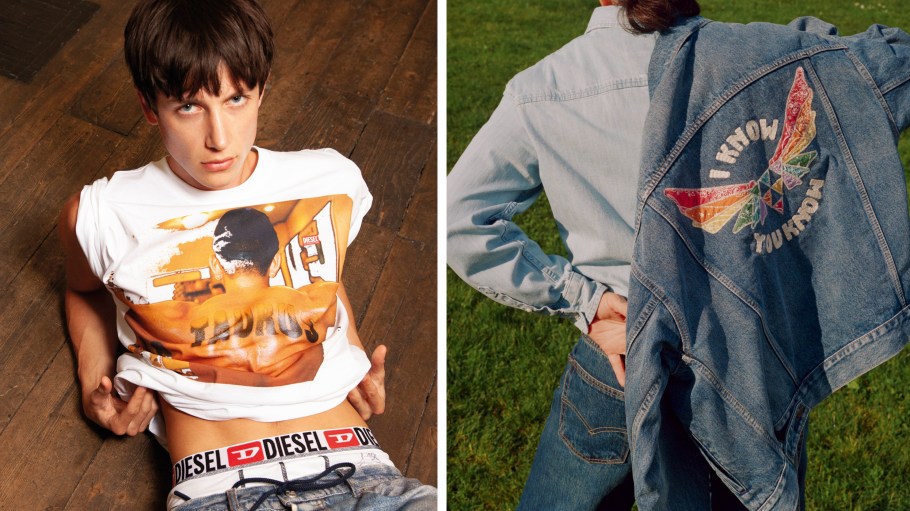
In addition to its financial contributions, Levi’s releases a Pride collection each year. This year’s drop, launched in May, centers on themes of togetherness and the importance of safe spaces for the LGBTQIA+ community. Drawing from queer iconography, the collection featured the Pink Triangle—a symbol of pride, remembrance and resistance—across various garments like T-shirts and denim jackets.
“We’ve had leading workplace policies and programs for decades and have scored a perfect 100 on the Human Rights Campaign Corporate Equality Index for 21 consecutive years. What’s more, the Levi’s brand has celebrated Pride by marketing a specially crafted and curated collection for the last decade, accompanied by annual donations to Outright International,” Walker said. “Through our products, advocacy and care for our employees, we live out our values and hope to influence how people perceive and treat each other. This is a legacy that we’re proud of—a legacy that continues to inform our actions today and that we will carry into the future.”
Diesel is also getting in on the Pride action…minus the rainbow-washing.
In May, the Italian denim brand reunited with Tom of Finland Foundation—a nonprofit organization established to preserve Finnish artist Tom of Finland’s catalog of homoerotic art—for the fourth consecutive year. The 2025 capsule collection focused on the work of Tom of Finland, the pseudonym of Touko Valio Laaksonen, the Finnish master of homoerotic art.
Illustrations of cruising scenes—including sailors, cops, construction workers and leather bars—were applied as prints to a series of T-shirts, underwear, jockstraps and a phone case. Additionally, hoodies, T-shirts, sweatpants, a tank and a shirt and short set featured prints of photographs capturing joyful moments from Tom of Finland Foundation parties and fundraising events between 1990 and 2005.
“Diesel is a very important partner to Tom of Finland Foundation and having the support of Glenn Martens [creative director of Diesel], Renzo Rosso [president of Diesel] and the entire Diesel team means the world to us,” Edward Cella, CEO of the Tom of Finland Foundation, told SJ Denim. “At a time when brands and corporations are stepping back from supporting the LGBTQIA+ community, we are proud to have Diesel by our side.”
Taking its partnership one step further, Diesel hosted “Forty Years of Pride” last fall, a special exhibition at the Diesel Art Gallery in Shibuya, Tokyo. The exhibition was created to examine Tom of Finland’s place in the contemporary art scene and how the homoerotic artist’s message resonates with diverse groups. It also featured the virtual reality work TOM House: The VR Experience, a visual and aural journey that allows visitors to immerse themselves in the Finnish artist’s world.
“Diesel’s motto of ‘For Successful Living’ applies wonderfully to the work of Tom of Finland,” Cella said. “Tom’s happy, proud gay subjects continue to inspire and empower the LGBTQIA+ community. For the last few years now, Diesel continues to support the Foundation in its core mission to protect, preserve and promote queer and erotic art.”
Calvin Klein is another brand showing up as allies. Since 2021, the PVH Group-owned brand has released Pride campaigns aimed at supporting the queer community.
In 2023, Australian singer-songwriter and actor Troye Sivan, Manahou Mackay, New Zealand’s first openly transgender model and Indigenous Australian model Nathan McGuire starred in the brand’s “Feel Pride” campaign, which celebrated the “euphoria at the heart of the LGBTQIA+ community.” Calvin Klein Australia donated a portion of the proceeds of each Pride item sold to BlaQ Aboriginal Corporation.
The brand’s 2024 Pride campaign, titled “This Is Love,” featured Cara Delevingne and Jeremy Pope. The collection included two limited-edition T-shirts created in collaboration with the Transgender Law Center and ILGA World, Calvin Klein’s NGO partners. The New York-based brand also committed $240,000 in 2024 to LGBTQIA+ organizations focused on safety and equity, including ILGA World and the Transgender Law Center.
Continuing its support, Calvin Klein released a limited-edition Pride collection this year, fronted by Golden Globe–nominated actor Cooper Koch. The capsule—featuring T-shirts, tanks, shorts and underwear—draws on a “retro fitness attitude” that the brand says feels both contemporary and relevant. Calvin Klein also confirmed it has made financial contributions to organizations supporting the LGBTQIA+ community this year, though did not disclose the exact amount.
“Fashion brands like Calvin Klein must navigate a delicate balance between demonstrating authentic support and engaging in performative marketing,” Fraley said. “True allyship requires ongoing initiatives that are embedded in company values, such as inclusive hiring practices, meaningful partnerships with LGBTQIA+ organizations and sustained storytelling that uplifts marginalized voices. That’s the way to make [real change].”