
It’s not only the Paris collections that are out to marry fashion and technology. A handful of recent graduates have branched out on their own to do the same thing, while others are partnering with big names in both fashion and technology to bring about a cross-pollination between the often mutually exclusive worlds.
Technology is clearly on fashion designers’ minds at the moment, with futuristic looks all over the Paris runways last week. Hussein Chalayan was one of the few who truly wedded technology and fashion with his collection of mechanically transforming dresses.
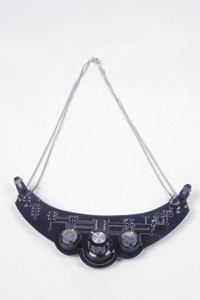
A more recent arrival is Black Box Nation, a partnership of Rhode Island School of Design graduates Diana Eng and Emily Albinski. The goal of the New York-based company is to merge fashion and technology in products and, not incidentally, to make math and science more accessible through fashion and vice versa.
Their wide-ranging designs are inspired by electronics, mathematical concepts and forms found in nature, such as insect wings and flower petals.
Fittingly, the two met in a class intended to teach artists how to use electricity, called “The Artist’s Machine.” Eng studied fashion design, and Albinski majored in industrial design. They formed the company last April. So far, Black Box Nation has consulted for Motorola and is selling a line of jewelry fashioned from electrical components on its Web site.
The company’s work has won prizes and been featured in exhibitions. Last week, Eng, Albinski and friend Audrey Roy won the 24-hour Yahoo Hack Day contest for “Blogging in Motion,” a purse that takes a photo every few steps and automatically posts each photo on a blog and stamps it with the time, date and subject.
Later this month, their creations will be part of an exhibition called “Extra Sensory: Fashion and New Technologies” at the Centre des Artes in Paris. In March, they exhibited more than a dozen outfits in a fashion show at the first Maker Fair in San Mateo, Calif., which attracted thousands to view do-it-yourself tech, craft and art demonstrations. In 2003, a dress they created for a school project appeared on the cover of I.D. magazine.
The Inflatable Dress, as it is called, can light up and change forms. It’s fashioned out of fused plastic tablecloths and a repurposed vacuum cleaner. The wearer can record her lighting and inflation sequences on an included memory chip and repeat them later.
Related Articles
You May Also Like
A line of convertible clothing based on biometric principles came out of a five-week course of study at Bath University with mechanical engineers and biologists. For instance, a jacket that turns into a purse plays with the idea of self-containment. The different ways the excess jacket fabric can be distributed inside the purse is based on insect wings and flower petals, said Eng. A collection of translucent, glowing jewelry can be snapped together in configurations of the wearer’s own design.
“It’s almost like Lego Mindstorms for girls,” said Eng. “They can learn about building working circuits.”
Designers Joshua Hupper and Miyako Nakamura are figuring out how to translate Kent, Ohio-based AlphaMicron Inc.’s expertise in liquid crystals to the fashion world. The company launched its first collection, called Adept by AlphaMicron, in an Eighth Avenue showroom during New York Fashion Week.
The line of sportswear separates, cocktail dresses and swimwear makes use of the ability of liquid crystals to appear to suddenly change color. So, for instance, a tone-on-tone striped swimsuit in pale green suddenly looks blue when its wearer steps outside. “It’s like a horse of a changing color,” said Hupper.
A liquid crystal is a material that is liquid but whose optical properties mimic a solid. So, for example, polymers can be injected with materials that have liquid-crystal properties, and these in turn can be mixed with fibers, fabrics, metals and other materials to create clothes, eyeglasses, sequins and buttons that suddenly change color.
AlphaMicron was founded in 1997 by physicist Bahman Taheri to find other applications for liquid crystals besides the computer and TV screen. Primarily a research organization with government and private contracts, the 30-person firm started shipping its first consumer product last year. The F1 Magic ski goggle, which Hupper and Nakamura did not have a hand in designing, retails for about $200 in ski shops and airline catalogues.
Last year, Taheri hired Hupper, who studied fashion design at Kent State University, and then brought on Nakamura in May. Hupper, 25, interned at Diane von Furstenberg, and Nakamura, 27, has worked at Zac Posen.
Earlier this month, the company received its first order for the Adept line, from Adelaide, a boutique in Tokyo that carries Balenciaga and Rick Owens. The collection is manufactured in New York. Hupper said he could see Adept growing into a larger brand with separates, jeans and sunglasses.
Hupper had no technology background before joining the company and said he spent a year with the firm’s scientists learning about the technology and educating the scientists about fashion. Taheri said he is not a fashion person but believes the eyeglasses could reach a fairly wide audience. “Right now, the goggles are flying off the shelf,” he said. “We don’t have the capacity to keep up with the manufacturing. We’re not making many. We didn’t anticipate the growth.
“I think the potential for growth is enormous,” added Taheri. “The line between physics and art is not as great as everybody makes it out to be.”
The company has the potential to branch out into other types of technology in the future, he said. For instance, it is currently working on a nanotechnology project.
Natalia Allen, 23, formed her design consulting firm after graduating from Parsons in 2004. A surfer from Santa Cruz, Calif., her senior thesis garnered a lot of attention for its networked surfboard, which used the U.S. government’s wireless network at sea to let surfers check out conditions at nearby beaches and signal for help if they went out on their own and got into trouble. She showed it with a collection of travel clothes that could easily go from beach to city.
She’s now consulting for Donna Karan and has an entry in the current exhibition “Black Style Now” at the Museum of the City of New York. Her fused wrap dress was made in a Canadian factory out of Sea Cell jersey fabric, which releases nutrients such as calcium and vitamin E to the skin.
One of her recent projects was to develop a phosphorescent fabric. She also works with business development firm Schlossberg Flynn to advise companies on how to increase their revenues by marrying the appropriate technology to the right design.
Angel Chang, 28, was a design assistant at Donna Karan before stepping out on her own. Inspired by the work of engineers in the U.S. Army and at schools such as the Massachusetts Institute of Technology and New York University, she collaborated with several students on her first collection of 10 pieces, which she showed during New York Fashion Week.
“It was embarrassing to me to be in a design company and not know these scientists,” she said. “Then I realized that no one in our industry did.” There’s a cultural divide, and the two groups don’t understand each other, she said.
Sonali Sridhar and Mouna Andraos, graduates of NYU’s Internet Telecommunications Program, contributed the concept of silk-screen prints with inks that change color or disappear when exposed to sunlight or sudden changes in temperature. The chiffon border of a five-layer cotton circle skirt was printed with a 3-D design in changing ink. An embossed vinyl raincoat lights up with battery-powered light-emitting diodes, or LEDs.
Except for the waterproof raincoat, all the clothes are washable, and Chang kept comfort and practicality in mind. Wholesale prices range from $200 to $2,000. Chang also works as a marketing consultant for W and writes reviews for French Vogue.
“Designers are always using the same materials and fabrics every year,” she said. “Nothing ever changes. I wanted to move fashion forward.”