
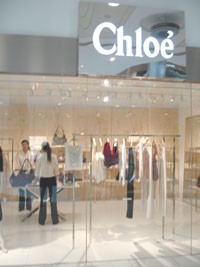
SHANGHAI – “In terms of energy, in Shanghai you feel like you’re in New York or Europe,” remarked Ralph Toledano, chairman and chief executive officer of Chloé International SpA.
Toledano was in China last month for the official launch of the French brand, which in the last six months has opened stores in Beijing and Shanghai. But he has been visiting the country twice annually for the past four years in preparation for the launch.
“In terms of fashion, what’s happening in China is like what happened in Japan 20 years ago, except much faster,” he said. “Two days ago, I was discussing China in Tokyo, and we were saying that Japan 20 years ago was also a men’s market. In terms of brands, the first ones successful here will be the same as with Japan 20 years ago. Japan was also a closed world, and it changed because people started traveling.”
Chloé’s first store in Beijing, located in the basement of China World, opened with a party in September. The Shanghai boutique, in Citic Square, had a soft opening in October. The official launch was delayed until November to avoid conflicts with the fashion weeks in New York and Paris. The launch party and show of Chloé’s spring 2006 collection were held in Shanghai’s Children’s Palace, originally the mansion of tycoon Sir Elly Kadoorie.
Chloé previously was distributed in China in stores like Three on the Bund, Lane Crawford and I.T., although now it will be sold solely through its own boutiques. While it is too early to comment on the performance of the new stores, Toledano said that so far they are “meeting expectations” and revealing some interesting sales patterns.
“There’s a lot of talk about accessories, because it’s no secret that accessories do well in China, but actually our ready-to-wear does best,” he said. “We’re told that China is a men’s market, and then watches, jewelry, accessories, but we’re finding the opposite, that women’s fashion performs well, too, since that’s what we do. Women’s wear worldwide is half rtw and half accessories, but here, for us, it’s 65 percent to 35 percent.”
Now that it has two stores open, the company plans to take a cautious approach to the Chinese market.
Related Articles
You May Also Like
“We’re in the beginning stage,” explained Gary Leung, Chloé’s China manager. The Singapore native has been working with the brand for two years, and previously launched a Spanish label in China. “We’ll take six months to establish the brand, and meanwhile we are looking for more locations. We will build up the business in Beijing and Shanghai, and then branch out slowly.”
Added Toledano, “We’re taking a careful approach to expansion in China. We plan second stores each in Beijing and Shanghai within two years, being careful in terms of location. At the same time, we are looking at Guangzhou and Dalian, but need the right partners and location. China will not impact our sales in the next two years, but rather in the next 10 years.”
The label is starting off with fairly low recognition in the market compared with most luxury brands, but has had a marketing campaign under way since last year, said Toledano. It includes heavy advertising, press and public relations programs, and a Chinese-language Web site. During the launch, the lobby of Citic Square featured an exhibition of vintage Chloé designs and screens showing its catwalk shows from over the years. According to Leung, though, the blank slate has not hurt its reception with the Chinese customer.
“Mainland women are extremely well-educated and trendy. Women come into the stores not knowing the brand, but are still opinionated and know what they want, which is trendy, classy and fitting into the market,” he said.
“The Chloé woman is the same woman worldwide: very feminine, well traveled, central, iconoclastic, adventurous,” said Toledano. “In Japan, she is 20 to 25, worldwide 25 to 40 or 45. China then is much the same as worldwide, but it is too early to say for sure.”
In addition to boutiques in China, Chloé has seen mainland tourists abroad become an important market. Toledano reported that mainland customers now represent 21 percent of the company’s Hong Kong business, up from 10 percent in 2003. At the same time, however, he believes that “Chinese are spending more at home…I guess Chinese women are buying more and more here, because two years ago the choice was so limited, the distribution was small and the service was not like abroad. Training sales people is so essential.”
He cited retail staff training as a market challenge in China, on par with piracy, as customer service remains a foreign concept. The sales ethos in China is usually either surly indifference or aggressive obsequiousness, and local staff often look down on customers from other regions of the country.
Chloé is not yet well known enough in China to suffer widespread piracy, although a few knockoffs can be found on the streets. Toledano described China as a minor part of the global piracy problem.
“Ebay has a huge, huge, huge effect,” he said. “The Internet is a big part of the piracy issue. The products come from China, but the medium is more of a problem than origin, making it so anyone can safely buy fakes. For me, at the moment, it’s the major issue: not the poor people selling them on the street, but the customers buying them on the Internet. It’s scary.”
The China launch is part of Chloé’s measured Asia expansion strategy. It first opened in Hong Kong and Taiwan a decade ago, and opened second stores in both locales in July and October, respectively. A third Taiwan boutique is scheduled for 2006.
In Japan, Chloé opened its first freestanding boutique three years ago, and also has 20 shops in department stores there. Two more freestanding stores will open in Tokyo in 2006 and 2007, and others in Sapporo in 2007 and Kobe in 2008. The company also plans to open five or six point-of-sale counters per year in Japan. It has four shops in Seoul, and is planning freestanding stores in Macao and Bangkok next year, as well as in Singapore in either 2006 or 2007. It will launch in India with a store in Mumbai in February, followed by New Delhi in July.