
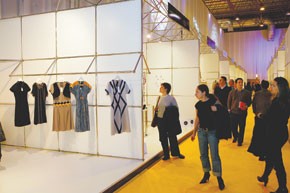
ISTANBUL — There was unity in the Turkish fashion trade fair scene this year after two seasons of almost concurrent fairs held at two venues.
The ninth International Istanbul Fashion Fair was held for the first time in the exhibition halls of organizing group CNR Expo, victors in a long-running battle of venues with the established rival hosts, TUYAP. The move brought Turkish exhibitors under one roof for the first time in a year.
“The days have arrived in which fashion shows and collections will talk and we will keep quiet — days in which we are able to enjoy the fruits of our efforts for the globalization of the Turkish fashion industry,” said a bullish Süleyman Orakçioglu, head of the Istanbul Textile & Apparel Exporters’ union at the opening of IIFF.
The February edition at CNR contained more categories than August’s Istanbul Moda Show, an ambitious but now-defunct fair series instigated by CNR prior to it wresting the ailing IIFF show away from TUYAP. There also were bigger brands than at last year’s Istanbul Fashion Fair at TUYAP. Visitor numbers were at record highs for a Turkish fashion fair at nearly 40,000, including 4,350 international attendees, CNR officials said. Exhibitor numbers also were up by around 20 percent. The show used five halls rather than three-and-a-half in the summer’s Istanbul Moda Show.
At Tita, a Turkish-German youth label launched in 2003, co-founder Peter Balzarek noted some improvement.
“It’s more crowded and more professional. The stands look better,” he said of IIFF, where Tita was exhibiting a summer 2007 range that included printed camisole dresses, long-line tank tops, stone pants and striped micro shorts. “But it still reminds me of what fairs in Europe looked like 20 years ago.”
According to some exhibitors, the sum of the parts did not make for a significantly bigger whole.
“This should have meant an improvement, but we don’t see much,” said Zafer Ekren, Domestic Marketing Manager at Nart Jeans, a Turkish denim and casualwear brand expanding in Ukraine and Russia. He said he had done more business last year when he attended the Istanbul Moda Show.
Gone were top Turkish women’s wear brands such as Ipekyol and Fabrika, which had been featured prominently in the Istanbul Moda Show, an absence that also annoyed CNR insiders. The powerful Orka Group — headed by Orakçioglu, an important player in the split and then reunion of the trade fairs — sent its value-driven men’s wear line D’S, and the new, Gothic Tween Black range, whereas previously it had supplied clout through the internationally active Damat, mainline Tween and ADV brands. The higher-profile labels that did turn up said they did so more as a show of strength rather than in pursuit of business.
Related Articles
You May Also Like
The fair kicked off with a runway show by Portuguese designer Fátima Lopes as part of a collaboration with Portugal and was closed by Turkish designer to the stars Hakan Yildirim, but the emphasis on high-profile names did not always carry through.
What had been a showy designers’ hall at last year’s two Istanbul Moda shows was given over to the Istanbul Boat Show, while the new designer hall lacked fanfare and names such as Hussein Chalayan and Bora Aksu, both featured last year.
Also absent was much talk of the Istanbul trade fair as a show to sell Turkish brands to European and American retailers. Turkish brands and organizers seem to have decided the immediate region, which comprises the former Soviet Union, the Balkans and the Middle East, is the better target for them since the West is so overcrowded and emerging markets are increasingly courted by the retail sector the world over.
IIFF did boast Koton, the trend-led chain often compared with Zara. Expanding domestically — sales growth was nearly 40 percent last year and the aim this year is the same again — and going through a renewal process, Koton was at the fair to raise the profile of its plans, said Murat Yanbay, its domestic sales manager.
“For the past year, our strategy has been to sell very cheap and very fashionable products in extremely luxurious and stylish environments,” said Yanbay. “We want to give this message to old friends.”
He admitted, however, that Koton already had a good network of domestic and international contacts through which to reach new buyers and did not make a policy of appearing at trade shows. Newly signed up to the Turquality project, a system aimed at improving the Made in Turkey name through a state seal of approval and incentives for successful and quality brands, Koton’s presence also could be seen as a show of support for the trade ministry, which backed the show.
Limon Co., an established Turkish smart casual label being relaunched since its relatively recent purchase by the Boyner Group, was also at the fair with its nautical-themed stand and collection. But group manager Erdem Can Tinarlioglu said the main purpose of its presence was to “share our collection” rather than take orders.
Koton’s Yarbay said the buzz at the show was the kind of fast-fashion espoused by Koton, and a market Turkish fashion executives have been encouraged to enter.
“Even the retailers from the farthest reaches of Anatolia are talking about it — using the English word,” he said. “There is a much better grasp of trends throughout Turkey, including in the men’s wear sector….I think this is a sign that we are doing the right thing in the face of problems such as China.”
Turkey has been struggling to move upmarket in the face of the Chinese threat. Figures released by IHKIB show that ready-to-wear and apparel exports have been holding up, increasing 2.1 percent to $13.9 billion in 2006 despite a predicted decline, but the figures are nowhere near the double-digit increases of recent years. Turkey’s branding efforts have been patchy, but the fast-fashion youthwear and denim-led casualwear sectors seem to be areas where inroads have been made. It is in this area that Turkey can make the most use of its key advantage over its Asian rivals — its proximity to Europe — allowing for smaller orders with shorter lead times.
Tita, Nart Jeans and names such as young denim label Keep Out and the prominently featured trendy men’s brand Avva are examples of this push toward fast and trendy fashion. S.N. Mirbagheri, who helped launch the Tween Black range, said Orka Group was poised to move into women’s wear for the first time with a line for Tween, which will be trend-led youth fashion.
Turkey’s branding spree also is throwing up some quirky lines. At the fair was a small stand for Helinist, a line of sequined T-shirts and party dresses by Helin Avsar, the wild child sister of famed Turkish actress-singer-TV personality Hülya Avsar, whose own relaunched basics collection was also on display.
But some of the biggest excitement at the show was in the underwear section, which got its own exhibition space at CNR.
“The reunification has been really good for us, we have had a lot of interest,” said Ferah Bildik, who runs the 40-year-old company Cicikom with her husband. Cicikom’s jersey pink nightdresses, leggings and comfortable cotton underwear were very popular with Syrian buyers, she observed.