
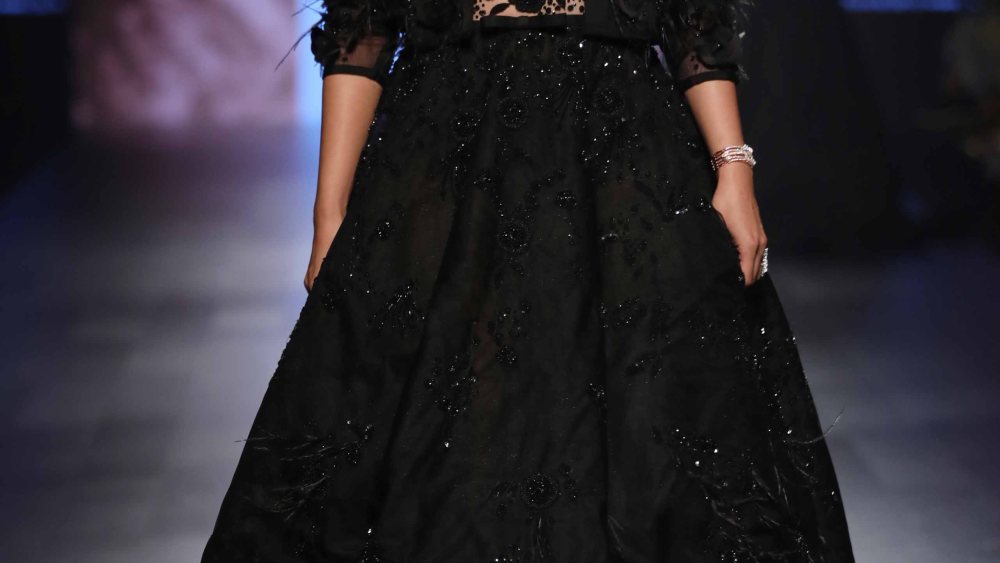
MUMBAI — Fashion weeks in India have been trying different things over the last few years, experimenting with location, physical spaces and timelines.
This season it was the turn of Lakme Fashion Week resort, which ran from Feb. 1 to 5, to try something new as it opened at Jio Garden in Bandra Kurla in Mumbai. This was a first for a more open venue spread across a larger space, with the exhibition area adjoining the main runway area.
At the previous location at the St. Regis Hotel, the main stage and exhibition areas were on different levels. Prior to that, at the Grand Hyatt, a considerable walk separated the different areas.
The new format this year provided the opportunity for more exhibitions, with 95 booths, up almost 30 percent from the previous 70.
Related Articles
In the large central square was a stage for live music, and a yellow Lamborghini which quickly became a landmark for those seeking to find each other and for celebrities to pose against.
You May Also Like
“The move to Jio Garden reaffirms our commitment to the business of fashion with a larger area for buyers and designers to meet. Everything this season has been bigger and further pushed the boundaries of what a fashion event can achieve,” Jaspreet Chandok, head of fashion at IMG Reliance Ltd., said.
IMG Reliance is a joint venture between Indian conglomerate Reliance Ltd. and IMG Worldwide, a global leaders in sports, events, media, and fashion.
An even bigger change this season was the switch in the timing of the shows to the first week in February from later in March.
“We decided to focus on current season long before it came into style,” Purnima Lamba, head of innovations at Lakme, said. “Moving the dates up to early February was planned to help designers streamline and plan for the current season instead of being able to get into stores just as the slump sets in with the monsoon and for better planning for the current season.”
Although fashion week has become a key hunting ground for domestic buyers and retailers from across the country, plans to draw in more international buyers continue to evolve, she admitted. The new dates would help give overseas buyers an early start, although they bump up against the start of New York Fashion Week and come right after Paris couture.
“The whole schedule has gone crazy because of the changing world and because we have to show current season because it’s all out there long before we can get it to our stores,” said designer Tarun Tahiliani, whose show was one of the top draws at the event.
“I must say it is a strategy that is working well for us,” he added. “We are seeing a jump in our store sales — we are attributing a part of this to the freshness, people feel that they are getting something that has not been copied yet and in a world of instant gratification, it’s all more spontaneous.”
His collection embodied the spirit of the event — more ready-to-wear and separates but with his characteristic draping.
The shows also aimed at more inclusiveness both in terms of the styles shown and in the models used on the runway. A transgender model, Anjali Lama, from Nepal was included in the model list, as was Petr Nitka, a gender neutral model from the Czech Republic, who wore both men and women’s wear.
Another show, labelled the #TagFree show, was curated by designer Kshitij Kankaria, showing designers such as Dhruv Kapoor, Sanchita Ajjampur and last year’s International Woolmark menswear winner Suket Dhir. The intention was to showcase fashion through women drawn from all walks of life, rather than just models.
A special showing by non-profit organization Kranti left observers filled with compassion and yet puzzled over a street style drama/fashion show by the daughters of sex workers in Mumbai’s red light areas. Designer Mandeep Nagi of Shades of India, known for her simplicity of design and unique work with textiles, put together the clothes for the presentation.
“Fashion is no longer restricted to the rich,” said Nagi, explaining that economics did not exempt any class or level of society from caring about how they dressed. “I make clothes that give personality and confidence to women. My idea was not really to show the clothes designed for spring/ summer but rather to project a woman to embody and project her strength. I use my design for empowerment.’
While several observers pointed out that tying the theme of the show with fashion seemed a bit stretched, Robin Chaurasia, director of Kranti, said, “Fashion is about different classes. Our kids are not any less knowledgeable about any of this stuff, and this can reach people at different levels.”
She added that there was “so much inclusivity about this fashion show, transgender models and stuff like that so that they acknowledge things like this is beautiful.”
The fashion week, now in it’s 18th year in Mumbai was inclusive in other ways too, drawing in more designers from other cities. These included Falguni and Shayne Peacock, who will show at New York Fashion Week; Narendra Kumar; Aneeth Arora; a combined men’s show by Rajest Pratap Singh; Abraham & Thakore, and Pero, among others.
There was experimentation on other levels — with layering being taken to new extremes, with ruffles and trims, and digital prints, long length cotton jackets and anti-fit themes. There was also a focus on more technical skills and finishing for garments that could serve multiple functions, such as Fahd Khatri’s cotton, zippered creations where a single piece could turn effortlessly from skirt to shirt to neck drapes.
Showing as the grand finale for the first time was designer Anita Dongre, which was held at the heritage site Bandra fort, with fairy tale lighting wrapped around coconut trees and arched, lit paths. Keeping with her promise of “fluid and flattering silhouettes,” Dongre’s designs used gold needlework and unbleached and undyed woven cotton silk. Brought to an end with actress Kareena Kapoor, who is also brand ambassador for Lakme Absolute, the finale displayed 60 outfits, with creations for not only the red carpet but also for weddings.
That this was Kapoor’s return to the runway after giving birth 45 days before had audiences interested in the concept of female power. “I always do what I want, and working is an important part of this,” Kapoor said after the show. She also walked for designer Sabyasachi Mukherjee for the finale for Lakme Fashion Week Winter/Festive last year, months before the baby was due.