
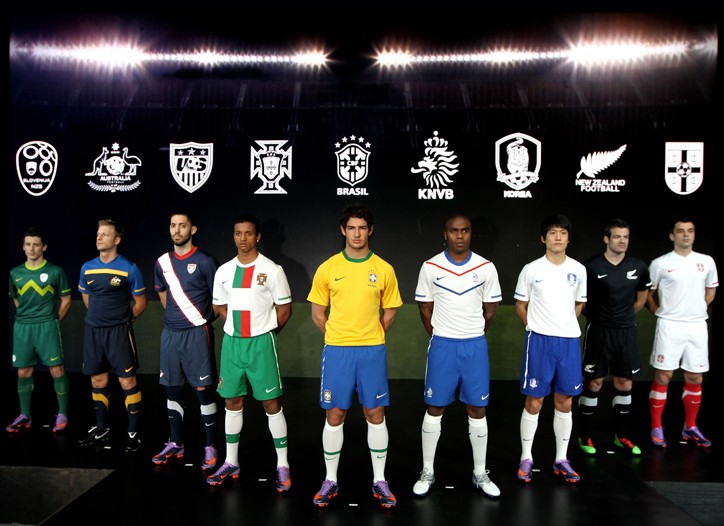
Nike is kick-starting its global soccer marketing for the FIFA World Cup.
The athleticwear giant has unveiled a lineup of products that it will push through social media and underground blogs in preparation for soccer’s greatest spectacle. New items include jerseys made of 100 percent recycled polyester and footwear.
Nike, which has developed software that works in conjunction with social media, has taken a functional and subtle approach to social networks as a marketing tool in the run-up to the monthlong event that starts June 11 in South Africa.
“We will absolutely use social networks, but we do it in the context of how it connects with the consumer and what role it can play in allowing them to interact with us and share their story, as opposed to it being a broadcast for us,” said Trevor Edwards, vice president of brand and category management for Nike Inc.
Related Articles
Users can upload their progress, compare it with their idols’ performance and share it with their friends. Parker said the product “connects the digital and physical worlds of football. These are among Nike’s most advanced products to date.”
You May Also Like
World Cup teams wearing the recycled jerseys will be Brazil, the Netherlands, Portugal, South Korea, Australia, New Zealand, Serbia, Slovenia and the U.S. An average of eight plastic bottles has been used to create each of the jerseys, said Kate Meyers, communications manager of Nike’s sustainability and innovation group. Yarn created in Taiwan from the recycled plastic was subsequently spun into fabric in Indonesia to create the collection of athletic shirts.
“This is an effort to offset declining natural resources, climate change and water scarcity” via recycling and shrinking Nike’s carbon imprint, Meyers said of the plan to make almost all Nike apparel from reclaimed materials in three years.
Outreach to consumers about Nike’s apparel fashioned of recycled materials will focus on store events, among other public relations; Nike’s Web site, and product labeling. The company’s Considered Design label will be used for now on the World Cup jerseys as well as on recycled polyester items such as performance jackets, introduced on a smaller scale during the past 18 months. But the products may take on a new name as the effort to make apparel entirely from recycled materials ramps up, Meyers said.
Nike also aims to launch six updated national N98 track jackets — first introduced in 1998 — for countries, including England, Brazil, the U.S., France, the Netherlands and South Africa, by collaborating with an artist from each of the nations.
For example, British graphic artist James Jarvis has designed a cartoon lion for the left breast of the red English track jacket, while Los Angeles-based street artist Mister Cartoon was inspired by prison tattoos for his black-and-white drawings for the U.S. top, which both retail for $100.
“We’ll be doing a lot of work with underground blogs because we’ll obviously have more limited runs of those products, and we’ll bring them to life at retail,” Edwards said of the marketing strategy to promote the collection, which is intended to bridge the worlds of sport and culture. “More key retailers will carry that kind of product.”
Along with the strategies for Nike’s new products, U.S. director of media relations Derek Kent said: “We will have a fully integrated communications campaign that leverages our athletes, teams, television, out-of-house advertising, social media and retail.”
There will be other social networking content available to access without purchasing the Mercurial Vapor SuperFly II. Edwards said the campaign would focus on the journey of a young player.