
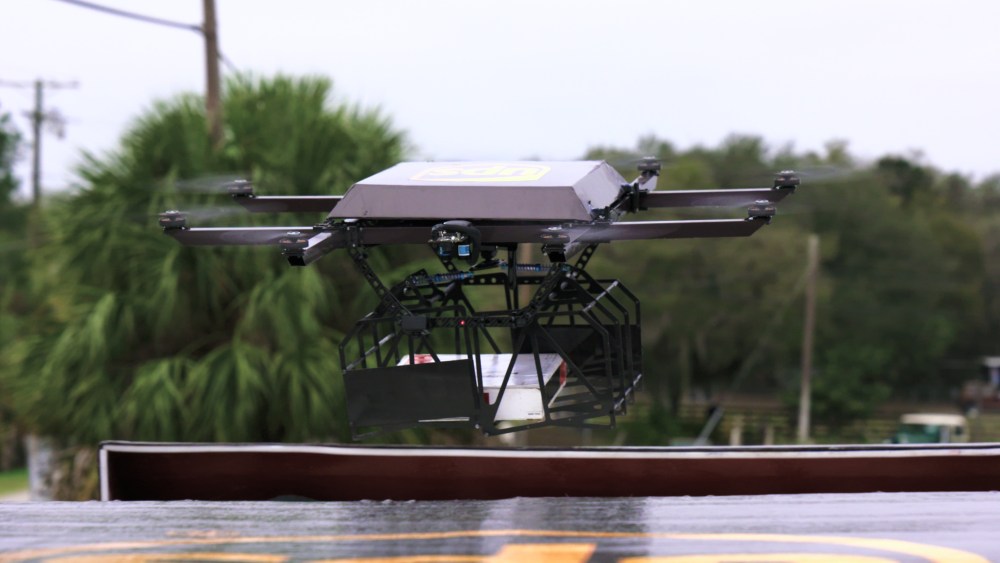
United Parcel Service’s test of a drone system last week marked the latest drive toward more automated — and efficient — deliveries to consumers. With e-commerce sales pegged to grow about 10 percent a year over the next two years, the move toward autonomous deliveries also includes efforts by UPS rival Federal Express, Amazon Inc. and Google (under Alphabet’s Project Wing program) as well as 7-11.
But further testing is needed, and federal regulations must be implemented before shoppers can expect to receive automated deliveries of the latest looks from Zara dropped off at their doorstep. But the efforts are significant as automation can save carriers billions of dollars each year on a global level.
Related Articles
In January, Amazon successfully tested a drone system as part of its Prime Air program, while FedEx said earlier this month that it was investing in AI (artificial intelligence) and robotics as it pursues autonomous trucks for deliveries. While most of the systems are well suited for sparsely populated rural areas, drone makers — and Amazon — are working out the kinks for suburban deliveries, which includes dodging power lines and navigating tightly clustered houses.
You May Also Like
The UPS test was with a drone that launches from a truck and “autonomously delivered” a package to a home before returning to the vehicle (while the truck continued en route to other delivery locations). UPS partnered with the Workhorse Group, which is an Ohio-based electric truck and drone developer. The company said a reduction of just one mile per driver a day over a one-year period can save the company up to $50 million.
Mark Wallace, UPS senior vice president of global engineering and sustainability, said the program would be ideal for “rural locations where our package cars often have to travel miles to make a single delivery.”
A UPS spokesman told WWD the program is still in the testing phase. “We will be testing a variety of delivery scenarios to build our knowledge about UAV [unmanned aerial vehicle] use for commercial delivery,” UPS said. “Our initial tests focused on deliveries to hard-to-reach areas. In fact, we are now using drones to delivery blood to clinics throughout Rwanda — drones are literally saving lives there. Now we are exploring how we can use drones in our day-to-day operations, and we are testing first in rural areas.”
The company said dense urban geographies “create challenges that may make drones less attractive (buildings impediments, lack of adequate landing locations, etc.). So, we’re looking more closely at rural areas first. In fact, rural areas are where we think we may have the most operational need for drones. These are places where UPS drivers have the longest routes and the lowest ‘stop density,’ as opposed to urban areas where we have higher stop density.”
Noteworthy is drone testing by convenience store chain 7-11, which said it made 77 drone deliveries in 2016 in Reno, Nev. — which is a more densely populated area than where other tests have been conducted. UPS, FedEx and Amazon all noted that implementing commercial UAV regulations is complex, and the UPS spokesman said there’s no timeline for regulations to be passed and implemented.
Yariv Bash, founder and chief executive officer of Flytrex, a drone delivery logistics company, said despite the “flashy test flights we see in the media, a lot of drone companies still have a lot of operational fine-tuning to do.”
“Anyone paying close attention to the market can see that the technology is developing by leaps and bounds, but there’s a big difference between a onetime media stunt, and a fully operational drone logistics system,” Bash noted.
For his part, Bash disagrees that urban deliveries are not suitable for drone deliveries. He said while urban areas are “congested with traditional road vehicles, making on-demand road delivery extremely inefficient,” his firm’s drone management system “has all buildings and city structures pre-programmed into our cloud base system, so autonomous drones will be able to soar through city skies in a manner far safer than on the roads below and fulfill orders just as easily as in rural areas — if not faster, given that the distances might even be shorter in urban areas.”
Of course, door-to-door drop-offs in apartment buildings would be impossible. Or would it? Bash suggested rooftop deliveries as one option. Others have suggested creating solutions that include dropping off deliveries directly to a consumer regardless of location using the IP address of their phone.
“But the biggest challenge to bringing drone delivery to urban areas is the regulatory one,” Bash said. “There are a lot of leaps and hurdles that we need to cross before drones will be delivering packages to Manhattan skyscrapers; however, I believe that this is just a matter of persistence, and time. The market need is stronger than ever and will only grow.”
Either way, the focus on the so-called “last mile” of fulfillment to the consumer is critical to the demands of shoppers. “The key for retailers and fashion brands is that it’s all about the customer experience from pre-purchase through delivery and returns,” the UPS spokesman said. “Drones are one example of several things that UPS is doing to provide an enhanced e-commerce delivery experience for retailers and consumers alike.”
Those offerings include products such as UPS Access Point locations for deliveries to a local retailer or a secure locker, or to a UPS Store location. And the company stressed that it doesn’t expect drone or robots to remove the human element of the company.
UPS said while drones may someday help it to reduce miles driven and gain operating efficiencies, “retailers and fashion brands can rest assured that UPS drivers will always remain the face of the company. Our drivers are an important connection between your products, UPS’ services, and our shared customers.”