
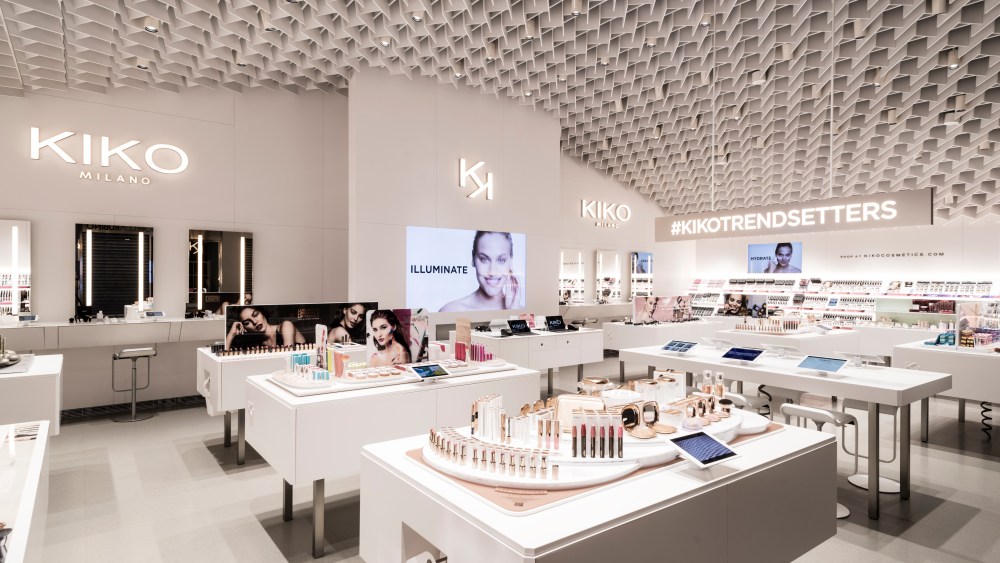
BERGAMO, Italy — Italian beauty powerhouse Kiko Milano unveiled a new store concept designed by Japanese architect Kengo Kuma that is aimed at attracting a more digital consumer.
Jan Heere, general manager of Kiko’s cosmetics division, said he hopes “to really push digitalization, to really connect the consumer as part of our community.”
Located on the first floor of the expansive Oriocenter shopping mall here, a half-hour’s drive from Milan, the store covers 1,615 square feet and has a minimalist interior, with white, open spaces.
Heere observed that Kiko founder Stefano Percassi assigned a Japanese name to the brand 20 years ago. “Now this doesn’t relate directly to Kengo Kuma, but it was kind of a sign,” he noted. More seriously, Heere emphasized Kiko’s aim for newness, which he links to Kuma. “In that search of always innovating, Kengo Kuma is an iconic architect, somebody that has done things on an international level, so it made a lot of sense to try this collaboration,” he explained.
Related Articles
“I know the Percassi family very well. Stefano came to me to show his ideas and I liked the philosophy of his shops, his ideas are very new,” said Kuma referring to the free-zone concept promoted by the entrepreneur to avoid any hierarchy between shop assistants and customers. “Customers can participate and be the protagonists of the space, and architecturally this is very new,” explained Kuma.
You May Also Like
Participation and interaction influence other key elements in the store, such as the cash desk and, for the first time, a social zone is introduced in a Kiko shop through a table displaying several iPads connected to an application that offers suggestions on different types of make-up looks. Heere said this helped understand customers’ preferences. Customers become “the top of the pyramid of our organization chart,” and “drive the direction of the company,” he added. Kuma observed that “the shop is not [only] a place to buy a product, but a space of communication and entertainment. And Kiko will be the good example of that kind of new shop design.”
Heere said Kuma highlighted the brand’s makeup colors, creating a contrast with the all-white space, which he defined as “very Zen, modern and sophisticated.”
“The design is so sober, while the colors are so vibrant. And in a way, what Kuma has done is to let the colors speak for themselves. He put the product at the center of the store,” Heere continued.
The ceiling is a standout element with a crisscross structure of laminated boards. “It’s inspired by some churches and cathedrals. We tried to combine Zen feelings and this church inspiration: It’s a new kind of collaboration between Italy and Japan,” Kuma said.
Asked for the reason to open at the Oriocenter mall, Heere said it was “quite obvious. It’s where it all started and where Percassi comes from,” referring to the businessman’s hometown. “It made sense to start here, at home. This is the pilot story. It’s an exercise and that’s what we wanted.”
Kiko is in an expansion phase. With 200 openings planned for 2016, the door count is expected to increase to about 1,000 by the end of the year. Turkey is the latest addition, but Heere revealed upcoming launches also in São Paulo, Dubai, New Delhi and Moscow. In Russia, the group will count more than 10 stores before the end of 2016. Kiko will also open stores in New York this year and in Hong Kong next year. The company has been expanding in Italy, France, Spain, the U.K. and Germany. The brand is also available at its online store.
In 2015, Kiko reported sales of 500 million euros, or $568 million at current exchange, up 17 percent compared with 2014. “This year, with the accelerated expansion, I expect to deliver a consistent growth,” Heere said. “We are seeing a double-digit growth of the business in the next three years.”
Heere was upbeat about the potential of the brand, and underscored the company’s plan to grow without outside investors. “I joined the Percassi team because Kiko is really the brand that everybody’s looking at in the cosmetics world and I think it’s fair that everybody’s looking at it. I personally believe it’s one of the next big things in retail, on a global level,” he said. “We have no ‘for sale’ tag. Our focus today is to be a leading cosmetics brand worldwide, and we don’t want to slow down.”
In addition to Kiko Milano, the commercial and real estate giant Percassi group owns the Madina, Womo and Bullfrog brands. The group is planning international rollout strategies for those brands, too.