
Cushman & Wakefield has released “The Cool Streets of North America,” in which it warns retailers to ignore hipster neighborhoods at their own peril.
“If retailers live and die by cool, the same also holds true of retail properties, shopping centers and entire neighborhoods,” says the report. Other factors may come into play, “but the reality is that cool matters. In an age of frugal consumers, e-commerce encroachment and vast gaps in performance between trophy malls and Class B and C centers, cool matters now more than ever.”
“This is the first time we decided to focus on this segment of the market,” said Garrick Brown, vice president of retail research for the Americas at Cushman & Wakefield. “Every major city has always had its artistic and creative neighborhoods. We see something different going on. We’re seeing arts neighborhoods becoming flourishing grounds for retailers and almost incubating retailers.”
Related Articles
Brown said that a new breed of retailers is connecting with elusive Millennial customers, something that’s not happening in malls, urban high-street markets such as Fifth Avenue or Rodeo Drive or Main Streets.
You May Also Like
At the heart of the cool-street trend is the fact that Millennials consistently display a preference for urban living. In an Urban Land Institute study, about 46 percent of the cohort chose an urban setting, compared with 24 percent for suburban and 30 percent for rural environments.
C&W surveyed 100 areas across North America and came up with the top 15 cool streets.
Williamsburg, Brooklyn, once the ultimate cool area, is now in limbo. The neighborhood began to take shape in the late Nineties, when artists, musicians and the LGBT community found affordable rents in Williamsburg’s edgy environs. New restaurants, bars, art galleries and boutiques opened. Rents then began their upward trajectory. National chains moved in and independent retailers were priced out.
Contrary to other opinions, Gene Spiegelman, vice chairman of Cushman & Wakefield, said that Williamsburg is “far from over. Although it may be quite pricy, Williamsburg is a cool street. Has it gone mainstream? Absolutely.
“It’s in that part of its cycle now,” he added. “Retail rents are $200 per square foot to $300 per square foot. Some of the cool factor has moved on, and national chains moved in. There’s going to be a shakeout there to see what really works.”
In general, asking rents in emerging retail districts are one-tenth to one-third less than rents in prime locations, according to Brown.
In the report, each neighborhood is assigned a level on a Hip-O-Meter, which indicates where it is in its development. Sunset Park, Brooklyn, for example, is labeled “edgy cool” and “in its infancy.” A largely industrial neighborhood since the early 1900s, Sunset Park was in decline until the opening, several years ago, of Bush Terminal Park and the rehabilitation projects along the waterfront — most notably, Industry City.
While names such as Bed Bath & Beyond and Saks Off Fifth aren’t usually associated with cool streets, C&W notes that Industry City’s office space has been leased to tenants such as West Elm, the Brooklyn Nets and BaubleBar. “Independents, start-ups and mom-and-pops have been actively looking,” said Spiegelman. “Asking rents range from $75 to $175 per square foot.”
The fortunes of Logan Square in Chicago (prime hipness on the Hip-O-Meter) have long been tied to its better-known neighbor, Wicker Park. As the latter’s rents priced out the arts community, creative types moved to Logan Square. The neighborhood’s momentum is now driven by a thriving dining and bar scene.
The revitalization of Over-the-Rhine, in downtown Cincinnati (“up-and-coming” and “the next big thing”), began in 2003, when $330 million in public and private resources were invested to spur economic development of distressed properties. The result has been the opening of more than 130 new businesses.
Shaw, in Washington, D.C. (“prime hipness”), has been undergoing a revival on several fronts. New apartment and condo complexes, vibrant nightlife and a retail revival with brands such as Warby Parker and Kit and Ace are contributing to the asking retail rents of $50 to $70 per square foot — and rising.
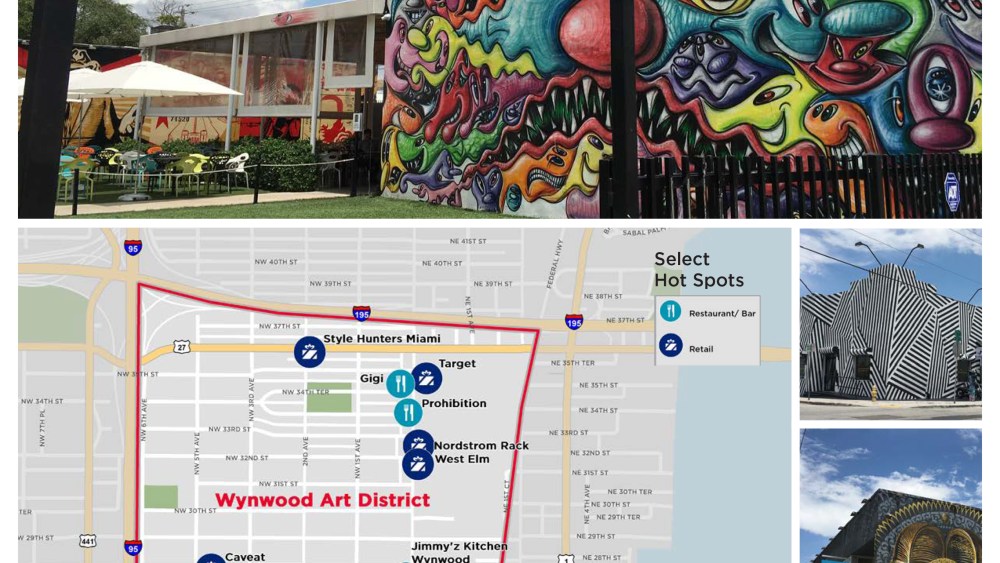
Other cool streets, according to Cushman & Wakefield, included Silver Lake in Los Angeles, Wynwood in Miami, North Loop in Minneapolis, Roosevelt Row in Phoenix, Carytown in Richmond, Va., East Village in San Diego, Jackson Square in San Francisco, Delmar Loop in St. Louis, West Queen West in Toronto and Mount Pleasant/Main in Vancouver.
“Eventually many neighborhoods will start to go toward mainstream appeal,” Brown said. “I don’t think all of them will become mainstream neighborhoods. Some of these markets will never have enough density, but they all can represent laboratories.”