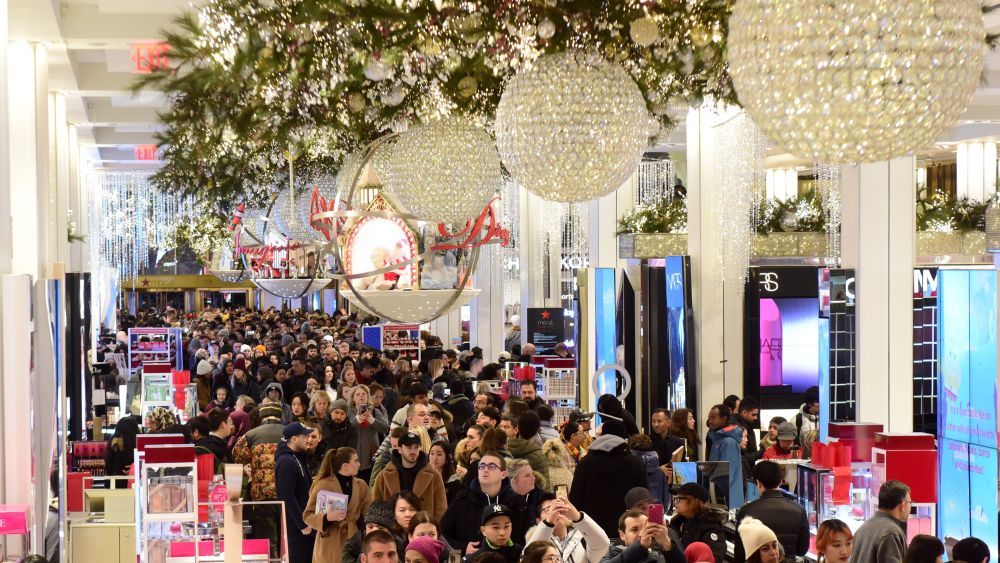

At the opening of the Herald Square flagship at 5 p.m. Thursday, there was the usual massive stream of shoppers seeking doorbusters and deals. “There was 20 minutes of just continuous customers coming in all the entrances.,” said Gennette, who was on the scene. “There will be thousands more throughout the night. It’s a big night for us.” The most popular categories were coats, cashmere, candy and fragrances.
“I don’t see any dearth of people out there,” said Charlie O’Shea, Moody’s vice president and senior credit officer on Friday afternoon. “Best Buy, Walmart and Target were packed Thursday night, and Target and Walmart were both packed this morning. It’s been steady. Consumer electronics is really the key for the holiday. It’s the category that really pops. The big players will really do well. Besides the stuff they sell very cheap, they’re selling some better margin products.” Overall, “I don’t see any negative surprises. There were some website outages, but that’s kind of good thing to happen,” since it’s related to heavy online traffic causing the crash. “Nobody can predict volume for sure.”
“Based on our checks this morning, promotions and crowds appear under control,” Cowen & Co. indicated in a research report Friday. “We believe shoppers have completed more shopping earlier and in-store traffic continues to trend negative. Our channel checks were most encouraging at Walmart, Nordstrom and Target, given sharp price execution and captivating deals. We maintain our overall holiday forecast of plus-2 to 3 percent inclusive of plus-20 to 30 percent online growth.” Cowen is less encouraged by Gap, Macy’s and Kohl’s due to their concentrations on women’s apparel, a sluggish area for several seasons.
“I’m sticking to my 4.25 percent holiday gain. It could be a better than expected holiday season,” predicted retail analyst Walter Loeb. His reasoning: consumers are in good financial shape; significant price hikes from tariffs don’t arrive until next year, and the weather turned cold.
However, there are always peaks and valleys in the holiday shopping pattern. “It’s going to peter out by around 5 today,” said Loeb on Friday. “Tomorrow will be a good day with a lot of business. I also believe that on Dec. 17, retailers will slash prices” in a heightened promotional push to compensate for the shorter selling season.
“Today the big box discounters still look like real winners, sporting goods retailers are making a comeback, and apparel specialty and department stores are still the problem children because there is more apparel capacity than demand,” said Craig Johnson, president of Customer Growth Partners, which dispatched 18 staffers to monitor shopping venues around the country. He cited Walmart, Target, as well as Costco as early winners, noting that Costco, after briefly crashing online, extended Thanksgiving specials once it went back online.
Johnson is projected a season with 5-plus sales gains, due to the nation’s job and wage growth, the S&P 500 up 24 percent year to date, and benign weather around most of the country.
On Friday, J. Crew offered 50 percent off on select full price items and free shipping for rewards customers. Theory offered 25 percent off $300 and 30 percent off $600 in a “buy more, save more” promotion. Joe Fresh offered 25 percent off and some door crashers like sherpa jackets reduced to $16 from $29; Bed Bath & Beyond offered 25 percent off an entire purchase instead of the usual one-item only deal; Rent the Runway was 40 percent, and Kate Spade up to 70 percent off.
Nordstrom’s “cyber sale” offered up to 50 percent on women’s products and promotional cards of $25 for spending $125; $50 for spending $250 and $100 for spending $400, though there were numerous exclusions. “You’ll get an e-mail with your reward by Jan. 17. Then spend it in stores or online at Nordstrom until March 15, 2020,” Nordstrom said.
With all the early promoting and Thanksgiving Day store openings, Black Friday has become a calmer — but still key — shopping day. “The Black Friday holiday weekend remains critical as 69 percent of those who expressed interest to shop this weekend plan to shop on Black Friday,” Cowen said, citing a Prosper Analytics survey. “We do expect adjusted store-traffic to be down low-single-digits; meanwhile, key positives from our checks include seasonably favorable weather, better-than-feared promotions and sharp opening-point price execution.”
According to Planalytics, which helps retailers in their planning based on weather patterns and forecasts, many markets in the western U.S. will be 5 to 20 degrees colder this weekend compared to last year, after just experiencing a cold and snowy Thanksgiving. That has driven sales of winter apparel and accessories and snow removal items and shifted more purchasing online.
This year, Macy’s, Best Buy, Target and Bed Bath & Beyond all opened at 5 p.m. on Thanksgiving Day, while Kmart stores opened Thanksgiving morning and J.C. Penney opened at 2 p.m. Thanksgiving and was scheduled to remain open until 10 p.m. Friday.
According to Adobe Analytics data, Thanksgiving Day hit new records for large and small retailers, with consumers spending $4.2 billion, or 14.5 percent more than last year, making this the first time Thanksgiving surpassed $4 billion.
E-commerce giants saw a 244 percent boost in sales on Thanksgiving Day; smaller retailers saw a 61 percent increase, Adobe said.
Mobile continued to play a large role: 44.9 percent of that revenue came from smartphones, an increase of 24.4 percent over last year.
Black Friday was on track to hit $7.4 billion in online sales, and as of 9 a.m. in the East, $600 million was already spent online, representing 19.2 percent growth year-over-year.
The full holiday season is tracking at 14.9 percent growth with $57.2 billion spent online between Nov. 1 and Nov. 28, representing a comparable increase of 16 percent from last year.
Adobe is forecasting $143.7 billion in sales online for the November to December 2019 period and cited sharp discounts on televisions, computers, toys, appliances and sporting goods.
While paid search ads continue to dominate the share of all purchases — 24 percent — social networks and e-mail are growing the fastest, at 20 percent and 9.4 percent, respectively, Adobe said.
Other trends on the rise this holiday: buy online, pick up in-store; buying products that support charitable giving; buying products that are sustainable in origin, and resale.