
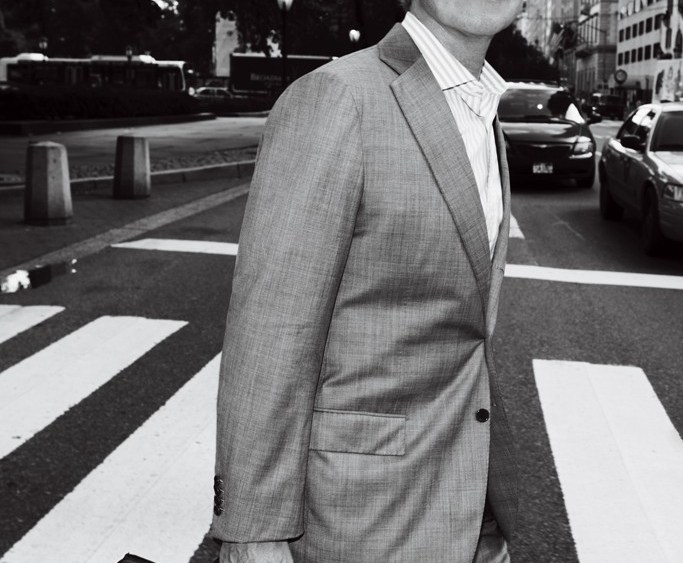
On a beautiful Thursday evening in late June, 72 of the rising stars of the Estée Lauder Cos. Inc. are seated at two long banquet tables in Bryn Mawr College’s baronial Great Hall, celebrating the successful completion of the company’s Semper Novus executive-development program. The wine is flowing and the mood is celebratory, the wrought-iron chandeliers above casting a warm glow on the scene. In the center sits Fabrizio Freda, president and chief executive officer of the company, chatting animatedly with his dinner companions who include a handful of strategic “outside partners” invited to participate in the week-long program, including this year executives from Isetan in Japan, Sephora Latin America and Ulta.
Related Articles
Suddenly, the Gothic majesty of the room is shattered with the sounds of pop diva Christina Aguilera singing “Feel This Moment.”
You May Also Like
Everyone jumps up for an impromptu dance party to what has become the program’s anthem, led by Freda who bops energetically up and down, fists pumping, arms waving in the air.
The crowd goes crazy.
Without a doubt, Freda’s got moves. In fact, since assuming his current position in July of 2009, Freda has demonstrated an exceptional agility to connect with employees, analysts, consumers and most importantly, the Lauder family, well beyond the dance floor.
By bringing a strategic focus and discipline to Lauder’s creative core, Freda has driven the company to record sales and profitability. Among the financial figures he likes to cite: The company has added $3 billion in sales in the last four years to reach almost $10 billion for fiscal year 2013. Operating profit has tripled, operating margin has increased from 7 to about 15 percent, the dividend has increased 162 percent and Lauder’s market capitalization has risen from $6 billion in June of 2009 to almost $26 billion four years later.
That performance makes Freda one of the most effective chief executives in business today.
One company insider—a newcomer—who spoke not for attribution because he didn’t have clearance to talk for this story, explains Freda’s impact thusly: “Fabrizio has effectively distilled the essence and strength of the organization and then built capability around it. If you think about it as a human body, he found the spine and then he built muscles around it without touching the spine.”
On this evening, Freda is in his element, firmly planted in the center of the action, connecting with the people charged with making his vision a reality, firing them up, explaining, teaching, explicating the future he has envisioned for the company—and how they’re going to get there.
“The most important concept is being open to change,” Freda says. “Progress and growth depend on agility, on innovation, on adaptability. In nature, the animals that live the longest, that survive, are not the strongest, they are the most adaptable.”
Freda is on stage now, delivering his graduation remarks, and he quickly comes to a key theme of his corporate transformation. “The best definition of change is a prayer from St. Francis of Assisi that says, God help me to change the things I have to change and help me accept the things you want me to accept, but most importantly, give me the ability to distinguish between the first and the second.
“That is the key,” Freda continues. “The art of leadership is distinguishing what you want to protect and what you need to change.”
In fact, Freda has been masterful at determining which aspects of the company are assets not to be tinkered with and which areas need modernizing, rethinking and restructuring, say people inside and outside of Lauder—and therein lies the secret to his success. Under the “protect” heading comes the company’s core values instilled by the Lauder family and the tenure of many of its veteran senior executives, some of whom have been with the firm for decades. Since Freda was named president and chief operating officer of the cosmetics giant in 2007, recruited from Procter & Gamble where he was president of global snacks, the fallout among the senior ranks has been minimal and includes Patrick Bousquet-Chavanne, now executive director of marketing and business development at Marks & Spencer; Philip Shearer, currently chief executive officer of Groupe Clarins, and Dan Brestle, who retired after three decades with the company. The list of those who have stayed at Lauder is much longer, and includes the quartet of group presidents—John Demsey, Cedric Prouvé, Lynne Greene and Thia Breen—who today form an integral part of Freda’s leadership circle.
“He has eliminated the silos of the company, brought everyone together as a team and made them the most effective team we’ve had in our history,” says Leonard A. Lauder, chairman emeritus of the company, who professes absolute delight about Freda’s performance thus far. “He’s doing great.”
When Leonard Lauder says Freda brought everyone together as a team, he means it literally. Whereas preceding ceo William P. Lauder, who today is executive chairman, had an executive committee, Freda took a different approach.“One of the first things that he immediately did when he became ceo was establish a leadership team,” says Breen, who is group president for North America. “We had never been in that large a group before and collaborative, and Fabrizio said, ‘I want you to start to trust one another.’”
That was a task easier said then done and was top of mind for Rose Marie Bravo, the former ceo of Burberry who is a Lauder board member, when she interviewed Freda for a Fashion Group International breakfast called The Tastemakers in early July. “In every company, there is a silo mentality, pyramids, fiefdoms, and Estée Lauder had their share of that….How did you get everybody integrated and working together?” she asked wonderingly.
Freda, whose self-professed love of teaching is one of his most marked traits, perched forward on his director’s chair and answered with his characteristic analysis—first noting why the silos existed, then assessing the inherent challenges they presented, before explaining the solutions and wrapping up with a reiteration of the key takeaway, all the while sharing credit with both the Lauder family and the senior executives whose roles most changed.
In his response, Freda stressed the importance of collaborating with the executive team to create a common vision for the company and getting buy-in from every key participant. In the eyes of some analysts, that was a critical factor in the success that followed, quashing dissension and presenting a united front to outsiders. “One of the things he did early was to get the buy-in of management of the plans that were going to be announced to investors,” says Connie Maneaty, senior analyst of BMO Capital Markets. “People had a choice internally to determine whether or not they wanted to go along with the changes. He already had the agreement of his management teams before the plans were made public, so when they were made public, he had a team that was committed to moving in one direction. Whatever discussions, uneasiness, disagreements there were were done behind closed doors and before the plan was made public. That is huge.”
Simultaneously, Freda attacked the operational and logistics side of Lauder to improve scale and efficiency. “He has brought a way of thinking to our business that we were not used to in the past that helps us focus on where we’re going in the future,” says William Lauder. “He is a very quick study in terms of understanding and identifying issues, what they are and what the right approach is to get our company to the right place.”
By all accounts, William Lauder and Freda have a warm working relationship—one insider calls them “Pete and Repeat”—with clear delineations of duty. Global communications and legal report directly to Lauder, finance and human resources have a dual report to the executive chairman and ceo, and all other functions report directly to Freda. “We have a very good collaborative approach… There is no overlap in space,” says Lauder. “We both understand the strengths of each of us and we know what the other enjoys doing. What works well is that the team within the company works very well with both of us and are very clear about whom to go to for which issues.”
For Freda, the aspects of Lauder that needed to change were also very clear, and he wasted little time in applying his analytical and organizational skills. “Fabrizio was able to push the thought process of the company using analytics to think more critically about Lauder’s channel focus, their geography focus and their cost structure, all within the context of being a creative, entrepreneurial company,” says Ali Dibadj, a senior analyst at Sanford C. Bernstein & Co. “The creativity and entrepreneurship that has been manifested for generations in the product is now manifested also in improving the actual business of the product.”
Ahhhh—creativity, the importance of which is impossible to overstate in the Lauder ethos. When Freda took the reins, many Lauderites openly fretted that intuition and original thinking would no longer have a place within the organization, replaced by an obsession with being guided by consumer-driven data. Instead, Freda recast the conversation to come up with a Big Idea that blends and balances the old approach and the new. Such Big Ideas, which succinctly convey a vision, a direction, a strategy, and can be broadcast concisely inside and outside of the organization, have become a hallmark of Freda’s communication style.
“We say we are creativity driven and consumer inspired,” Freda says. “This means that the best thing you can do when you have creativity is put it at the service of the biggest opportunities and inspire it with amazing insights that will make the creative people think and create even better. For our industry, I don’t believe that the consumer is boss,” he continues, voicing an opinion that would probably be considered heresy in his previous stomping grounds.
“You need to get the information of what the consumer thinks, their aspirations, their dreams, to inspire creativity. But then you need to create not what the consumer tells you. You need to create something which is different, something consumers don’t yet know they want but can not do without after,” he says. “If you look at the financial implications of just doing what the consumer wants, who’s going to win in the end? The low-cost producer. We are not the low-cost producer.”
When giving speeches, Freda always gets an appreciative laugh from the audience when he explains his definition of creativity and then applies it to himself. “There are two ways to create,” he likes to say. “One way is blue sky. You wake up in the morning and have a beautiful new idea. We have people blessed with this gift. I am not. I wake up in the morning and I am tired.”
Then a pause before continuing: “Or, you learn, study, analyze and connect the dots of knowledge that no one has connected and this way you see things that no one has seen before. That is my creativity.”
Over the past four years, Freda has connected a lot of dots. “The strategy of the company is to outperform the market on a continual basis and so far, we have,” says John Demsey, group president who oversees a number of brands, including Estée Lauder, MAC, Tom Ford Beauty, Bobbi Brown and Smashbox Cosmetics. “We’ve gone through the worst recession since the Great Depression, and in that time we have built up our Asia Pacific business, acquired Smashbox Cosmetics, diversified our portfolio, rationalized the fragrance business, doubled down on skin care and makeup and focused on the core equity and storytelling—he has accomplished a lot.”
Outsiders agree. The Wall Street analysts interviewed for this story all unhesitatingly give Freda an A on the performance front—and not just because he’s wrung about $780 million worth of costs out of the system or pushed gross margin to 80 percent. “He has done a terrific job of expanding the market for Estée Lauder,” says Deutsche Bank analyst Bill Schmitz. “The old mind-set was, ‘We sell very high-end cosmetics in department stores.’ They have slowly embraced other channels. The most important thing he did was broaden the market and say, ‘We compete with mass.’ If they can source from the higher end of the mass customer, that is a huge prize. He has done it.”
Freda has also concentrated much of his attention on building Lauder’s business in China, which he believes is a make-or-break market when it comes to the company’s long-term success. By July of this year, Freda had already made three trips to Greater China, including one to attend the prestigious government-sponsored China Development Forum; he has a fourth trip scheduled for October.
In early May, he convened Lauder’s SWAT team on the region for a trimonthly Steering Committee meeting called China 2020. On this morning, there are 18 people sitting around the large oval table in the recently installed corporate conference room located one floor above Freda’s 40th floor office in the General Motors building. Freda enters at 9:12 a.m., a relatively on-time arrival for an executive who’s known to often run late, and takes his place at the head of the table. To his right sits chief financial officer Tracey T. Travis; to his left, Cedric Prouvé, group president, international, and Fabrice Weber, president of the Asia Pacific region.
“Good morning, bonjour,” Freda says as he sits down.
“Ni Hao,” Weber answers, earning a laugh and response in kind from Freda.
With that, the morning’s chitchat is done and Weber launches into the agenda for the three-hour meeting. The purpose of today’s session is threefold: First, for Freda to share his insights with the group; second, for the group to discuss and gain alignment on the company’s long-term strategy, and third, to discuss near- and short-term issues that have arisen since the group met last. During his 15-minute opening remarks, Weber frames the conversation. “This is not just about China, it’s about the Chinese consumers and about greater China in its broader scope, because we have learned anything we do in China has an impact way beyond China in terms of consumers,” he says. “This is not just about building a second home market in China [another Big Idea that Freda is implementing at Lauder], it is about developing within the Estée Lauder companies a level of expertise, a level of knowledge, a level of cultural insight that will allow the entire organization to support what is going to be a second continent in terms of scale and meaningfulness to the organization.”
When Weber has concluded, Freda stands and praises him on the thoroughness of his presentation, before reiterating the significance of the mission. “We have many great project teams, but I believe that this is the single most important, in the sense that if we don’t make this happen, all of the rest that we are doing will not make us a global leader in 10 years from now,” he says. “This is the biggest long-term project we are working on. All of us have to look at it this way, in the prioritization of our resources, our time, our investment, in every single aspect. I definitely treat it this way personally.”
The numbers bear out Freda’s concentration. Research from McKinsey Global Institute estimates that China’s urban population will grow by 400 million by 2025, to comprise about 64 percent of the entire population, creating a new consumer culture in a country where research shows the average income tripling as a result of urbanization. By 2022, McKinsey’s research suggests that more than 75 percent of China’s urban consumers will earn $9,000 to $34,000 a year, and that the upper-middle class will account for 54 percent of urban households.
Freda himself is laser focused on the development of China’s tier-two, -three, and -four cities, and likens the development of those areas to Lauder’s development in the U.S. in the Sixties. “There is potential for an enormous amount of people to be urbanized over the next five years,” he says. “Do you realize the implications of why I wanted to visit the tier-three cities a month ago? Because that’s where one day the consumption will be huge,” he tells the group. “That’s the way Leonard did it in Cleveland and other smaller cities many years ago, when expanding into the center of this country was not necessarily true for every multinational. Being first in doing that paid dividends over the years.”
Freda has notes prepared for today’s meeting, but he barely consults them when he’s speaking. That level of preparation is typical, say his team. “We bombard him with so much material before a trip and he has always read everything,” says Prouvé. “He synthesizes the information very well. He is amazing at analyzing the data very fast and he is always looking at the right triggers in terms of specific impact and what does it mean to us. He never looks at the data in a superficial way.”
Freda’s erudite speaking style is also considered an asset on Wall Street. “You get the feeling he is talking from the heart, that he’s actually telling you what he thinks,” says Dibadj. “You may not always agree, but he is telling you what he thinks. That is relatively unique for the ceo of a large company, and has served him very, very well. Investors look at him and they trust him. I think that happens internally, too. You trust the guy. It’s self-fulfilling almost.”
Freda’s linguistic acuity and deep understanding of the business are on full display the morning after the China 2020 meeting, when’s he back on the 40th floor, this time in a bright corner conference room set up for a breakfast roundtable with business journalists. Products from each brand are arranged just so on the table and the scent of Jo Malone’s Lime Basil & Mandarin permeates the room. Bento boxes with breakfast—French toast sticks, a small frittata, fruit—sit in front of each place. Freda bounds into the room with a big “Good morning” and a coffee in his hand, takes his place and launches into his presentation with his favorite and most oft-used business metaphor—putting the company in the “winds of growth.”
Freda’s notes remain untouched—so, too, does his breakfast—as he details for almost 45 minutes the past, present and future of the Estée Lauder Cos. Inc. “The key message I would like to deliver is a message of growth,” he begins, reeling off some opening stats—a projected $10 billion in sales in 2013, 30 brands, 150 countries, 10 channels, half a billion consumers, 30,000 employees—and wraps up his introduction with a bold declaration. “We are growing share and we plan to continue doing so in this global industry, where we have about a 15 percent global market share. We have a lot of space to grow in the future.”
Explaining how the company is going to do this provides Freda the perfect segue to introduce another key Big Idea: the compass.
The compass is the name for Lauder’s long-term planning process, which Freda considers a very different undertaking than creating shorter-term strategy. “The compass is a view of the world 10 years from now,” Freda explains. “We call it a compass not a strategy, because the only thing we know about this exercise is that the numbers are wrong. You cannot predict 10 years from now with precision, but you can predict the direction and start making sure that your plans are in the right direction for the long term.
“That is the way companies survive and become sustainable,” he continues. “The key finding is that we have identified the biggest categories, the fastest-growing segments, the most important opportunities shaping the beauty industry and we are focusing our resources there. That, at the end, is the game.”
In light of the recent goings on at Procter & Gamble, which ousted its ceo Bob McDonald in late May and brought back former head A.G. Lafley to set up a succession plan over the next two years, questions persist as to whether Freda will be in this particular game for the long run, with some wondering will he stay or will he go? Freda himself insists he has no plans and no desire to leave Lauder—“I have never enjoyed anything I did in my life in the past as much as I’m enjoying these years here,” he says—and his pay package contains a number of equity compensation elements staggered from 2015 through 2017, including some that are tied to Lauder’s stock reaching $75. At press time, the stock price was $66.33.
Freda has identified a number of opportunities that he thinks will help the company grow and the stock price rise over the next few years and this morning, he is sharing them with journalists. Connecting the dots on demographic trends in the U.S. has led him to a Big Idea, that of the U.S. as the company’s biggest emerging market. While the concept seems almost redundant—Lauder has a 40 percent market share in the U.S., a country where, says NPD’s global beauty analyst Karen Grant, Lauder “is both in line with the wind and helping blow the wind”—Freda sees tremendous opportunity in capitalizing on the exploding multicultural market. “When you calculate it with the concept of growth in mind, what you understand is 80 percent of the growth will come from ethnicities other than Caucasian in the U.S. in the next seven years,” he says, “and 65 percent of all future growth will come from the aging of the population.”
Among the other major opportunities that Lauder will seize on to drive sales:
• Global population trends, which show an increase in both the aging population and the number of people moving into the middle class in key emerging markets, which in addition to China include Brazil and Africa.
• Traveling consumers, both international and domestic. “Only 15 percent of people traveling in an airport shop for cosmetics,” Freda says. “The opportunity to increase this number is huge. We’ve increased it from 12 to 15 percent in the past three years and I think this can continue. You can imagine if you only add five, 10 points of conversion, it’s like doubling the amount of the market in a few years.”
• A renewed emphasis on fragrance, a category that hasn’t figured as prominently in the last three years, but which Lauder is again focusing on with a streamlined business model and more finely honed global approach. To that end, major launches this year include scents from Estée Lauder, Tory Burch, Marni, Michael Kors and Ermenegildo Zegna.
Freda is also using this meeting to introduce his newest thinking on emerging sources of growth. “Dynamic distribution,” is one such area. Noting that Lauder remains committed to its core department store market, Freda expands on the impact of accelerated growth in the specialty retail, e-commerce and freestanding store channels. Currently, Lauder has more than 800 freestanding stores, primarily for MAC, Aveda and Origins, plus a handful of Jo Malone boutiques, and improving the capability of the organization as a retailer is a key area of focus. The stores range from the recently opened MAC flagship on the Champs-Elysées in Paris to smaller formats in tier-two Chinese cities. “Freestanding stores are particularly important in emerging markets, because the development of department and specialty stores at the moment is lower than the development of consumer demand,” Freda says. “Freestanding stores are a great tool to follow demand and not wait for distribution development.”
Indeed, Freda has significantly broadened Lauder’s traditional distribution network, and one of the most frequent questions he is asked, be it at a meeting of Wall Street analysts or the aforementioned FGI breakfast, is whether the company would ever consider opening multibrand stores. “That will never be our business model,” he says, when the question arises at FGI. “It’s not clean strategically and in general, I don’t think it’s viable….Occasionally and practically when there are no alternatives, we can use a model like that, but it’s not a strategic, long-term model for us.”
Whatever the channel, Freda is squarely focused on the shopping experience itself—on continuously improving the environment, the education, the entertainment value. Lynne Greene, the group president who oversees Clinique, Origins, Ojon and Aveda, recalls an early trip to China where she stood in front of a wall of products in a Sephora store with the newly minted ceo. “Fabrizio said, ‘If I’m a consumer looking at the wall and I don’t have the opportunity to have someone educate me, how would I know what to do?’” recalls Greene. “He said, ‘I want to make sure the consumer knows where they are and once they know where they are, direct them in terms of how they learn about what is here. Once they know that, that prompts them to buy.’”
Greene immediately understood his point. “First we hook them, then we engage them and if we have done that well, we sell them,” she says. “We worked with that as a prototype and philosophy in terms of many subsequent designs. He inspired the team to look at it in a different way and doing that has brought us many different manifestations of service.”
Green pauses a moment before concluding, “Fabrizio doesn’t say, ‘I want you to do this or that.’ He frames a dialogue by telling you what he’s learned. The dialogues are not telling you specifically what to do. They are dialogues of opportunity that bring you to new innovations and growth.”
If you were to ask Freda what gives him the most pleasure in his position, the answer would almost certainly revolve around the exchange of information— teaching and learning. One of his key long-term aspirations is that “the organization will become even more of a learning organization that will be able to anticipate the trends and build capabilities in all of the new areas that we identify.”
It is the same morning of the FGI event, and Freda is now back in his office, preparing for a day-long meeting to take place the next day in which he will present the strategy for the next three years to Lauder’s board of directors. Though he arrived back from a trip to Australia and Hong Kong two days earlier and professes still to be suffering the effects of jet lag, he betrays no signs of fatigue as he takes a thick navy blue linen binder from his desk, rifling through pages of text, charts and figures, fingering an introductory letter tucked into the binder’s left pocket.
“This is the strategy I prepare every year, an entire book of analysis of everything that is happening in the world, the future,” he says.
“I prepare this with a group of people who do only this, who are fully dedicated to creating the strategy of the company with me, and then my leadership team and I discuss it and together we present it to the board and get approval for the next three to five years,” he explains.
“It’s your Bible,” says a visitor.
“Yes, it is my Bible. But frankly, I’ve written it, so it becomes the Bible of the rest of the team, where their own strategies will be based on this.”
Freda pauses before returning the book to his desk and taking a seat. “The chain that connects the entire company starts with this book.”