
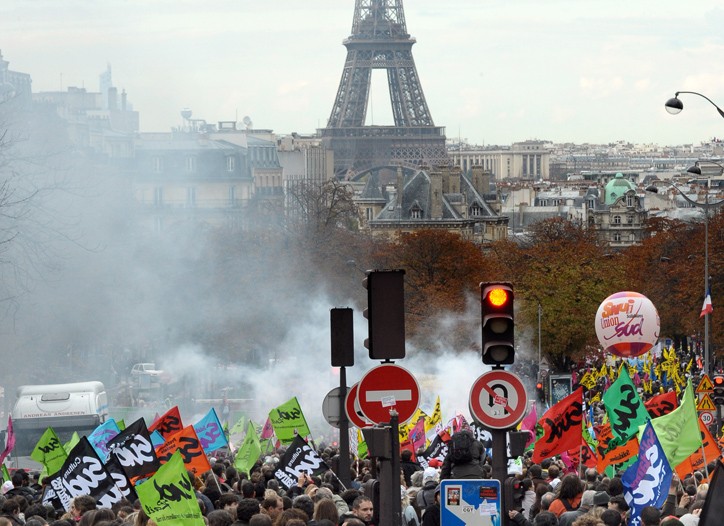
PARIS — Transport strikes in Paris and London this month have not only brought misery to thousands of commuters, but reflect widespread public anxiety about the impact of government measures to stem ballooning budget deficits.
Economists predict the austerity measures being implemented across the Eurozone will dampen household morale throughout the second half, causing consumer spending to slow — although the majority think a double-dip recession is unlikely.
The prospect of widespread public sector spending cuts has already begun to send shivers through the U.K. retail sector, while French households are struggling to emerge from the doldrums despite brightening job prospects.
Related Articles
Repeated strikes in France risk further harm to an already tepid retail outlook.
You May Also Like
Striking workers on Tuesday staged the fourth day of nationwide protests in two months against President Nicolas Sarkozy’s plans to raise the minimum retirement age to 62 from 60. Rail and air traffic were severely disrupted, while a weeklong refinery strike has left thousands of gas stations dry, threatening to paralyze road transport.
Sarkozy appealed for calm after the protests turned violent in several cities, with troublemakers burning cars and looting shops. However, the government has said repeatedly it will not back down on the pension reform bill, ahead of a final vote in the Senate expected this week.
Pierre Pelarrey, managing director of the flagship Paris department store Printemps Haussmann, said increased numbers of Chinese visitors had compensated for a drop in local shoppers during the first two walkouts, on Sept. 7 and 23. But he predicted the impact of the latest strikes would be more keenly felt.
“I feel there is less foot traffic, in particular among local customers,” said Pelarrey. “This is not a particularly busy time for foreign visitors.”
While French unions dig in their heels, transport unions in London are threatening fresh subway strikes in November over plans to cut hundreds of jobs.
The protests come on the heels of European-wide demonstrations on Sept. 29 against deficit reduction plans, which included Spain’s first general strike in eight years.
At the heart of the problem is the Eurozone’s two-speed recovery from the worst economic and financial crisis since the Great Depression. As consumers head into the crucial holiday spending season, growth in Germany, the currency area’s biggest economy, is far outstripping that of debt-laden peripheral countries like Spain, Ireland, Italy, Portugal and Greece.
“They’re all struggling to manage their budget deficits and that’s going to mean that there’s going to be persistent high unemployment probably, because the public sector cannot stimulate jobs growth and the private sector is suffering with weak demand as well,” said Chris Williamson, chief economist at financial information services company Markit. “So in those countries, the outlook would seem to be one whereby households and consumers will continue to be reluctant to spend on the high street.”
Overall, Eurozone’s gross domestic product rose by a better-than-expected 1 percent in the second quarter, compared with the first quarter, prompting the European Commission in September to revise upward its 2010 growth forecast for the zone to 1.7 percent from 0.9 percent in May.
The strongest revision was for Germany, which is now seen posting growth of 3.4 percent this year, versus a forecast of 1.2 percent in May, after registering GDP growth of 2.2 percent in the second quarter versus the first three months of the year — its best performance since reunification in 1990. Nonetheless, the commission expects GDP growth in the Eurozone to ease in the second half, reflecting a softer global economy and the expiry of temporary stimulus measures designed to kick-start growth.
That outlook is echoed by the Organisation for Economic Co-Operation and Development in Paris. “We were surprised by the strength of growth in the second quarter, as many people were, but I think our forecast for the coming quarters really hasn’t changed very much,” said Sebastian Barnes, senior economist at the organization. “Our central projection is for the economy to continue to recover gradually. It’s a weaker recovery than we’ve had in past recessions, but we basically expected that to happen and we think it’s very unlikely that we’ll have this kind of double-dip scenario.”
Jean-Michel Six, chief economist, Europe, at Standard & Poor’s, predicted that factors such as historically low interest rates would support growth. “We think that the consumers’ response to tighter fiscal policies might not be as negative as is sometimes feared. This is because what consumers like the least is uncertainty,” he said. “Once the new ‘rules’ are set, consumers have the possibility to draw on their savings to maintain a certain level of spending. Savings rates are currently relatively high in countries such as Italy, France and Germany.”
However, other economists are concerned that prematurely lifting the stimulus policies implemented during the recession could stall the recovery. “The risk of a double-dip deflation is considerable if fiscal stimulus is withdrawn too soon, as it is likely to happen in most European countries,” warned Detlef Kotte, chief of macroeconomics at the United Nations Conference on Trade and Development. “The reason is that the private sector still has a long way to go to restore balance sheets: after the asset price deflation, debt has to be paid off and private borrowing for investment and consumption remains weak.”
Kotte also criticized what he described as the go-it-alone attitude of certain governments, which he said were unwilling to take responsibility for the recovery of the Eurozone. “This is especially the case for Germany, which has a huge trade surplus with countries inside and outside the zone and would need to stimulate domestic demand much more to raise imports from its trading partners,” he said.
Domestic observers point out that there are signs of a pickup in German consumer demand, even though its economy remains primarily export driven.
“We’re in a very stable and positive situation because exports are picking up, the wage restraints of the past years are loosening and demand is growing,” said Siegfried Jacobs, associate director of the German Association of Apparel Retailers (BTE).
German consumer confidence hit a three-year high in September, according to Nuremberg-based market research company GfK.
The retail sector is also breathing a sigh of relief over the successful takeover of the Karstadt department store chain by private investor Nicolas Berggruen and the BCBG Max Azria Group last month. Up until the final deadline of Sept. 3, there was still the possibility that the group — comprised of 86 department stores, three premium department stores, 26 sports stores and eight bargain centers — could be liquidated.
Ursula Vierkötter, director of KaDeWe in Berlin — the premium flagship of the Karstadt group — said the store is expecting a “very good” Christmas. Having saved during the crisis, consumers are in the mood to treat themselves, she noted. “There’s a certain backlog demand now. Germans don’t spend beyond their means. They’re not faced with a mountain of debts,” Vierkötter said.
Jacobs predicted that German apparel sales would rise by 3 to 4 percent in 2010 as a whole, after a 1 percent increase in 2009 and a flat 2008. “We’re very optimistic. We’ve had good turnover in the first half of the year and in the last weeks as well. The fall turn of the weather has been good for business, and it’s been profitable business too, because we’re not yet in a markdown phase,” Jacobs added.
By contrast, French clothing sales are expected to remain flat this year following a 3.2 percent decrease in 2009, according to François-Marie Grau, general secretary of the French Women’s Ready-to-Wear Federation.
“This is linked to the fact that purchasing power has stalled, and a growing number of unemployed people are reaching the end of their compensation rights,” said Grau. “That is going to weigh on consumer spending, and then there is also a price effect. With the proliferation of discounts, sales and promotions on the French market, prices are on a downward trend, meaning that consumer spending, naturally, is tending to diminish also in value terms.”
That is supported by the latest data from French statistics institute INSEE, which showed consumer spending — the traditional driver of the French economy — rose 2.7 percent in July during the summer sales, but then fell 1.6 percent in August when merchandise went back to full price.
Grau said the outlook for 2011 would depend in part on the government’s ability to curb its debt levels without jeopardizing growth.
In its budget for 2011, France has pledged to slash spending and eliminate certain tax breaks in order to cut its deficit to 6 percent of GDP from a forecast of 7.7 percent in 2010. It is also banking on increased tax revenues, based on its expectation that growth will increase to 2 percent in 2011 after a forecast of 1.5 percent this year and a drop of 2.6 percent in 2009. “There’s always a delicate balance to be struck between supporting activity and consolidating the public finances, and that’s a very difficult balance to strike,” noted the OECD’s Barnes. He pointed to the example of the U.K., saying that fiscal consolidation of the radical sort that is being carried out by the coalition government there could either sap or boost confidence. “On the one hand, it can weaken demand with people being worried about losing their jobs and things like that, but on the other hand, the public finances in the U.K. were on an unsustainable footing and something needed to be done, so that can also have a positive confidence effect,” he said.
For the time being, the impact of the austerity drive has been overwhelmingly negative: U.K. retail sales fell sharply and unexpectedly in August, dropping 0.5 percent versus July. “Since the U.K. government announced its austerity measures in the emergency budget of June 22, we saw very quickly a sharp downturn in household confidence,” said Williamson at Markit. “They became very worried about their job security, very worried about their future incomes, and as a result we are now seeing a sharp reversal of the retail sales trend from strong growth in the spring to falling sales now,” he said. “You can be sure that similar pressures on spending will be evident in countries such as Ireland and Spain and Italy.”
Worsening matters is a planned increase in value added tax (VAT) in the U.K. in January. While this could prompt consumers to bring forward some purchases, thereby artificially boosting holiday sales, most analysts are relatively pessimistic about the longer-term prospects as Britain embarks on an unprecedented savings drive.
“The overall scenario remains one whereby we’ve got the first decline now and that’s going to continue a trend of ongoing weakness which will probably persist for some time,” said Williamson.