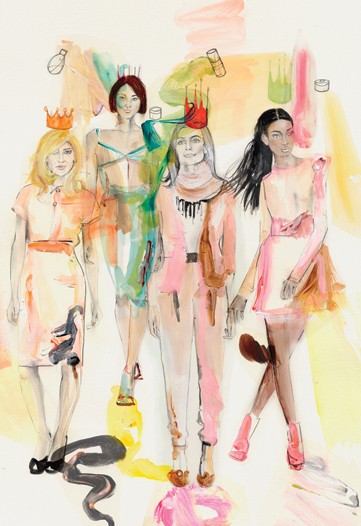

Call it beauty’s new world order.
After being rocked by unprecedented waves of radical change over the last 18 months, a new consumer has emerged, one whose spirit is as altered as her circumstances and one for whom the same old, same old holds absolutely no allure.
For the first time in a decade, beauty marketers are being compelled to rewrite the rules. A new road map for the future is surfacing, one with a notable shift in the balance of power. As we emerge from the fiscal wreckage of the past two years, companies aren’t the ones dictating price points and brand positioning. Now it’s the other way around. The consumer is setting a new standard—one that embraces social media, environmental savvy and a global approach that reassesses the very definition of beauty.
Related Articles
“We’ve had to reimagine the business model,” says Claudia Poccia, global president of Avon’s Mark division. “The customer has to come first. That will never change—but how we listen to her and communicate with her, that is changing.”
In other words: new day, new rules, new consumer zeitgeist. The recession has ushered us into the post–demographic age, one in which the similarities and nuances between Baby Boomers, Gen-Xers and Millennials are as important to identify as their differences. Not surprisingly, defining the consumer—and her changing needs—has never been more critical. But there’s an asterisk: She is harder to define than ever. All those Excel sheet columns and rows—the ones that divide people by age, income, race and geography—are fading.
Labeling people based on criteria that used to be considered concrete feels outdated. Demographics, in effect, have become dinosaurs. Regardless of our statistical facts, we are all becoming smarter shoppers, we’re all trying to spend less and we all want to look as good as we can. “The differences that defined these demographics are increasingly less distinct,” says Wendy Liebmann, founder and chief executive officer of WSL Strategic Retail. “To a company, it can be limiting—almost dangerously so—to think in terms of demographics.”
Marketers have dubbed the emerging mentality the “era of the new conservative shopper.” It’s not a trend, experts believe, as much as a fundamental and long-lasting shift in consumers’ attitudes. “It’s a whole new way of shopping,” says John Debutato, senior vice president of client solutions at Information Resources Inc., which tracks trends in the marketplace. “If you learn how to be comfortable with five products, are you going to buy 10 once the economy bounces back?” He, like many, believes the answer is no.
Over the last year, women have redefi ned what is a beauty necessity and what is expendable. “The first fat to get trimmed was fragrance, color cosmetics and salon services,” says Liebmann. “When 10 of your friends just got laid off, those are the things that feel like unnecessary luxuries. Of course, people cut back on their skin care, as well, but not nearly as much.”
This means that marketers are stuck between analyzing the differences in our demographics and deciding how much weight to give those differences. Welcome to the era in which 20-year-olds buy antiaging cream and compete with fiftysomething “cougars” for a mate. Add to that the great tide of immigration sweeping the planet and borderless issues like global warming, and age and socioeconomic delineations become virtually moot.
“The growing Hispanic population, the confluence of cultures, the unprecedented longevity of Baby Boomers all mean that demographics are getting blurred,” says Joe Arcuri, vice president of Procter & Gamble Beauty North America. Minorities were expected to constitute half the population of the U.S. by 2050, but that date was just moved up to 2042.
“We are finding that Caucasian young people are checking off the ‘other’ box on applications,” says Melissa Lavigne, managing director at the Intelligence Group. “People don’t want to be typed anymore. Look at the President,” she continues. “He’s the poster child for diversity.”
To wit: Back in 1993, the Costume Institute at the Metropolitan Museum of Art commissioned 120 mannequins carved with the likeness of supermodel Christy Turlington. Today, that thinking seems almost quaint. There simply doesn’t exist a universal ideal of beauty anymore—one would be hard pressed to narrow it down to an even dozen.
“When we did those mannequins, that was the standard of beauty,” says Ralph Pucci of Ralph Pucci International, the company that designed the Turlington mannequins. “Right now, we’re looking for faces with lots of character and interesting features, a well-traveled, exotic look. Our most recent collection was based on an Asian model, but we used features from many different women.”
In other words, the standard hasn’t shifted, it’s multiplied. “There is no longer an ideal beauty,” says Mark’s Poccia. “People, especially young people, are taking pride in their diversity. There is something very antiquated about formulaic beauty.”
The new goal is looking like the most beautiful version of yourself. “Now it’s about looking healthy and feeling good in your skin,” says John Demsey, group president of the Estée Lauder Cos., who oversees the Lauder, MAC, La Mer, Tom Ford Beauty, Jo Malone and Bobbi Brown brands. “Women want to look radiant and that translates to having great skin.”
In fact, the desire for radiant skin has swelled so much it has upended the famous Lipstick Index—the moniker given to the resilience of color cosmetics sales typical in an economic downturn. “During this recession, we saw foundation sales pick up,” says Demsey. “The Lipstick Index has been replaced by a Foundation Index. It’s not about a pop of color anymore, it’s about looking healthy.”
But saying we live in a post–Gisele Bündchen world and manifesting it are two different things. “The reason that the beauty industry feels stale is that it’s not reflecting the fresh, new take we see everywhere else,” says Jonah Disend, ceo of Redscout. “Magazines have the same five people on their covers over and over, but the rest of the world is moving on.”
Still, Disend notes, there are companies within the industry who are doing an excellent job of appealing to the new zeitgeist, citing P&G’s Cover Girl makeup brand as one such example. “We’ve shifted away from easy, breezy, brainless to substantive beauty,” he says. “The faces of Cover Girl are Rihanna, Ellen DeGeneres, Queen Latifah—they represent a deeper sense of accomplishment.”
They are also symbolic of a much more relatable approach to beauty. Whereas in the past, the move was toward an industrywide embrace of perfection—airbrush foundation, high-definition powder, flawless-finish products—there is now a groundswell movement for authenticity.
Consider, for example, the swelling backlash against retouching beauty and fashion photographs. In Europe, efforts to ban airbrushing in fashion and beauty photography are gaining momentum. Spain is considering banning ads for certain beauty products and services before 10 p.m., while a group of academics banded together in Britain to petition the U.K.’s Committee of Advertising Practice to ban ads that feature digitally altered models in ads targeting girls under 16 years of age.
In France, a law has been proposed that would require all retouched photographs to be labeled as such—not unlike the warning labels that are mandatory on cigarette and alcohol ads. And in the U.S., designer Ralph Lauren became embroiled in a public relations nightmare when size 4 model Filippa Hamilton claimed she was fired for being “too fat,” just as the brand was running images of Hamilton Photoshopped to unrealistic Barbie-esque proportions.
The desire for genuineness doesn’t stop at advertising. “As people consider their own health, they’re stopping to consider the health of the planet, as well,” says Marcia Kilgore, who founded and sold Bliss Spas and most recently launched a face and body line called Soap & Glory.
Of course, organics and naturals have had their own prominent shelf space for years, but now people are questioning the bottles themselves. “Excessive packaging is on its way to being shameful,” says Kilgore. “We used to ask ourselves, ‘Is it good for the customer?’ Now we ask, ‘Is it good for the earth? What will 17,000 of these look like in a landfill?’”
According to the experts, it’s only a matter of time before companies have to answer these questions. It’s not unlike animal testing 10 years ago: Consumers became educated, demanded cruelty-free products and most of the major players acquiesced.
“There is an enormous amount of waste created by cosmetics packaging, but there are real hurdles to overcome,” says Kilgore. “How do we get around the gloss varnish on the cardboard? And where do the chemicals go when you pour them down the drain? I’m afraid to finish that thought.”
Moreover, green-washing, or trying to make a product seem more eco-friendly than it actually is, is increasingly difficult as consumers become more knowledgeable. “Environmentally sound products are not a trend, they are a major shift in the marketplace and one that speaks to the new sophistication of the consumer,” says P&G’s Arcuri. “We’ve passed the point where a product just has to work. Now we have to ask ourselves, ‘Is it good for the environment? Does it play a positive role in the community?’ As marketers, we need to give people an extra reason to buy a product—it has to have a social cause behind it.”
Again, it’s a post-demographic issue. The Millennial generation is biologically wired to jump on the cause bandwagon, Gen-Xers grew up with global warming as the biggest threat to their security and Baby Boomers rank the environment as a critical issue. “Baby Boomers buy more hybrids than any other group,” says Brent Bouchez, co-founder of Agency Five 0. “There’s a sense that we bought the SUVs, we did the damage, and we now have grandchildren—we have to fix this mess.”
To some extent, the recession itself spurred the movement toward taking responsibility forward. “It became a new way to excuse yourself from purchase,” says Lesley Jane Seymour, editor in chief of More magazine. “If you don’t want to buy something, you’re not being cheap, you’re being concerned about excessive waste. The recession really shook people awake, and in this way, the environmental movement within the cosmetics industry is only going to get bigger.”
Already, brands in Europe and Japan have responded to this demand. Refillable products are widely popular, particularly in the mass market, as are at-the-counter recycling programs. “This line of thinking was already well established in other countries before we came around to it,” says Carrie Mellage, consumer products practice director at Kline & Co.
To many, like the U.K.-based Kilgore, the day has already arrived. “We need to find a way to be more creative and we can’t rely on superfluous packaging to do it,” she says. “Unless big companies can really innovate and address global warming, people will look to small, niche brands that don’t have a lot of bells and whistles attached.”
In fact, they already are. “This segment of the market has grown at double-digit rates in the last five years,” says Mellage, citing the success of Burt’s Bees. “When Clorox paid close to a billion dollars for that company [in October, 2007], it signified a major change in the marketplace.” Believes Mellage: Those small, niche brands aren’t going to be so small and so niche for long.
This presents a new head-scratcher for beauty marketers, who are used to a more-is-more marketing mentality. “There is such a proliferation of products that people are shutting down,” says Lavigne of the Intelligence Group. “They don’t have time to deal so they just stick to what they know.”
The goal for marketers isn’t just to separate yourself from the competition, it’s to “show people beauty isn’t a new product every 10 minutes,” says Liebmann.
“It’s incumbent upon us to break through the clutter,” agrees Lauder’s Demsey, noting the problem is particularly acute in the fragrance category. “The constant proliferation, the incessant newness, is one of the unhealthy aspects of the industry.”
Newness, in other words, feels old. You’ve heard of Slow Food? Think of this as Slow Beauty. “When a company promises that you can have skin that looks 10 years younger in two weeks, the next company has to promise skin that looks 10 years younger overnight,” says Agency Five O’s Bouchez. “This marketing is unsustainable.”
“We’re at the point where beauty has to slow down,” agrees Ann Clurman, executive vice president and futures consulting for The Futures Company, a market research fi rm in New York City. “It’s going to be less invasive, not more. And it’s going to be about nurturing yourself—physical therapy for the skin.”
Consequently, the notion of holistic beauty is expected to gain an even more significant presence in the marketplace, elbowing out more conventional products. “You’ll start to see labels that talk about what kinds of food you can eat to complement a product,” says Clurman. “Beauty and nutrition will continue to become more engaged. We’ve started down that path and nothing is steering us off it.”
In this new nurturing, uncluttered environment, there is less room for overly complex products—skin care in 10 steps, four eye shadows that create one look and so on. “I don’t think we’ve ever seen an era in which people were so interested in simplifying,” says Timothy Ressmeyer, a partner in consulting and innovation at Information Resources Inc. “Shoppers are overwhelmed and asking themselves what they really need.
“Research has shown that the overwhelming approach doesn’t work,” continues Ressmeyer. “‘Buy one, get one’ or ‘This card entitles you…’ or ‘Comes with a free toner.’ Whatever marketers and store owners can do to streamline the process will translate into more customers.”
As the value proposition is being rethought, so, too, are a product’s actual ingredients. “Typically, it takes five years to bounce back from a downturn,” says Kline’s Mellage. “In the early Nineties, body washes caught on and Avon introduced AHAs—both were major drivers in getting us out of a slump. It will have to be innovation that pulls us out this time, too.”
That thought has many in the industry on their toes. “We have done so much in terms of what a product can do, I wonder if that kind of innovation has been maxed out,” says Kilgore. “Tell me a problem and we can fix it—we’ve solved it all.
“We’ve actually changed the way skin cells behave,” continues Kilgore. “I’m in product development and I’m stumped. Innovation will start meaning something else.”
No one is about to lay off their research and development departments, but their focuses may be shifting. “When we look back at some of the economic contractions of the past few decades, that’s when you see some of the most interesting creations in beauty,” says Lauder’s Demsey. “And we’re already seeing the changes in the industry that are going to get us through the downturn.”
This time around, however, the very nature of innovation has evolved. “Innovation is very misunderstood,” continues Demsey. “It can be a device, an ingredient, how something is sold, how it is experienced, how it is marketed and positioned, how it is packaged. It’s an oversimplification to say that innovation is about features and benefits—we’re at a point where the communication strategy is often the most innovating thing about a product.”
Facebook. YouTube. Twitter. Blogs. All are now as instrumental when it comes to brand and product positioning as traditional mediums such as print and television. Like others, Lauder has fully embraced the new electronic landscape. MAC’s makeup artists tweeted from behind the scenes during New York Fashion Week, for example, garnering more than two million views during the fall 2009 shows, while Estée Lauder’s Sensuous fragrance was able to have a successful launch despite a dismal 2008 for the fragrance category overall, thanks in large part to a strategy that included a significant online component.
“The new approach is about leveraging social media and bringing our product forward in a way that connects with our audience,” says Poccia. “We brought forward new ways to interact with the product so the consumer can mix it up and personalize it.”
Which, like everything else, eventually leads to Facebook. According to Poccia, 83 percent of Generations X and Y socialize online, and of that, 74 percent shop online. “This is a place where they live, work, play and shop,” she says. “As marketers, it’s our job to deliver an immersive brand experience—tips, blogs, the ability to interface with experts.” To that end, in January, Mark introduced one of the first digital social selling applications on Facebook, a sales widget said to be a first for the beauty industry, according to a Facebook executive.
Social media may have started out as the stomping ground for the Millennial generation, but it isn’t staying that way. Says Bouchez: The Boomers are becoming more and more comfortable in a virtual world—specifically, using the social media network to research brands. “There is a power shift away from traditional methods of getting information,” says Arcuri. “Social networks have become the most trusted source of information. The challenge is controlling how your brand shows up, how it’s talked about.”
A challenge? Undoubtably. But executives are confident that, as this new era unfolds and the seismic changes fan out over the industry, the essential message remains the same. “I have a weird theory about beauty,” says Demsey. “I say, ‘Success sits in the room.’ At the end of the day, your brand has to make an emotional connection with the consumer. We know that works. That’s what always works.”