
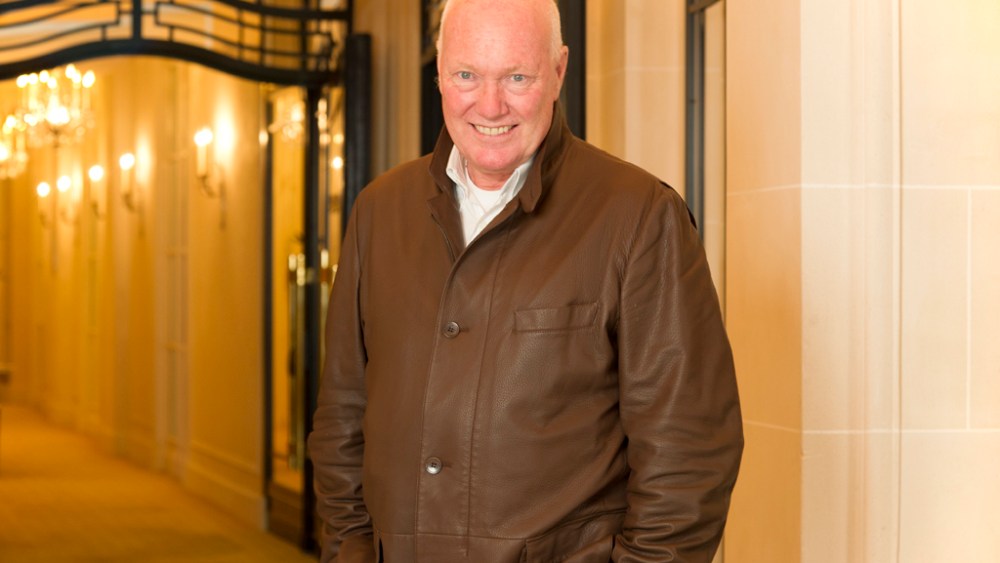
Jean-Claude Biver is a man on the move.
As head of the watch division at LVMH Moët Hennessy Louis Vuitton, the 66-year-old executive is on the road more often than not, drumming up business for the luxury conglomerate’s three Swiss watch brands: Tag Heuer, Hublot and Zenith.
On a Tuesday in February, he was in Paris to pore over contracts with two potential megapartners in Tag Heuer’s first smartwatch venture. Two days later, he appeared in New York, posing alongside basketball star Dwyane Wade and Israeli model Bar Refaeli at the fashion week event introducing her as the new face of Hublot.
Having eased out of day-to-day operations at Hublot in 2011, leaving his longtime lieutenant Ricardo Guadalupe to take over as chief executive officer, the man considered an icon in watch industry circles appeared ready to devote more time to his other great passion: Making cheese in the Swiss Alps.
Related Articles
Instead, he not only took charge of timepieces at LVMH last year, but also in December added the role of ceo of Tag Heuer — officially on an interim basis, though Biver sees himself holding the position at least two years.
You May Also Like
“I can do 10, I don’t care,” he says. “But I would like to be able to leave in two years’ time, not because I want to, but because that’s part of my mission: Training people, preparing a succession.”
A larger-than-life figure with indefatigable enthusiasm, Biver is reputed for his golden touch, turning around the fortunes of Blancpain and Omega before taking over as ceo of Hublot in 2004.
The brand has seen rapid growth, thanks to the launch of watches like the Big Bang and the signing of brand ambassadors including Usain Bolt, Pelé and Kobe Bryant. Biver has also inked a slew of timekeeping partnerships with organizers of events including the FIFA World Cup.
His motto? “Be first, be different, be unique.”
Now he has turned his laserlike focus to Tag Heuer. The first order of business was shoring up production, which prompted the firm to fire 46 employees in September and put another 49 on temporary unemployment until year-end.
This resulted in heavy one-time costs that hit revenues at LVMH’s watches and jewelry division, which also includes Bulgari, Chaumet, Fred and De Beers. The department’s sales in organic terms rose 3 percent in the fourth quarter, with LVMH noting that throughout 2014, “watches were penalized by the cautious behavior of multibrand retailers in an uncertain economic environment.”
Among Biver’s initiatives:
• Spearheading a drive to refocus Tag’s offer with introductions in the $1,000 to $3,000 segment;
• Reviving the old “Don’t Crack Under Pressure” advertising slogan;
• Redirecting research-and-development efforts from high-performance chronographs toward the planned smartwatch, which he hopes to unveil next year.
He predicts that a handful of competitors, including Swatch Group, will arrive at the Baselworld watch and jewelry fair this year with a connected watch in their coffers. Striving to be first to market, Biver is determined to make Tag’s offering different and unique, with innovative applications and microprocessors.
“We are different from Swatch Group in that we don’t have the knowledge, the capacity nor the production expertise in Switzerland for the watch we want to make,” he said, noting that he uses the Swatch Access connected watch as a ski pass.
“We figured that if we want a smartwatch that is not inspired by the Swatch Access, we needed to sign partnerships with very, very big players,” he added.
If the contracts are inked this spring, Biver expects to develop a smartwatch that, like Tag Heuer, is anchored in the sports universe. But whereas Tag has deep-rooted links to motor racing, the smartwatch could also appeal to fans of soccer or basketball with dedicated functions, he explained.
“So with a bit of luck, in addition to having a watch produced with two giants, we will also have innovations that the others don’t have,” he said.
Such zeal might seem surprising from a man who has previously been skeptical of the appeal of smartwatches, and initially dismissed the Apple watch as “not sexy at all.” Biver has since revised his opinion of the eagerly awaited offering from the tech giant, expected to hit stores soon.
“The Apple watch is quite exceptionally coherent with the Apple brand. If they had taken the same approach that I would have mistakenly followed — a slightly sexier watchmaking approach — I think it would have been not right. So I had to recognize that they’re right, in terms of their logic, and I was sorry I spoke too soon,” he said.
Biver is reasonably optimistic heading into Basel. Though he agrees with the Federation of the Swiss Watch Industry’s forecast that Swiss watch exports will remain stable this year, he hopes to snatch business from his competitors.
“We have entered a phase where the market’s growth will perhaps be less strong, and if you want to increase your revenues in a market that is not expanding, you need to win market share,” he noted.
Biver hopes to achieve this through his time-tested method of focusing on a small number of models — a technique he likens to that of Australian hunters killing lizards with poisoned blow darts.
“The arrow has to be extremely small but very sharp,” he explained. “That gives a strong penetration.”
Accordingly, he scrapped the launch of Tag’s much-hyped new chronograph movement, the CH80, to focus on production of its existing model, the CH1887. Tag Heuer is also phasing out high-concept watches such as the Mikrogirder chronograph, unveiled with great fanfare in 2012.
Its Basel novelties will span from two vintage-inspired Carrera chronographs to the futuristic Monaco V4 Phantom, an all-black carbon-fiber watch.
Meanwhile, Zenith is refocusing its offer on the Chronomaster 1969 chronograph, which comes equipped with its award-winning El Primero movement. In June, it unveiled a limited edition of the timepiece in partnership with the Rolling Stones.
Biver is also shaking up Tag’s roster of ambassadors. He revealed that it will part ways with Leonardo DiCaprio, who has been with the brand since 2009, and Cameron Diaz, who joined its roster in 2012.
In January, Cara Delevingne was named as the new face of Tag Heuer. The announcement was made at an event during Men’s Fashion Week in Paris that was originally due to feature Biver and the British model locked in a cage with an adult lion, his tamer and a lion cub — until the executive kicked up a stink.
“I said: ‘I’m 66 years old, I don’t want to die because of some stupid lion,’” Biver recalled.
“They found an elegant way to back out of it. They used the excuse that the lion did not want to come out of its cage,” he added with a chuckle.
With her fondness for wearing onesies and pulling silly faces, Delevingne might not seem like a poster girl for Formula One-inspired watches, but Biver is keen to expand Tag’s traditional demographic of 25-to-45-year-olds.
“The 15-to-30 set is exactly the target audience I’m seeking for Tag. Why? Because they are my future customers, and someone like Cara Delevingne, who is very active on social media — that’s the communication tool of tomorrow’s generation,” he said.
Tag Heuer will also soon reveal that it has recruited DJ David Guetta as brand ambassador. But don’t expect another one of its giant dance parties at this year’s Basel fair.
Biver has redirected its budget toward a campaign aimed at distributors that has echoes of a sci-fi movie. Last month, 600 sales associates were invited to 15 hotels across the U.S. for a cocktail reception at which the executive addressed them via an 18-minute movie projected on giant screens.
“I want to communicate that Tag Heuer is avant-garde,” he explained.
Notwithstanding the tech trappings, Biver is anything but a Big Brother figure. He has pledged to have breakfast with all of Tag Heuer’s 800 staff members in the next few months. At the two sessions held so far, he mingled with around 40 employees for two hours, sharing his cheese and answering questions.
“The business world suffers from a lack of proximity. Bosses are often ex cathedra — they are either on the top floor of the building or somewhere else entirely. I want everyone to be in communication with me. At the end of the breakfast, everyone gets my home phone number, work phone number and e-mail,” he said. “When you do that as a boss, you create a team, you create a soul, you create solidarity.”
After decades in the business, Biver would be justified in considering he’s seen it all and done it all. So how does he keep his fervor intact?
“You know, Paul McCartney isn’t blasé,” he replied. “He was in The Beatles, he reached the pinnacle of success, yet he’s still singing. He just recorded a song with Rihanna and Kanye West. Why? Because you can’t retire a passion.”